The town where trade and the sea shaped the streets
Roscoff's position on a peninsula at the western end of the English Channel has influenced the appearance and commercial history of the town. Brittany Tourism describes the richly decorated granite houses once occupied by merchants and shipowners, the old harbour, the later deep-water port and a landscape unusually favourable to certain kinds of subtropical planting. For owners of yachts between twelve and twenty-four metres, the town can provide a satisfying base from which to explore Brittany's maritime and botanical heritage. The captain should establish the appropriate recreational berth and its actual accepted dimensions before confirming an itinerary. A commercial ferry terminal and a historic fishing quay are not interchangeable with a suitable yacht-berthing facility. Once the operating arrangements are settled, the family can investigate the older town, its gardens and the nearby island of Batz. This allows the guests to develop an appreciation of the coast without requiring the yacht itself to move every time they wish to visit a different part of it.
From an early settlement to the granite harbour
The regional tourism organisation traces Roscoff's beginnings to the Roskogoz quarter, initially associated with the outer harbour of Saint-Pol-de-Léon. Its account describes silting and repeated attacks as among the reasons the settlement shifted towards the site of the present old harbour. A surviving fifteenth-century religious monument marks the earlier village site. These changes illustrate how the usefulness of a harbour can alter with physical conditions and the political circumstances of its occupants.
The old harbour developed from granite construction in the seventeenth century. Its history is more interesting when examined alongside the surrounding streets than when regarded merely as an attractive waterfront. A visitor can observe the relationship between warehouses, residences and routes towards the water. Contemporary yacht operators should not infer available depth or access from the fact that a harbour formerly served maritime trade. Its current physical characteristics, restrictions and the actual vessel's requirements determine whether it can be used. The historic harbour's principal value to the shore itinerary is the evidence it preserves of the town's development.
The houses of merchants and shipowners
Brittany Tourism identifies a number of granite houses constructed by wealthy merchants and shipowners in the sixteenth century, some formally protected as historic monuments. The buildings include finely carved dormer windows, elaborate waterspouts and cellars accessible from the lower levels. Those features give insight into the relationship between the public appearance of a residence and its practical use.
A guest interested in architecture can compare the proportions of the historic façades with the form of the smaller houses surrounding them. The texture of granite changes considerably according to the direction of light and whether the stone is wet or dry. These differences are especially apparent during a walk through the streets surrounding the old harbour. An owner commissioning an interior or restoring a residence may find the treatment of materials informative without trying to reproduce an architectural feature in the quite different circumstances of a yacht. Many historic buildings remain private premises; appreciation from the street is sufficient unless public access has been expressly arranged.
Notre-Dame-de-Croas-Batz and the history of decoration
The church of Notre-Dame-de-Croas-Batz is identified by the tourist board as a significant example of flamboyant Gothic architecture. Its restored painted decoration, ossuaries and enclosure form part of the town's recognised historic heritage. Nearby landmarks include the sixteenth-century Maison Forte and the house known as Mary Stuart. The ecclesiastical architecture provides a different perspective on the prosperity and traditions of the people associated with the maritime town.
A visit can be approached through the contribution of different crafts to the building, including stone carving and the decorative treatment of the interior. A public church has a continuing religious purpose, and its actual visiting arrangements and restrictions must be respected. Where a member of the family wishes to study the architecture in depth, a qualified guide can help distinguish the original construction from subsequent restoration. Visitors should not expect every interior or historic object mentioned in the destination guide to be available at every hour. Allow enough time to appreciate the surrounding streets and enclosure as well as the main building.
Onion Johnnies and an unexpected link with Britain
The national and regional identity of Roscoff includes a particularly distinctive agricultural and commercial tradition. Brittany Tourism describes the Onion Johnnies who began crossing the Channel in the early nineteenth century to sell the region's pink onions in Britain. Their activities illustrate the connections that can arise between small agricultural producers, maritime transport and distant customers. The trade is a useful reminder that the history of a port is not limited to the vessels that used it.
For guests interested in food, this is a reason to investigate the ingredients produced in the hinterland as well as the fish and shellfish associated with the waterfront. A local market or shop can introduce the family to the products of the region. Ask about origin and actual seasonal availability rather than assume that a product advertised through its geographical association is always in stock. Yacht owners wishing to purchase supplies should make appropriate arrangements for storage, transport and compliance with any requirements affecting movement of food across borders. A meal aboard can provide an enjoyable conclusion to a visit focused on the connections between the agricultural landscape and maritime trade.
An exceptional botanical collection beside the sea
The regional tourism authority highlights the garden established around the Roch-Hievec cliff, where approximately three thousand subtropical plant species are described as benefiting from the mild coastal climate. A botanical visit offers a different experience of the maritime environment than a day spent aboard. The influence of the surrounding sea, local exposure and the physical arrangement of the garden becomes part of the context in which the plants are seen.
Guests with an interest in horticulture may find it particularly rewarding to observe how plants from different geographical regions are arranged within the available terrain. A specialised collection does not develop simply through the selection of visually attractive specimens. The people responsible for it must consider each plant's requirements, the conditions in which it can be grown and the maintenance necessary to preserve it. Seasonal changes influence the appearance of the garden. Consult its current opening calendar and accessibility information before travelling, and allow for slopes and uneven paths. The outing can be a central element of the visit rather than a short addition to a crowded harbour tour.
The island of Batz as a separate excursion
The nearby Île de Batz is another opportunity to appreciate the coastal landscape and its mild climate. Brittany Tourism identifies the island as a destination in its own right. Owners should establish the operating arrangements for any passenger excursion rather than assume their yacht can use the same landings. A local ferry can offer a convenient way to spend time on the island while the yacht remains at an agreed suitable berth.
The excursion should reflect the interests and mobility of the guests. A shorter walk with time to observe the surroundings may be more satisfying than a programme requiring the entire group to cover a substantial distance. Consult actual ferry timetables, access requirements and weather conditions, including the arrangements for returning to the mainland. The captain's assessment of any proposed private yacht passage remains a distinct responsibility, based on authoritative marine information and the specific characteristics of the vessel. The island's attractions do not depend upon approaching it in the owner's yacht.
Marine science, seaweed and the modern coastal economy
Brittany Tourism identifies the marine biological station and seaweed-producing businesses as important elements of Roscoff's more recent identity. The town was also the location of France's first thalassotherapy centre, opened in 1899 by Dr Bagot. These activities illustrate several quite different ways in which a community's relationship with the sea has evolved. Scientific observation, commercial production and the provision of wellness services should not be confused with one another.
A guest interested in marine science might investigate publicly available activities or exhibitions connected with the research undertaken in the region. Do not presume that a working laboratory accepts casual visitors. Similarly, the harvesting of seaweed is a regulated activity rather than an invitation to remove marine organisms from the shore. The interest lies in learning how contemporary coastal businesses and research institutions use knowledge of the marine environment. A wellness appointment, if desired, should be arranged directly with a suitable provider, taking account of the guest's individual circumstances.
A considered Breton holiday
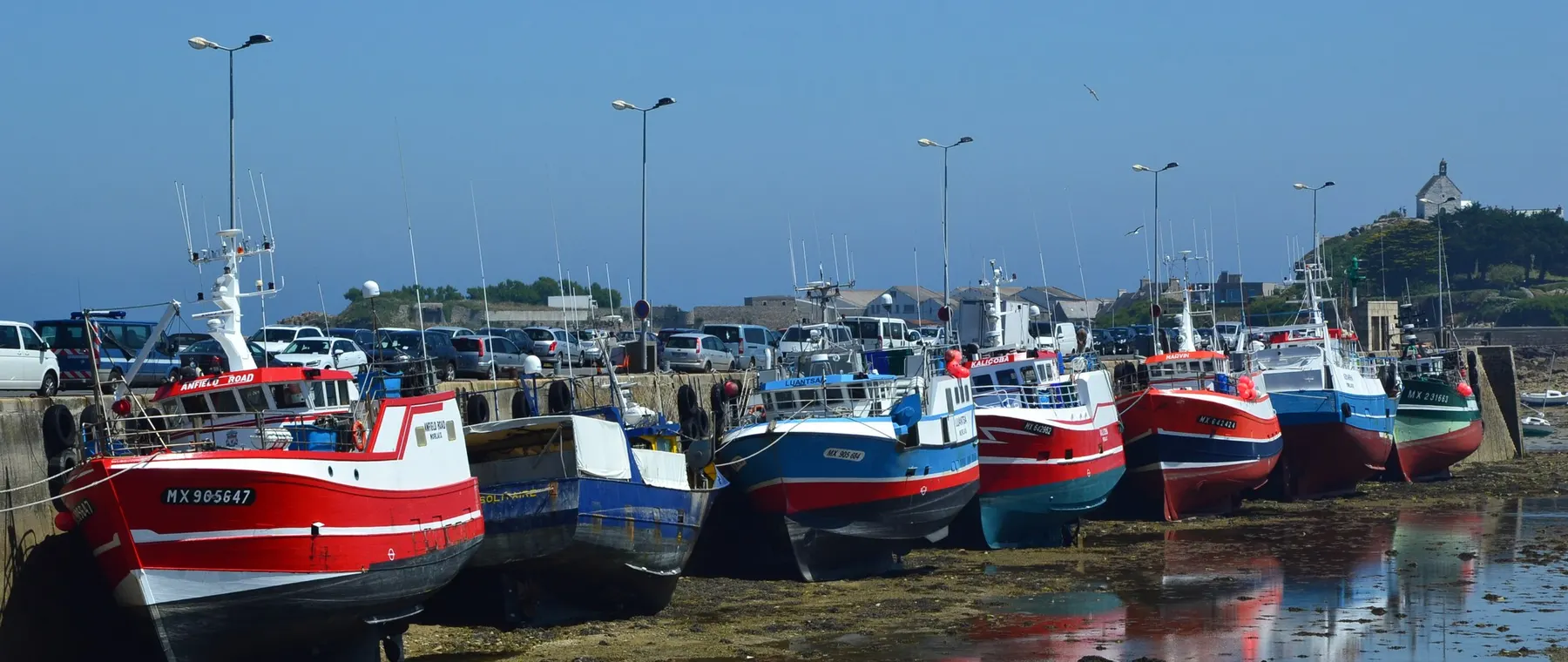
Roscoff's cross-Channel transport connections provide possibilities for passengers arriving independently of the yacht. Confirm actual ferry schedules and onward transport before arranging transfers. A rewarding stay might combine an exploration of the streets and church with a separate botanical excursion, followed by a visit to Batz or a meal highlighting local produce. The accompanying photograph by MartinD depicts the Roscoff fishing fleet and records the town's working maritime character, not current berth availability. The yacht's skipper should confirm marine arrangements directly and use current navigation information. Roscoff's particular value for a private yacht itinerary lies in its combination of historic trade, distinctive ingredients and a landscape that supports an unusual range of botanical experiences.
Sources and photograph
Source documentation: https://www.brittanytourism.com/destinations/the-10-destinations/pink-granite-coast-morlaix-bay/roscoff/. Photograph: Roscoff fishing fleet — MartinD / Wikimedia Commons, CC BY-SA 4.0. Resized for web display under CC BY-SA 4.0.