A granite city at the edge of the Channel
Saint-Malo's historic walled town occupies a distinctive position on Brittany's Emerald Coast. The regional tourism authority describes a settlement whose prosperity was associated with maritime trade, fishing expeditions and privateering, and which continues to host significant offshore sailing events. For owners of yachts between twelve and twenty-four metres, that history gives the destination a particular appeal beyond its restaurants and beaches. The town's elaborate defensive arrangements are visible from the water, but their cultural significance becomes much clearer during a walk through the streets and ramparts. The yacht's actual berth needs to be confirmed independently, with attention to the conditions of the approach and the accepted size and draft of the vessel. A scheduled passenger service or an offshore race starting in the area does not establish that an individual private yacht can use a particular facility. A well-organised shore itinerary can remain worthwhile even when the vessel itself is based elsewhere.
The ramparts and a changing view of the sea
Brittany Tourism identifies the ramparts as an enclosure incorporating medieval towers and later bastions. A walk along the accessible sections gives visitors a changing perspective of the coastline, the older city and the outlying islands. The interest lies partly in seeing how the configuration of the buildings responds to the shape of the shoreline. A considerable defensive undertaking was required to create a protected settlement in this exposed setting.
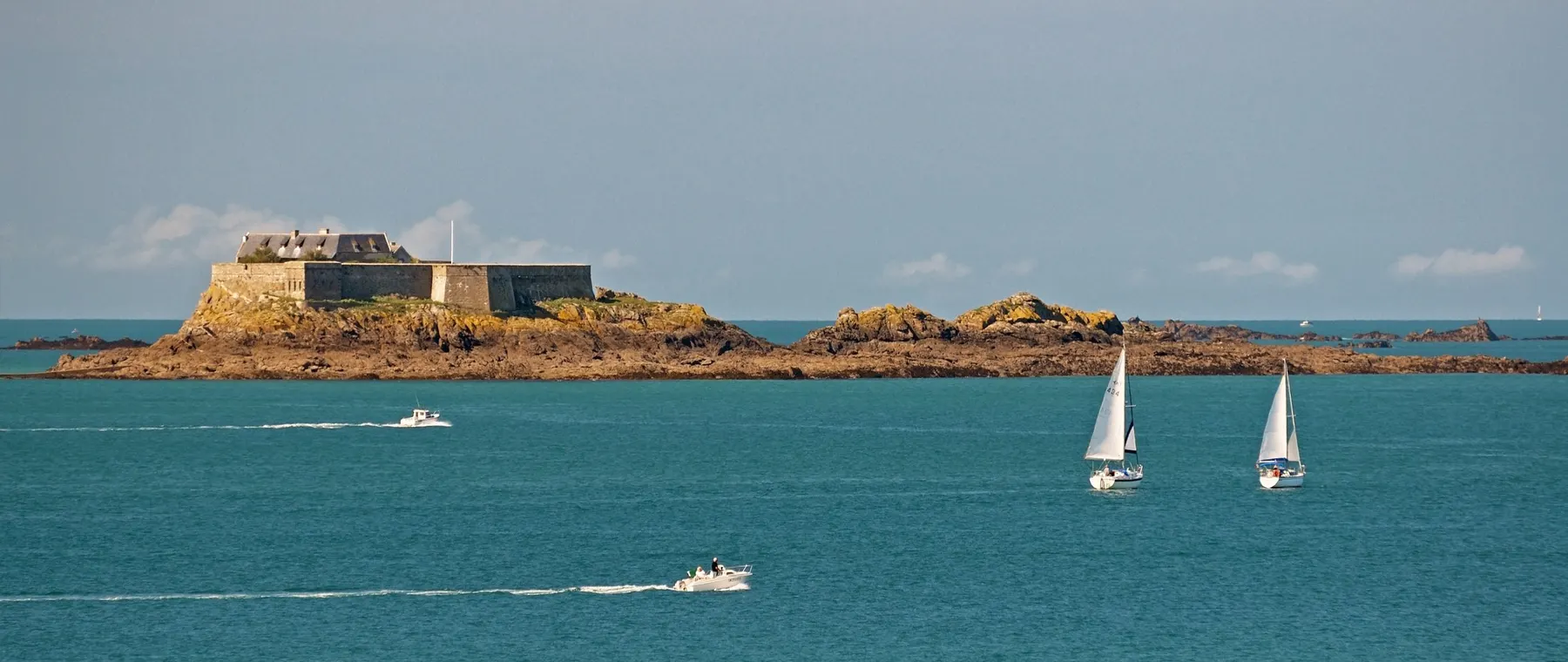
Guests can begin near Porte Saint-Vincent and explore the accessible sections of the wall, subject to current restrictions. The route includes changes in height and access arrangements that may not suit every visitor. The party should choose the walking programme according to the actual weather and mobility of its members. A quieter morning or late afternoon can provide a particularly interesting opportunity to observe the granite architecture without the distraction of a crowded schedule. The photograph accompanying this feature shows the Fort de Harbour from the Bidouane tower, illustrating the relationship between the city and its outlying maritime defences. It does not represent current navigational conditions.
A city of privateers, merchants and fishermen
The official tourism account connects Saint-Malo's maritime identity with the development of trade from the fourteenth century, fishing voyages to Newfoundland and the activities of prominent shipowners and privateers. A privateer operated under state authority in a particular historical context; the term should not be used indiscriminately for every form of piracy. The distinction helps visitors understand why the maritime history of Saint-Malo involves political and commercial relationships as well as feats of individual sailors.
Walking through the old town offers opportunities to consider how the prosperity associated with these activities affected the buildings. Residential architecture can reveal differences in social standing and the requirements of merchants who depended on access to the port. A qualified historical guide can help distinguish buildings surviving from earlier periods from those reconstructed or altered later. This is more rewarding than relying on the appearance of a single historic façade to establish the age of the structure. Many houses are private, and the visitor can appreciate their contribution to the streetscape without assuming that entry is permitted.
The figure of Robert Surcouf
The statue of the privateer Robert Surcouf is among the landmarks identified by Brittany Tourism. It provides a convenient point from which to investigate the historical context of his maritime activities. Celebrated figures of naval history are often represented through monuments whose appearance communicates the values of the people commissioning them. A monument is not the same as an impartial historical account.
A family travelling aboard a contemporary sailing yacht may find the differences between historical and modern offshore navigation particularly interesting. The information available to earlier mariners, the communications at their disposal and the arrangements for supporting their ships differed significantly from present practice. Nevertheless, their decisions were shaped by real environmental and logistical constraints. Discussing the history can give younger guests a more meaningful introduction to maritime heritage than simply identifying a famous name. A local tour or museum visit may provide further context, subject to current availability, and the owner can arrange a longer visit around the interests of the group.
Fort National and the tidal geography of the islands
The Fort National is associated with Vauban and the engineer Garangeau, and dates to 1689 according to the regional tourism guide. Petit Bé is another prominent fortified island. Grand Bé is recognised for its association with the writer François-René de Chateaubriand, whose tomb is situated there. These locations are particularly interesting because they bring the history of fortification and literature into direct contact with the tidal environment.
Access on foot to tidal islands must be assessed according to current local advice, actual tide and weather information and the complete duration of the visit. A photograph showing people on an exposed route does not establish that the same route is available at another time. If there is uncertainty about safe access or return, enjoy the islands from an appropriate viewpoint on the mainland. A yacht skipper must separately establish applicable navigation and access restrictions; the existence of a pedestrian route at low tide does not provide an appropriate guide to navigating the waters. The islands can form a rewarding part of the cultural programme without any attempt to land from the private yacht.
Saint-Servan and the Solidor Tower
The Saint-Servan district offers a contrast with the denser walled centre. Brittany Tourism recommends the route around the Cité d'Alet and the Solidor Tower, a historic structure formed by three adjoining towers whose present configuration is associated with the sixteenth century. This part of the town gives visitors another perspective on the relationship between the River Rance, the open coast and the maritime activities of the surrounding settlements.
A walk can be organised around particular views or architectural interests rather than treated as an endurance exercise. Guests travelling together may have widely differing requirements, particularly after several days at sea. Confirm the actual route, availability of interior access and suitable transport for the return. Those who prefer a shorter excursion can spend time in the historic district and meet the remainder of the party later. The benefit of a confirmed yacht base is the flexibility it permits for these different shore programmes, rather than a requirement to move the entire vessel to collect passengers from another waterfront.
The contemporary offshore racing tradition
Saint-Malo's relationship with offshore sailing continues through events such as the Route du Rhum and the Transat Québec-Saint-Malo. The regional tourism authority identifies these races as elements of the contemporary maritime identity of the city. A yacht owner interested in attending a future edition should establish the actual published dates, spectator arrangements and requirements of the relevant harbour operators.
A race departure can involve considerable changes to ordinary port operations, with temporary traffic management, restricted areas and particular safety arrangements. The captain of a private yacht must follow the current official instructions rather than use the movements of racing boats as guidance for private navigation. A shore-based viewing arrangement may provide a more appropriate experience for the guests than an attempt to approach a congested race area. Attending an event is one possible way to appreciate Saint-Malo's continuing sailing culture, but the city offers a rewarding experience on other dates as well. This feature concerns the destination's broader historical and contemporary identity, not a report on the results of any individual race.
Dinard and an alternative view across the water
Brittany Tourism identifies seasonal passenger boat services across the Rance to Dinard. The excursion gives a family the opportunity to see the setting of Saint-Malo from a different position without changing the berth of its own yacht. The visitor service has its own timetable and access arrangements, which should be confirmed directly. The crossing may be especially attractive to guests interested in the contrast between the fortified maritime city and the resort architecture on the other side.
Saint-Malo also has high-speed railway connections with Paris, providing an independent way for guests to join or leave a cruise. Check current services before scheduling transfers. A flexible visit can combine a day within the walls, an excursion towards Saint-Servan and time for a meal or cultural activity, while the captain retains responsibility for the yacht's movements. The particular value of the city lies in the relationship between its geography and several centuries of maritime life. It deserves time for exploration rather than being treated simply as an overnight stop on the way to another marina.
Sources and photograph
Source documentation: https://www.brittanytourism.com/destinations/the-10-destinations/cap-frehel-saint-malo-mont-saint-michel-bay/saint-malo/. Photograph: Fort de Harbour seen from the Bidouane tower, Saint-Malo — Ввласенко / Wikimedia Commons, CC BY-SA 3.0. Resized for web display under CC BY-SA 3.0.