A port built for more than one maritime era
Cherbourg's waterfront provides a particularly clear demonstration of the different forms of engineering that can shape a single harbour. Normandy Tourism describes the natural harbour on the northern Cotentin peninsula, its extensive artificial protective structures and a history extending from naval operations to transatlantic passenger travel. For owners of yachts between twelve and twenty-four metres, the port has cultural significance as well as practical importance. A modern cruising yacht operates in a very different way from the liners and naval vessels associated with Cherbourg's history, but it enters an environment whose physical form owes much to the requirements of those larger vessels. The appropriate first step when contemplating a visit is to obtain confirmation of a suitable recreational berth, its accepted dimensions and the shore services required by the yacht. The commercial and naval character of a port should never be mistaken for an assurance that every approach or facility is open to private vessels. The cultural programme can then be arranged around the confirmed operating base.
La Grande Rade and the ambition of a maritime barrier
The regional tourism authority identifies La Grande Rade as a particularly important aspect of Cherbourg's engineering history. The project involved a barrier approximately four kilometres long, located offshore rather than built as a simple extension from the coast. Work was interrupted by the French Revolution, resumed during the Napoleonic period and culminated in completion of the central breakwater in 1853. Its scale demonstrates the resources needed to substantially alter an exposed maritime environment using the materials and construction practices available during the period.
A protective structure changes the relationship between a harbour and the open sea. The geometry of the barrier, the direction of incoming waves and the character of its openings all influence the conditions experienced within the sheltered area. The fact that such an extensive structure exists does not mean the enclosed water will be uniformly calm. Nor can a historical account of its construction establish the dimensions or present condition of a particular channel. A yacht captain should consult current official nautical information and local requirements. Guests can nevertheless appreciate the significance of the engineering by studying it from appropriate public viewpoints, where the location of the structure in relation to the natural coastline can be understood.
The Gare Maritime and the architecture of departure
The Cité de la Mer occupies the former transatlantic passenger terminal, an Art Deco building that was used by passengers embarking and disembarking from ocean liners. Normandy Tourism dates the opening of the museum to 2002. The conversion from an active transport terminal to a cultural institution provides an opportunity to examine a building conceived around the movement of large numbers of people between land and sea.
Modern yacht guests generally encounter embarkation on a much smaller scale. They may arrive directly at a berth and move aboard through a relatively compact access arrangement. The former Gare Maritime reflects a different world, in which the passenger terminal was an integral part of a long international journey. Its vast interior spaces help visitors understand the significance of ocean travel as a social and architectural experience. Consider how the public spaces and forms of circulation differ from those of a contemporary airport or cruise terminal. The museum's collections add evidence of the human experiences associated with these journeys. Confirm its actual opening times and the accessibility of particular areas before arranging an excursion.
Titanic and the human history of a transatlantic voyage
Cherbourg was one of the ports at which Titanic took on passengers during its inaugural voyage in April 1912, before proceeding to Queenstown in Ireland and then across the Atlantic. The museum's exhibition devoted to Titanic offers a means of investigating the journey in relation to the people who travelled and worked aboard it. The story should not be reduced to an illustration of luxury interiors or the celebrity of individual passengers. It also concerns the responsibilities of those operating a vessel, the technical assumptions of a period and the consequences of a disaster at sea.
For a family familiar with contemporary yacht travel, the exhibition may provide an opportunity to reflect on the different circumstances in which ocean voyages took place. An historical event cannot be directly equated with present-day yacht operations, particularly because equipment, procedures and regulatory arrangements have changed. The useful connection is an appreciation of how much the experience of travelling by sea depends on the work done before and during a passage. Consult the museum's interpretation and exhibition schedule rather than rely exclusively on fictional portrayals of the vessel.
Le Redoutable and a radically different operating environment
The opportunity to visit the retired French nuclear submarine Le Redoutable is one of the Cité de la Mer's distinctive attractions. Normandy Tourism identifies it as the largest submarine accessible to the public. A submarine's requirements are fundamentally different from those of a private yacht. Its arrangement, engineering systems and internal spaces reflect service obligations that bear little resemblance to recreational cruising.
The contrast is informative precisely because the vessels cannot be compared on the basis of accommodation preferences alone. A visitor can consider the complexity of fitting machinery, equipment and living quarters into a hull whose intended operation places severe constraints on its internal organisation. The public exhibition is a historical and educational experience, not an invitation to infer the operating procedures of an active naval vessel. Ask about the visit's duration, age restrictions and accessibility. Confined spaces, narrow routes and changes in level may not be comfortable for every member of a family. Other parts of the museum, including its exhibits about underwater exploration and marine life, offer separate experiences for guests who do not wish to undertake the submarine tour.
Jean-François Millet and the Thomas Henry Museum
Cherbourg's artistic inheritance provides an alternative to a full day of maritime engineering. The Musée Thomas Henry reopened in 2015 following renovation, according to the regional tourist authority. Its collections reflect the gifts of Thomas Henry, who came from Cherbourg and developed expertise in art at the Louvre. They also include work associated with Jean-François Millet, whose paintings of rural life have a close connection with the landscapes of the Cotentin.
A visit can be arranged around the interest a family has in a particular painter or period. Guests who collect art may appreciate the chance to consider the history of a public collection created in part through gifts from an individual. The selection of works actually exhibited may vary between visits. A museum of this kind is also a valuable contrast to the sea-focused material at the Cité de la Mer. It places Cherbourg within a wider regional landscape in which agricultural communities and rural traditions are significant. Check the current exhibitions before making commitments based on the presence of a named work.
Craftsmanship at the umbrella factory
The town's association with Jacques Demy's film Les Parapluies de Cherbourg is celebrated through the local umbrella business, which Normandy Tourism identifies as offering visits connected with the manufacture of the product. A guided factory visit provides a different sort of cultural encounter from a museum exhibition: it can reveal the sequence of operations involved in producing a contemporary object.
For a yacht owner who values workmanship, understanding why a product is assembled in a certain way can be more interesting than acquiring it solely because of its association with a famous place. A demonstration also gives insight into the skills that need to be retained when a manufacturer wishes to maintain consistency and quality. Confirm the actual arrangements for tours rather than assume that all production activities can be seen on any particular day. A visit to the factory and art museum can together provide a rewarding shore programme for guests who have already spent several days aboard.
The liberation history at Fort du Roule
The Liberation Museum at Fort du Roule addresses the role of Cherbourg during the Allied campaign in Normandy and subsequent operations. The significance of the port extended beyond the immediate military fighting because the movement and supply of people and equipment depended on substantial logistical facilities. The high ground occupied by the fort gives a different perspective on that strategic geography.
A visit to a museum concerned with conflict should be approached on its own terms, with appropriate respect for the events and the people they affected. Guests interested in naval and military history can compare this perspective with the history of the harbour defences, without conflating the different historical periods. Establish access and opening arrangements beforehand, particularly because the site is on elevated ground.
Connecting a shore programme with a confirmed yacht base
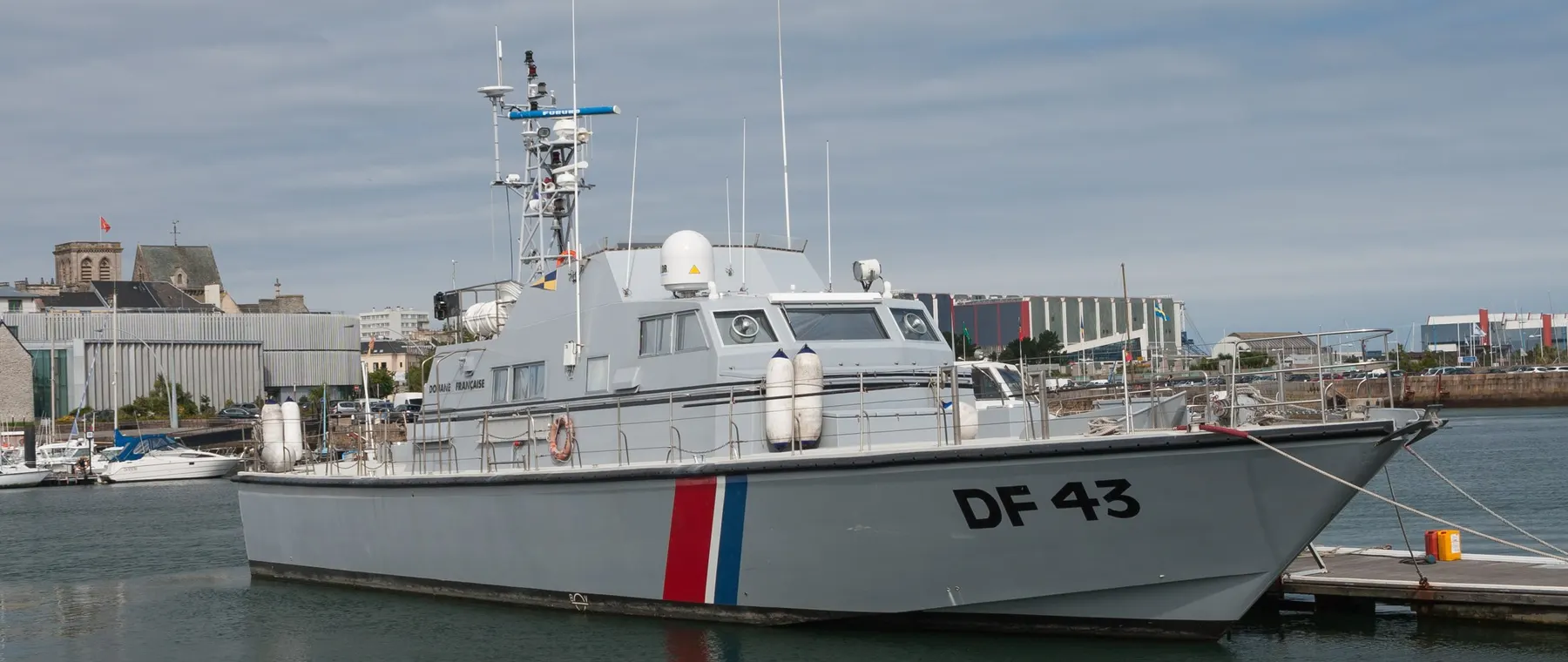
Cherbourg offers rail connections towards Paris Saint-Lazare and ferry links with British and Irish ports, according to Normandy Tourism. These provide useful alternatives for guests joining or departing from the yacht. Confirm current schedules with the actual operators and leave sufficient time for transfers. The accompanying licensed photograph depicts a French customs patrol vessel in Cherbourg harbour in 2017, illustrating the working maritime environment rather than today's recreational facilities. A considered visit allows enough time for the engineering history, the passenger terminal and the cultural attractions inland. The captain retains responsibility for the marine arrangements, including current navigation requirements and confirmed berthing. Cherbourg's value is that it gives the yacht's guests an opportunity to understand how transport, engineering and the cultural life of a port have evolved together.
Sources and photograph
Source documentation: https://en.normandie-tourisme.fr/unmissable-sites/cherbourg/. Photograph: French customs patrol vessel DF 43, Cherbourg harbour, 2017 — Andreas F. Borchert / Wikimedia Commons, CC BY-SA 4.0. Resized for web display under CC BY-SA 4.0.