The aviation collection that rewards a full day
Just outside Washington Dulles International Airport, the Smithsonian’s Steven F. Udvar-Hazy Center brings extraordinary aircraft and spacecraft into two immense hangars in Chantilly, Virginia. This is a visit for people who care about engineering as much as appearance: the museum’s large-scale setting allows visitors to study shapes, machinery and relationships between eras that are difficult to appreciate from photographs. The National Air and Space Museum says the complex contains more than 3,000 historically significant objects, including over 200 aircraft and spacecraft. Those figures describe the collection on view at the site, not the number of objects that a visitor could realistically inspect in a single afternoon.
For private-aviation owners, collectors and travellers whose interest extends beyond cabin luxury, the value is perspective. Modern business jets owe their comfort and reliability to generations of experiments in structures, aerodynamics, propulsion, instrumentation and human factors. At Udvar-Hazy, those threads can be followed across early aeroplanes, military research aircraft, airliners and spacecraft without suggesting that one technology simply developed into the next. The most satisfying approach is to choose a few important objects, allow time for close observation, then let the surrounding displays supply the larger story.
A Blackbird and a space shuttle under one roof
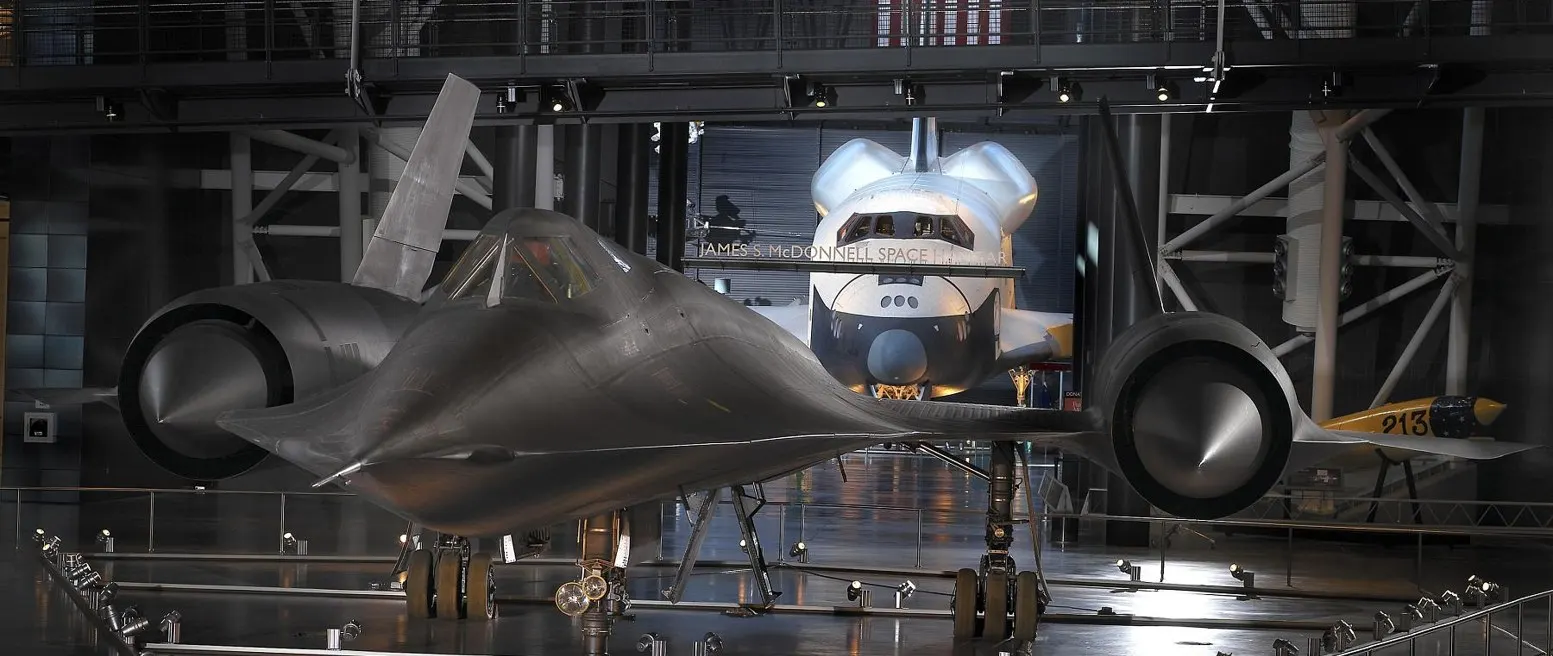
Two of the most arresting objects are the Lockheed SR-71 Blackbird and the Space Shuttle Discovery. Their proximity makes a powerful introduction to the possibilities and limits of engineering under very different missions. The SR-71’s long, sculpted fuselage, specialised inlets and dramatic planform reflect the demands of sustained very-high-speed reconnaissance flight. Discovery represents another world of thermal protection, reusable spaceflight operations and the enormous support systems needed to put a complex vehicle beyond the atmosphere. Neither machine is adequately understood by judging its silhouette alone.
A particularly effective way to experience the Blackbird is to look at its proportions from different sightlines, noting how the wings and fuselage merge and how the large engine nacelles become part of the aircraft’s overall aerodynamic shape. The space shuttle asks different questions, especially about the surfaces needed to withstand re-entry and the compromise between the roles of spacecraft and glider. Museum interpretation and collection descriptions provide the historical setting. The lesson for contemporary aviation enthusiasts is not a simplistic ranking of technologies, but an appreciation of how precisely an airframe can be designed around its operational purpose.
Concorde and the changing idea of air travel
Udvar-Hazy also displays an Air France Concorde, a landmark of the era when supersonic passenger travel became a commercial reality for a small number of long-distance routes. Its drooping nose, slender fuselage and delta wing are recognisable even to people with little interest in aviation history. Seen at full scale, however, its design also conveys the constraints of speed, cabin space, fuel use and airport compatibility. A visitor accustomed to the generous interiors of contemporary long-range private jets may find the contrasts especially revealing. Prestige and technical ambition have never automatically produced a spacious passenger cabin.
The museum’s commercial-aviation exhibitions place Concorde within a wider story of aircraft development and the changing expectations of passengers. It is worth resisting the temptation to interpret every supersonic project as the inevitable future of luxury flying. Economic, environmental and regulatory questions matter, as do route geography and operational infrastructure. For owners and operators considering the future of business travel, the historic aircraft is a useful prompt to look beyond headline speed and ask how consistently a journey can be undertaken. The most elegant design remains part of a much larger transport system.
Business aviation has its own place in the hangar
Although the celebrated record-setters tend to attract the most attention, the museum also has a dedicated Business Aviation exhibition. Its presence is significant for visitors who fly privately or manage corporate aircraft, because the sector has developed its own demanding combinations of range, cabin environment, airport access and dispatch reliability. The exhibition includes aircraft such as the Beechcraft King Air, a reminder that private and business flying encompasses far more than the newest intercontinental jet. Turboprops, smaller aeroplanes and specialised aircraft remain part of the aviation story.
Walking through this part of the collection encourages a closer look at what owners actually value in an aircraft. Size and speed are only part of the equation. Aircraft that can operate usefully from a wider range of airports, withstand demanding schedules and be maintained predictably often succeed because of their versatility. The museum does not function as a buyer’s guide to current models, and it would be inappropriate to treat a historic exhibit as a recommendation for a modern fleet. It does, however, offer a grounded setting for asking why certain configurations became enduringly important.
The restoration hangar makes preservation visible
One of the center’s most distinctive experiences is the Mary Baker Engen Restoration Hangar. Visitors can look towards the working area where specialists conserve and rebuild significant artefacts, gaining an understanding that a museum aircraft is rarely a static object requiring no attention. The challenge may involve stabilising original material, studying historic methods or deciding how far restoration should go without obscuring evidence of use. Seeing this work gives the display halls an additional dimension: many of the machines represent both engineering achievement and decades of subsequent stewardship.
This process has clear parallels for collectors of historic cars, vessels and mechanical objects. Authenticity and condition can be in tension, while a beautifully refinished surface may tell less about an object’s working life than a carefully preserved original one. The observation area does not guarantee that a particular restoration will be underway on a chosen day, and public access does not include entering specialist workspaces. Nevertheless, it is an excellent stop for visitors curious about the judgement and craft required to keep industrial heritage intelligible for future generations.
An observation tower beside Dulles
The Donald D. Engen Observation Tower offers a different perspective: views of the surrounding area and aircraft activity at Washington Dulles. It is an opportunity to connect the museum’s history with aviation that continues around it, although actual aircraft movements and weather conditions will shape what there is to see. The tower is one reason not to hurry straight to the exit after the main hangars. It also gives family members or companions with different interests a change of pace between major exhibitions.
Free docent-led highlights tours are another worthwhile feature, particularly for someone who would rather understand a small number of objects properly than skim hundreds of labels. The museum also advertises educational stations, programmes and an IMAX experience. Check on the day for times, operating arrangements and any special closures rather than assuming every activity is always available. A knowledgeable guide can often connect a well-known object to a less familiar story that changes how the rest of the museum feels. For an aviation enthusiast, that is a better luxury than trying to see everything at maximum speed.
Planning an unhurried visit
The Smithsonian currently lists free admission without timed-entry passes for the Chantilly center, with a separate parking charge and an opening window of 10am to 5.30pm on most days. It is closed on 25 December. These are published visitor details rather than guarantees for a future date, so verify arrangements before travel, particularly if combining a museum stop with flights or a larger Washington itinerary. The center is in Virginia, not at the museum’s separate location on the National Mall in Washington, DC, and that distinction matters for transport and timing.
Plan the visit as a half-day at minimum, and preferably longer if the aircraft collection is a serious personal interest. Comfortable shoes, a considered list of priority exhibits and time for the restoration and observation areas will produce a richer experience than an exhausting sprint through every gallery. Travellers moving between a yacht and a private aircraft may particularly enjoy the view that the collection gives of systems design, operational trade-offs and preservation. Udvar-Hazy succeeds because it turns extraordinary machines into objects that can be inspected with patience and curiosity, then sends the visitor away with better questions about the future of flight.