An Estate That Demands a Second Look
Among the grand historic houses accessible from the Chesapeake region, Hampton National Historic Site offers an unusually complex architectural experience. The mansion north of Baltimore has the classical proportions and carefully composed landscape that appeal to enthusiasts of historic interiors, yet it cannot be understood simply as a beautiful country house. The National Park Service now makes the stories of the people who worked there, including enslaved African Americans, central to its interpretation.
For luxury-yacht travellers using Baltimore or the upper Chesapeake as a base, Hampton is an inland excursion rather than a waterside landing. That distinction is worth making at the outset: the pleasure lies in spending part of a longer shore visit on architecture, collections and garden history, with road transport arranged separately from the vessel. It is also a way to see a dimension of Maryland history that a harbour cruise alone cannot reveal.
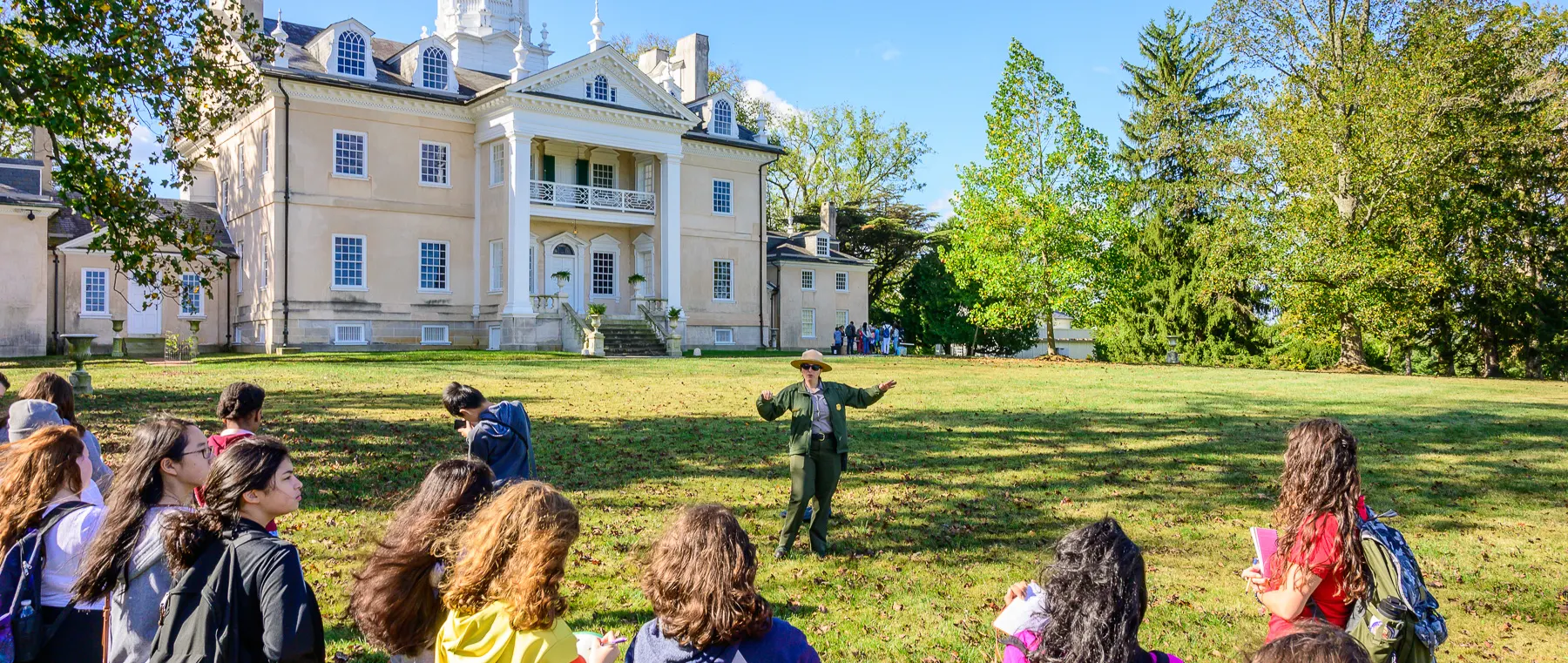
An essential part of the estate’s appeal is its surviving spatial relationship between the mansion and the working property around it. Formal presentation rooms, terraces, service areas, gardens and agricultural buildings belong to the same history. Visitors who make time for both sides of the grounds gain a far fuller picture than those who treat the principal façade as the destination.
The Architectural Language of Hampton
Captain Charles Ridgely commissioned the mansion as a country house after the American Revolutionary War, and construction took place between 1783 and 1790. The National Park Service traces its design language to European Georgian, Baroque and Palladian influences that Ridgely had encountered while travelling in England. The resulting building is not a straightforward copy of a single European original but a deliberate statement of American status and aspiration.
The historical account identifies master builder Jehu Howell as an important contributor to the design and construction process. Instead of imposing a modern idea of an architect working alone, the visitor should consider the many kinds of skilled labour involved, from layout and carpentry to masonry, decorative work and estate maintenance. The achievement is visually impressive, but the process that produced it was profoundly unequal.
Looking at architecture with that fuller understanding sharpens the experience rather than diminishing it. Sightlines, room sequences, scale and decorative finishes reveal how inhabitants wanted their social position to be seen, while service circulation and surviving work spaces show the tasks that supported the display. A thoughtful guided tour can connect these physical details to evidence about the people whose labour created and maintained them.
Gardens, Grounds and the Hidden Working Estate
The landscape beyond the mansion deserves time in its own right. Formal gardens and planted grounds create an elegant approach, but Hampton was once the centre of a far larger operation with agricultural and industrial activities. The National Park Service explains that the historic property ultimately encompassed substantial landholdings, while the protected site today preserves a much smaller, interpretable core.
This shift in scale matters for garden lovers and collectors of designed landscapes. The visible grounds were not independent artistic compositions separated from the economics of the estate; they were maintained as part of a wider working system. Understanding those connections brings an added dimension to the balance of formal symmetry, open space and service buildings.
The park includes two self-guided walking experiences through its app, one concentrating on the mansion side and another on the farm side. Travellers with a particular interest in horticulture might take the formal areas slowly and then devote equal time to the working structures. The second walk is the one that prevents an attractive landscape from becoming a misleadingly complete version of the past.
People and Collections Beyond the Drawing Room
Hampton’s public history has evolved. The National Park Service acknowledges that the early preservation narrative emphasised architectural distinction and insufficiently represented the enslaved people whose labour shaped the place. Its present interpretation draws on historical and descendant research to recover individual stories, families and the lives of free and unfree workers across generations.
Visitors may encounter accounts of skilled craftspeople, cooks, gardeners, domestic staff, ironworkers and families who pursued freedom in the face of coercion. These histories belong in any serious discussion of the estate’s material culture. Furniture and finishes cannot be detached from the human effort required to acquire, build, polish, clean and sustain them.
For those interested in provenance and heritage collections, Hampton therefore makes a particularly useful stop. It invites questions about who created objects, whose possessions were recorded, which lives generated archives and whose experiences were omitted. Those questions are relevant in contemporary collecting and conservation too, especially when a beautiful historic object has a complex chain of ownership or use.
How to Arrange the Mansion Visit in Autumn 2026
The National Park Service’s autumn 2026 schedule lists guided mansion tours from Thursday through Sunday, with morning and afternoon departures. Interior entry is by ticketed guided tour rather than independent admission, and visitor numbers are limited for each tour. It is sensible to choose a time before confirming a chauffeur, restaurant reservation or other components of a longer Baltimore day.
Advance booking is available through Recreation.gov, and the park advises reserving because spaces are limited. The reservation service fee is modest, but that should not be confused with unlimited access or the ability to arrive at any hour. Confirm the latest tour calendar directly with the park because programming can change, particularly around special events and conservation work.
Accessibility should be discussed before booking where any guest has mobility requirements. The park’s October 2026 visitor notice states that the mansion lift is not functioning and that the upper floor is not accessible by lift, while online virtual interpretation offers another way to explore portions of the interior. It is more considerate to make arrangements in advance than to discover a practical limitation at the entrance.
A Distinctive Day from a Chesapeake Yacht
A rewarding itinerary starts with a morning transfer to Hampton, a guided mansion tour and an unhurried walk through the grounds. If the group has an interest in garden composition or interior craftsmanship, allow time for questions rather than compressing the visit into a succession of photographs. Guests who prefer not to enter the mansion can still explore the public grounds, subject to current access information.
Return travel to Baltimore can then be used to connect the estate’s history with the port through which people, materials and commercial goods moved. The relationship is thematic rather than a claim of a particular historic route for a guest’s yacht. This makes the day an informed cultural diversion from the water while still fitting naturally into a Chesapeake itinerary.
The practical sources are the NPS 2026 tour guidance, its architectural history and research on enslaved people and their descendants. The accompanying image is the National Park Service’s official photograph of a gardens-and-architecture programme. Hampton rewards visitors most when beauty, craftsmanship and historical responsibility remain part of the same conversation.