The English Riviera through the eyes of a novelist
Torquay's cultural geography offers an engaging alternative to the conventional resort itinerary. The English Riviera's official tourism organisation has developed the Agatha Christie Mile around the locations associated with the novelist's life, including her family's connections with the waterfront, bathing places and Royal Torbay Yacht Club. Christie was born in Torquay on 15 September 1890. The route was first established during her centenary year, with the involvement of her daughter Rosalind Hicks. Its seven commemorative plaques provide a structure for exploring the town rather than simply following a collection of locations that resemble settings in her novels. For guests aboard a luxury yacht between twelve and twenty-four metres, the walk offers a particularly appropriate way to discover the town's relationship with the sea and the social life of an earlier period. The yacht's owner can organise the visit from an appropriate confirmed berth or independently arranged accommodation, without needing to move the vessel to each location on the route.
Vaughan Parade and a century of change on the waterfront
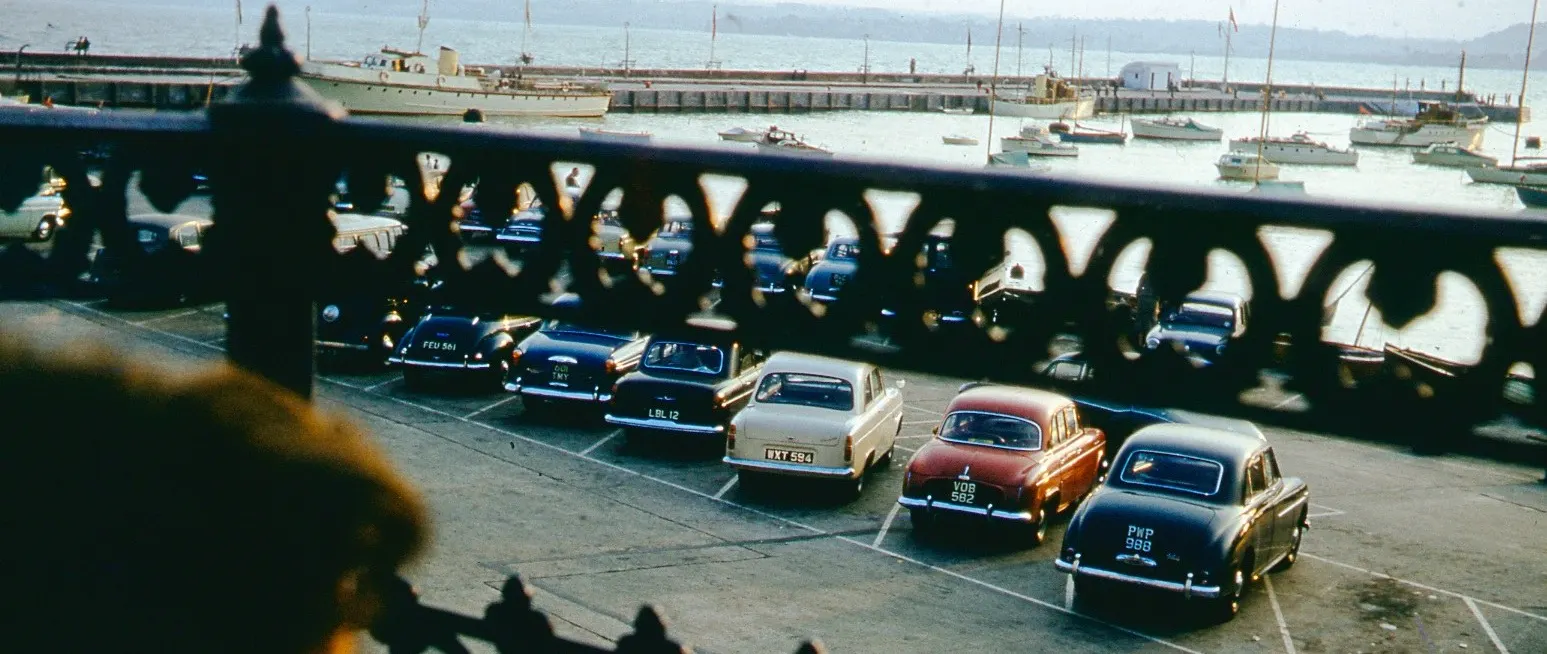
The official walking guide starts at the visitor information centre on Vaughan Parade, where a plaque marks the connection with Christie. The Georgian terraces provide a useful opportunity to compare the modern waterfront with the urban setting of her childhood. Horse-drawn traffic and the gradual introduction of motor vehicles formed part of the changing transport environment in the years after her birth. A licensed photograph by Cyril Mitchell, taken in 1959, accompanies this article. It represents a later stage in the history of the harbour and offers a visual contrast with the modern marina landscape. It is not an image of Torquay during Christie's childhood and should not be interpreted as evidence of present-day harbour facilities. For those who enjoy social history, comparing the historical image with the present streetscape can be more rewarding than photographing a familiar landmark without examining its context. The changing proportions of streets, buildings and transport infrastructure give clues to how a resort accommodates successive generations of visitors.
Beacon Quay connects recreation and wartime history
The next part of the route leads to Beacon Quay, where the tourism account describes Christie's childhood enjoyment of the annual regatta fair. That relatively modest association gives a different perspective on an event often considered from the point of view of the vessels participating in it. An activity ashore could be as significant to a child's experience as the racing itself. The quay also contains a memorial to the embarkation of troops for the Allied invasion of Normandy. The visitor guide explains that concrete slipways were constructed for American troops leaving for Operation Overlord, and identifies Bob Budd's memorial installation, which incorporates lighting spelling a phrase in Morse code and a ring indicating the direction of departure. A visitor can consider these two very different uses of the same waterfront without conflating them. The events belong to different periods and had profoundly different purposes. A pause at the memorial is an opportunity for historical reflection rather than just another photograph on a busy itinerary.
Beacon Cove and changing attitudes to bathing
Beacon Cove was once known as the Ladies' Bathing Cove. The destination guide describes bathing machines being used to allow women to enter the water in accordance with the social expectations of the period. It also recounts an incident in which Christie came into difficulty swimming with her young nephew and was assisted by a local boatman. The cove illustrates how a familiar coastal landscape can acquire different meanings as social conventions and recreational facilities change. Today, yacht owners may have ready access to bathing platforms and water-sports equipment unavailable to most Victorian holidaymakers. The underlying need to understand local conditions remains. A historical account of a person's swimming experience does not establish that a location is suitable for present-day bathing. Enjoying the cove from the land is quite sufficient for those primarily interested in Christie's life. Where guests wish to enter the water, consult current local information and assess conditions, ability and appropriate supervision. There is no need to incorporate a swimming activity simply to reproduce an episode in the historical guide.
Royal Torbay Yacht Club and the novelist's family
The official trail includes the Royal Torbay Yacht Club because Christie's father, Frederick Miller, was closely associated with it. The tourism organisation describes his regular visits and participation in social activities including card games. For modern yacht owners, this is an interesting reminder that the influence of a yacht club within a maritime town extends beyond the conduct of races and the organisation of boating activities. Such institutions can provide settings in which people develop relationships, exchange information and maintain shared traditions. Their character has changed considerably over time, and a historical account of the club's social life should not be treated as a description of its current membership or operation. The commemorative plaque can be appreciated from the route identified by the tourism office. Access to any private club premises must be arranged in accordance with its current rules. The visit is primarily an opportunity to understand the family's connection with the waterfront community rather than to presume the privileges of a member.
The Imperial Hotel and the relationship between setting and fiction
Several works by Christie are associated with the Imperial Hotel, according to the official literary trail, including Peril at End House, The Body in the Library and Sleeping Murder. A place experienced through literature can acquire a significance that differs from its role as a functioning hotel. Readers may recognise elements of a setting without expecting the architecture or interior arrangements to correspond exactly to each imagined scene. Those interested in hospitality design can also consider the social functions of a large resort hotel during different periods. Its public rooms formed a setting for gatherings whose character might be quite different from the relatively private occasions organised aboard a yacht. If the family wishes to spend part of the visit at the hotel, establish current availability for the desired meal or service. A published literary connection does not provide access to every room or historic part of a property. A well-planned visit gives the building its own contemporary identity while acknowledging the associations that bring readers to it.
Torquay Museum and a different form of literary interpretation
Torquay Museum was founded in 1876 by the Torquay Natural History Society, according to the destination's account. The visitor guide identifies an Agatha Christie Gallery that includes a representation of Hercule Poirot's study and lounge, with interpretive information about the writer's childhood and subsequent life. A museum exhibition provides a different experience from walking past a building associated with an author. Objects, photographs and designed interiors can be brought together to indicate relationships that are difficult to observe at their original locations. In particular, a representation of a fictional detective's home should be distinguished from a reconstructed room belonging to a historical person. A reader may appreciate the distinction between descriptions in the books, settings created for adaptations and material connected with the author herself. Check the museum's current exhibition programme, accessibility and opening arrangements in advance. A longer visit may also provide an opportunity to explore subjects other than Christie. For a group with interests extending beyond fiction, that variety can make a museum outing more rewarding.
Extending a literary visit beyond the town
The official tourism material identifies Greenway, on the River Dart, as the holiday home purchased by Christie and Max Mallowan in 1938. The property and its surroundings form a further element of the region's literary heritage, but visiting requires separate practical arrangements. An owner does not need to take the yacht up the Dart simply because the property lies beside it. Suitable land transport or published visitor services can enable a visit from an established base subject to operating times and booking conditions. Reading a novel set in the wider region before travelling can add context to the different landscapes encountered. The coast, river and more distant moorland provide quite distinct settings, and a thoughtful itinerary need not incorporate them all in one outing. The attraction of expanding beyond the town is the opportunity to explore the relationship between the author's private life and her literary imagination, without interpreting every landscape as the scene of a particular fictional event.
Planning the stay around the interests of the guests
Tourism information and the public plaque trail provide a clear starting point for a cultural visit. Owners should obtain current details of the route, gradients and opening arrangements, particularly for guests who may find the steeper sections of the town difficult. A shore excursion can be divided between several days rather than completed in one continuous walk. The yacht's skipper should independently establish suitable marine arrangements, including accepted dimensions, access and services, and retain discretion over vessel movements based on current nautical information. An interesting literary itinerary does not depend on the vessel lying beside the exact location of the first plaque. Torquay is a particularly rewarding destination when the guests allow the town's maritime and cultural heritage to provide a meaningful context for their holiday, returning to the yacht with a greater appreciation of the place rather than merely another collection of familiar views.
Sources and photograph
Source documentation: https://www.englishriviera.co.uk/be-inspired/agatha-christie/agatha-christie-mile. Photograph: Torquay harbour in 1959 — Cyril Mitchell / Wikimedia Commons, CC BY-SA 4.0. Resized for web display under CC BY-SA 4.0.