A fishing village rather than a conventional yacht resort
The narrow streets of Mevagissey descend to a twin harbour on Cornwall's south coast, where the local fishing industry has helped shape the layout and identity of the settlement. Visit Cornwall associates the village's name with the saints Meva and Issey and records a medieval quay dating to 1430. Later expansion of the fishing industry created a need for further protection, and the outer harbour was developed and improved over successive periods. The village is therefore particularly interesting to yacht owners who appreciate the history of coastal communities, but its attraction does not establish that its working harbour can accommodate a luxury yacht measuring between twelve and twenty-four metres. Owners should consider a visit from an appropriate confirmed base elsewhere on the coast if the actual vessel cannot be accommodated locally. The following itinerary focuses on the experience ashore, where the village's architecture, fishing heritage and proximity to the Lost Gardens of Heligan provide the principal reasons to visit.
The pilchard trade and the physical shape of the waterfront
In the nineteenth century Mevagissey's economy benefited from fishing for pilchards, according to the local destination guide. A fishery creates demands extending well beyond the space occupied by its boats. It requires places for landing and handling catches, areas for equipment and supplies, and connections with the people responsible for processing and selling the product. The arrangement of a historic waterfront can be considered in relation to those activities. An observer walking around the harbour today can still appreciate how the scale of the buildings and access routes reflects the geography within which the village developed. The modern visitor should respect the fact that fishing is not simply an illustration of local history. Boats and their crews continue to use the harbour for work. Do not interfere with landing operations or assume that areas accessible to workers are open for general recreation. A walk along the public sections of the harbour walls is an opportunity to examine the setting without intruding on operational activity.
Exploring the collection at Mevagissey Museum
Visit Cornwall identifies the museum on the harbour as a place to investigate the village's past through local objects and memorabilia. Such a collection can offer a perspective quite different from that of a large national maritime institution. It can bring the everyday details of a particular community into focus: the things people used at work, photographs of changing streets, and the evidence of activities that may no longer occupy the same place within the economy. For yacht guests interested in maritime design, an object associated with an earlier fishing practice can illustrate the relationship between its construction and the particular task it was intended to perform. The museum's wider social history is also worth considering, since a fishing village is not simply a collection of boats and equipment. Before travelling, establish the current opening and access arrangements through the museum. The destination's description of its collection is not a guarantee that every item or exhibition will be available during a chosen visit.
A meal that reflects the village's maritime identity
The visitor authority highlights seafood as one of the principal attractions of Mevagissey's restaurants. Local scallops, crab and mackerel are among the ingredients it mentions. These are examples rather than a statement of what will be available on an individual menu. A guest interested in food can ask about seasonality and the origin of the ingredients actually offered. The village's independent establishments provide a different kind of hospitality from a highly formal dinner aboard a private yacht. That contrast is part of the appeal. Rather than attempt to reproduce a favourite yacht menu ashore, visitors may find it more interesting to choose a simple meal that reflects the character of the destination. Owners wishing to purchase supplies for the yacht should arrange the transport, storage and delivery independently. A restaurant's proximity to a working harbour does not imply that its supply facilities are available to visitors. Confirm reservations where required, particularly during the established holiday season, and check dietary requirements directly with the chosen business.
Heligan as a separate day in the itinerary
The Lost Gardens of Heligan lie inland from Mevagissey and are identified by Visit Cornwall as a particularly worthwhile excursion. The tourism authority suggests allowing at least four hours to enjoy the gardens. That is a useful reminder that a substantial garden should not be approached as a short addition to a tightly scheduled harbour visit. A yacht owner concerned with the design of a residence or the collection of plants may appreciate how a historic garden develops its character through the relationship between its spaces, mature planting, seasonal activities and maintenance. Rhododendrons and azaleas in spring are among the attractions mentioned by the visitor authority, although the appearance of actual specimens depends on season and conditions. A winter visit offers a different experience from that of spring or summer. Consult Heligan's current visitor information for the actual opening programme, access, route and facilities. Guests who wish to devote the whole day to the gardens should be able to do so without putting pressure on a yacht's planned departure.
Pentewan and the legacy of industrial transport
The former port of Pentewan offers another way to interpret the landscape surrounding Mevagissey. Visit Cornwall describes the Pentewan Trail as following the bed of a narrow-gauge railway that transported china clay and tin ore to the harbour. The railway ceased operation in 1916 after the harbour became silted. This provides an interesting comparison with a contemporary yacht's operation: a port's usefulness depends not solely on its location but on the maintenance of its connections, the physical condition of its navigable waters and the economic activities it serves. The present walking and cycling route has a very different purpose from the original industrial line, but the continuity of the route enables visitors to consider that earlier function. The visitor guide describes a roughly five-mile round trip from Pentewan to London Apprentice and back. Confirm access conditions, equipment hire if required and the suitability of the route for the guests. A quiet day exploring this landscape may be as informative as a formal museum outing.
Feast Week and the living traditions of a maritime community
Mevagissey's Feast Week is normally held in late June. Visit Cornwall associates its present timing with the adoption of St Peter as the village's patron saint in 1752 and describes activities that include music, street celebrations, boat races and a fireworks display. The history gives context to the event beyond its appeal as a visitor attraction. Local celebrations can preserve a sense of identity while also adapting to changing economic and social circumstances. An owner planning to attend should obtain current dates and arrangements from the organisers. Events increase demand for transport and hospitality and can affect the use of particular harbour areas. A booking ashore should therefore not be interpreted as securing an appropriate place for the yacht. Arrange an independent transfer from the yacht's confirmed base if necessary. Families may prefer to spend part of a day enjoying the programme and return to a quieter setting for dinner. The attraction of an established community event is that guests can share in its public activities without attempting to make the entire waterfront part of their private arrangements.
Coastal walks and the villages beyond Mevagissey
The small beach reached by steps near Mevagissey is not necessarily an appropriate recreation site for every visitor. The regional guide suggests Porthmellon and Gorran Haven among the alternatives. For yacht guests, these places can be explored through properly arranged land excursions, subject to weather, daylight, access and the mobility of the group. The attractiveness of a beach is distinct from its suitability for swimming, launching a tender or bringing a larger vessel close to shore. Consult current local conditions and restrictions before planning water-based activities. A coastal walk can provide a satisfying means of understanding the landscape without requiring those activities at all. The family's interests should determine the length and nature of the outing, and suitable transport can be arranged for those who prefer not to undertake the whole route. This approach allows a yacht holiday to incorporate relatively small coastal communities without expecting their facilities to meet all the requirements of a substantial private yacht.
The best way to include Mevagissey in a cruise
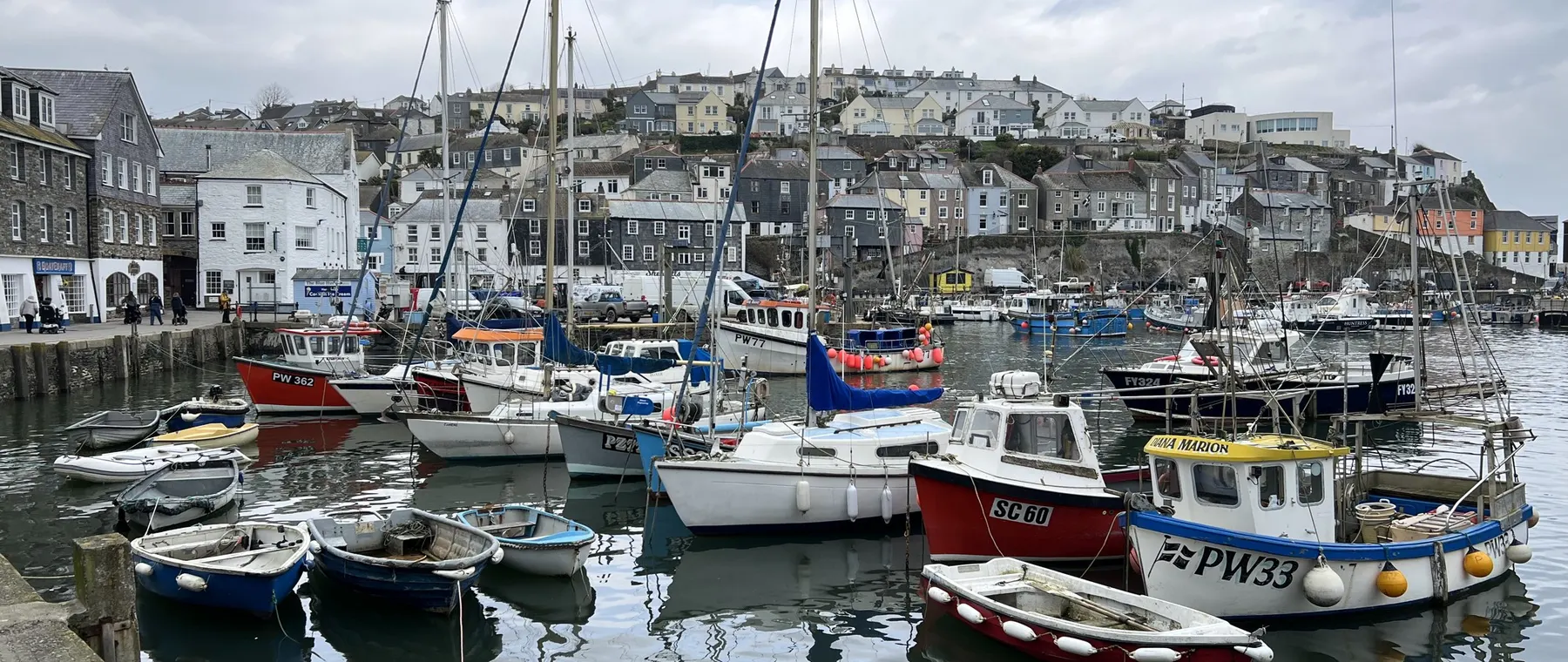
A considered programme could include the harbour museum and a meal in the village on one day, with a separate visit to Heligan or the Pentewan Trail. St Austell is identified by the tourism authority as the nearest mainline railway station and provides another option for organising independent land travel. The skipper should establish actual harbour access, berthing, marine services and current navigation conditions at the intended yacht base before committing to the visit. The accompanying photograph by Andrew Abbott records boats in Mevagissey harbour and is provided under a Creative Commons licence. It is not a statement of current yacht-berthing availability. The value of the destination is its distinct working maritime identity and the remarkable gardens and industrial history nearby. The yacht owner who makes those interests the centre of the programme can appreciate the village without seeking to turn an intimate fishing harbour into a conventional large-yacht marina.
Sources and photograph
Source documentation: https://www.visitcornwall.com/destinations/mevagissey. Photograph: Boats in Mevagissey harbour — Andrew Abbott / Wikimedia Commons, CC BY-SA 2.0. Resized for web display under CC BY-SA 2.0.