A Cornish dining destination within a living estuary
Padstow on Cornwall's north coast combines a celebrated culinary scene with a working harbour and the changing landscapes of the Camel Estuary. Visit Cornwall identifies the estuary and Carnewas to Stepper Point as protected National Landscapes. The town's association with Rick Stein and the subsequent development of restaurants by other chefs make food a particularly interesting part of a visit. A private yacht holiday, however, should not be arranged entirely around the expectation of obtaining a berth close to a restaurant. The entrance to the estuary presents substantial navigational considerations, and a yacht measuring between twelve and twenty-four metres may have different requirements from the local fishing and pleasure boats. Owners should establish whether a suitable marine arrangement exists before making a commitment to bring the vessel. If it does not, the same culinary and cultural programme can be undertaken from a suitable base elsewhere using land transport. The experience of the town remains worthwhile regardless of the precise location of the yacht.
The Doom Bar and the importance of local knowledge
The official destination information draws attention to the Doom Bar, a notorious sandbar near the mouth of the Camel Estuary. Its position and configuration can be affected by currents, tides and storms. For a yacht skipper, the relevant question is not how attractive the harbour appears once inside, but whether the complete approach and departure are suitable under the actual conditions. Consult current official charts, navigational warnings and specific harbour instructions. Historical descriptions of the bar, photographs and tracks followed by other boats are not adequate substitutes for that assessment. The yacht's loaded draft, motion and manoeuvring characteristics need to be taken into account. A skipper should be free to reconsider the decision even when a meal has been reserved in the town. An owner who has agreed flexible accommodation or transport arrangements is better able to enjoy Padstow without creating pressure to undertake an unsuitable passage. This guide provides no navigational route or recommendation to cross the bar.
The development of a dining tradition
Visit Cornwall traces the town's modern culinary reputation to the opening of Rick Stein's first restaurant in the 1970s. It also identifies Paul Ainsworth at Number 6 as having received its first Michelin star in 2013. These milestones are useful in understanding how a fishing port developed an additional identity as a destination for people particularly interested in food. They are historical observations rather than confirmation of any restaurant's current award status or booking availability. A family interested in gastronomy can arrange an itinerary around a particular chef, style of cooking or ingredient rather than simply attempt to visit the most celebrated names in a short period. The character of the town includes more informal cafés, pubs, bistros and other independent establishments. An excellent meal need not be the longest or most elaborate experience of the holiday. Confirm current menus and discuss dietary requirements directly with the chosen venue. In particular, the needs of someone with a serious allergy should be communicated explicitly rather than inferred from the general availability of alternatives on a menu.
Exploring ingredients rather than collecting reservations
For yacht owners who regularly entertain aboard, a visit to a place with a distinctive food culture can also provide ideas for their own hospitality programme. The relationship between a seasonal ingredient, the production or fishing activity that supplies it and the way it is prepared may be more interesting than its simple inclusion in a luxury meal. Guests could arrange a cookery experience through an appropriate provider or discuss available local ingredients with the yacht's chef if the boat is based within practical reach of the town. The latter requires consideration of how the ingredients will be transported, stored and used. A restaurant's own supply relationships should not be assumed to extend to direct provisioning of privately operated yachts. Nor is a commercial fish market automatically open to casual visitors. Ask about the actual purchasing arrangements and allow the crew adequate time to receive the food safely. An unhurried lunch ashore and a separate meal aboard can provide complementary experiences without trying to reproduce a restaurant's entire service in the confines of a yacht.
The National Lobster Hatchery and conservation
The National Lobster Hatchery in Padstow offers a different perspective on the region's relationship with seafood. Visit Cornwall identifies it as a visitor centre explaining the biology of lobsters and conservation work intended to support wild populations. For children and adults interested in marine life, the visit can connect the experience of looking out over the estuary with questions about the animals living below its surface. A hatchery is a specialised working environment, not merely a collection of aquaria. The process of raising animals and releasing them as part of a conservation programme involves a different set of responsibilities from keeping specimens for public display. Guests may wish to find out how the organisation monitors its activities, which life stages are involved and what other research supports the programme. Current opening arrangements and any scheduled demonstrations should be checked directly. The existence of conservation work does not establish the sustainability of every individual seafood purchase, but it can encourage a more informed discussion of the wider local marine environment.
The Camel Trail and the advantages of independent travel
The Camel Trail follows a former railway route along the estuary to Wadebridge and beyond towards Bodmin. The destination guide describes its surface and relatively gentle profile, making it a useful possibility for families looking for cycling or walking activities ashore. Bicycle hire is available in the vicinity of the harbour, according to the visitor information. Confirm the actual arrangements, suitable sizes and equipment before travelling. The party should choose a distance appropriate to everyone's abilities and make a realistic plan for returning. The route is also an interesting way of viewing the estuary from the land. Where the yacht's navigational options are determined by its dimensions and conditions in the waterway, walking and cycling offer a different means of reaching the surroundings. Guests who do not wish to take part can spend time in Padstow independently. A family cruise gains flexibility when it does not require all its members to undertake the same activity for the same length of time.
Prideaux Place and the perspective from a country estate
The regional visitor information describes Prideaux Place as an historic mansion near the town, associated with fourteen generations of the Prideaux family. Its deer park and views over the estuary provide a different experience from that obtained during a harbour walk. An owner interested in architecture, collecting or country-house conservation may find a visit particularly worthwhile. The significance of a house occupied across many generations often lies in the way rooms, objects and alterations record changing patterns of family life. Rather than interpret the property as an entirely preserved example of a single design period, consider the relationship between its accumulated history and the landscape surrounding it. Confirm the actual dates and conditions for guided access; the presence of the house in the destination guide does not establish that every part of the estate is open throughout the year. A suitable visit can be organised as a separate cultural activity, leaving sufficient time to enjoy the grounds or other places nearby where access permits.
Rock and the surrounding coastal landscape
The opposite bank of the estuary provides access to Rock, while Daymer Bay and Polzeath are among the beaches highlighted by Visit Cornwall. Passenger ferry connections offer a possible way to visit Rock independently of moving a private yacht. Check the current operating schedule and any conditions affecting the relevant landing points. Coastal walking and visits to other beaches can be organised by land according to the mobility and interests of the passengers. The northern Cornish coastline has a character that differs markedly from the sheltered appearance of the harbour. Exposure, wave conditions and tidal access should influence decisions about any water-based recreation. Organise an activity through qualified local providers where appropriate, rather than assume that a guest comfortable aboard a large yacht is also experienced in surf or small-craft conditions. The protected landscapes are places for observation and responsible visiting, not a reason to approach wildlife or sensitive areas unnecessarily.
A culinary visit that does not depend on one particular berth
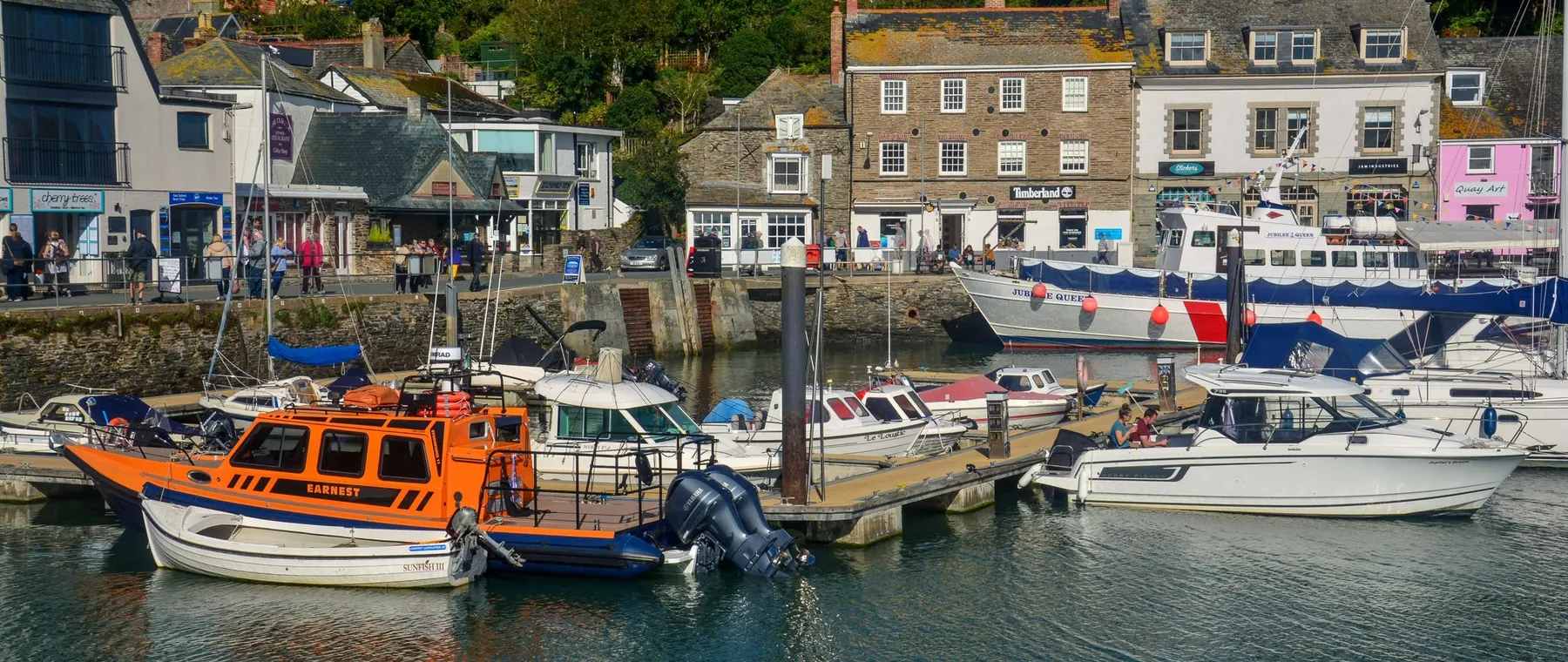
Padstow can be enjoyed through a programme of food, conservation, walking and architectural heritage. An owner might choose one central dining reservation and leave time for spontaneous exploration, including a visit to the hatchery or a short outing along the Camel Trail. The nearest mainline station is Bodmin Parkway, according to the regional destination guide; independently arranged transport can connect the town with another confirmed yacht base. The accompanying licensed photograph shows Padstow harbour and is not evidence of current moorings or water depth. Captain and harbour authority must establish whether the actual vessel and its planned route are suitable. The value of the destination is that its culinary identity is deeply connected with a real maritime landscape, and both can be appreciated without making the enjoyment of the holiday contingent on a particular yacht manoeuvre.
Sources and photograph
Source documentation: https://www.visitcornwall.com/destinations/padstow. Photograph: Padstow Harbour — Lewis Clarke / Wikimedia Commons, CC BY-SA 2.0. Resized for web display under CC BY-SA 2.0.