An estuary that rewards a longer visit
Fowey offers a rather different form of cruising from the open bays along Cornwall's south coast. Its town rises steeply from the western bank of the River Fowey, opposite Polruan, and the waterway remains a working route to commercial docks farther inland. Visit Cornwall describes Fowey as a centre for visiting pleasure boats, with an active sailing community and a varied programme of activities ashore. For owners of yachts between twelve and twenty-four metres, it is a place where the experience of river navigation, the organisation of guest accommodation and the pleasures of walking through an old maritime town can be brought together. The actual berth or mooring needs to be assessed with the harbour authority before the owner commits to dates. A yacht's beam, loaded draft, displacement and method of boarding matter just as much as its length, and a riverside photograph cannot establish which arrangements are available. The appealing feature of Fowey is that a visit can retain its interest even when guests explore the surrounding settlements by passenger ferry instead of continually moving their own vessel.
The literary geography of a steep harbour town
The association of Fowey with writers is inseparable from its geography. Visit Cornwall draws attention to Kenneth Grahame's description of a small grey town clinging to the steep side of its harbour, from The Wind in the Willows. The image is a useful starting point for considering why a landscape occupies a significant place in a work of fiction without needing to be reproduced literally. Daphne du Maurier's association with the area offers another reason for readers to discover the landscape on foot. A contemporary yacht guest may see the same river as a route between quays or a view from the salon. A literary visit invites a slower investigation of the streets, gardens and changing outlook that lie beyond the vessel's immediate surroundings. It can also be a useful shared experience for families who have quite different levels of familiarity with the writers. Choose a book to read before travelling, then allow time for a walk and conversation rather than treating the visit as a compulsory checklist of locations.
Fore Street, individual makers and glass
The town's Fore Street connects the waterfront with a sequence of independent shops and galleries. The official destination guide identifies Jo Downs Glass Gallery, which specialises in handmade glass inspired by coastal Cornwall. Glass is a particularly interesting subject for yacht owners because its appearance depends so strongly on lighting, scale and the background against which it is seen. A small object on a shelf in a gallery may have a different visual effect in a yacht's living space where the direction and quality of daylight change considerably. If a piece is intended for use or display aboard, ask about dimensions and care requirements, and discuss with the yacht's interior specialists how it can be appropriately supported or secured. Objects should not be purchased simply because their colours suit a nautical theme. A conversation about the way a maker develops a design or works with materials can be a distinctive element of a destination visit. Establish actual opening times in advance if an individual gallery is a particular reason for travelling to Fowey.
Hall Walk connects two banks of the river
One of the most distinctive experiences described by Visit Cornwall is the four-mile Fowey Hall Walk, incorporating two ferry crossings. It offers a way of discovering the relationship between the river, woods, settlements and creeks without asking the skipper to use the yacht as a local shuttle. The two ferry journeys form part of the route rather than being optional transport at its beginning or conclusion. Visitors should check that the necessary services are operating, the location of their landing points and the time required to complete the outing before setting off. The actual terrain and daylight should be considered for members of the group who may prefer a shorter walk. Those whose mobility is limited may wish to choose a different way of experiencing the river. A yacht's private accommodation can remain available to other members of the group during the excursion. The captain can use the time for normal preparations without having to arrange another position in the river simply to collect guests from an attractive viewpoint.
Polruan and the tradition of building and protecting boats
Across the river lies Polruan, identified by the tourism authority for its shipbuilding heritage and narrow streets. The passenger ferry offers a means of visiting the settlement independently of moving one's own vessel, subject to actual operating times and conditions. Its historic defensive blockhouse is one reason to explore the area. Looking at defensive structures on opposite sides of a narrow river entrance gives a different perspective on coastal settlements from looking at a modern marina plan. The concern was once the relationship between vessels seeking access and the ability to control that access. Today's yacht operators are concerned with different limitations, including traffic, depth, conditions and the suitability of facilities. The two periods should not be confused, but visiting the historic structures makes the geographical continuity apparent. Allow time to walk the settlement rather than cross merely to photograph Fowey from another bank. The captain should confirm the practical arrangements for guests returning aboard, particularly if the vessel's position requires a separate transfer after the passenger ferry arrives.
Readymoney Cove and St Catherine's Castle
The destination's official information describes Readymoney Cove as a sandy inlet towards the entrance to the harbour. Overlooking it is St Catherine's Castle, constructed in the 1530s during the reign of Henry VIII to protect the approach. These two attractions offer a particularly interesting combination of landscape and built history. A walk to the cove can be arranged as a separate activity from yacht navigation. The beach's appeal to swimmers should not be interpreted as confirmation that it is suitable for access by the yacht or its tender. Current local rules, prevailing conditions and the group's experience determine whether water-based activities are appropriate. The castle offers another perspective on the entrance, and visitors can consider how the same geography that attracts recreational boats influenced earlier defensive arrangements. Check current access information for the historic structure and choose footwear appropriate to the actual walking route. It is perfectly reasonable to spend time in the landscape without attempting to turn every feature into an organised activity.
A separate excursion into Cornwall's industrial history
The region offers experiences well beyond the harbour's immediate attractions. Visit Cornwall identifies Wheal Martyn Clay Works as a means of exploring the history of china clay extraction, and the Eden Project as an alternative day out with its tropical and Mediterranean planted environments. The two destinations represent different ways of interpreting the landscape. Industrial collections explain the organisation of production, transport and the people who worked in the industry. A contemporary planted environment provides an opportunity to examine living collections and the conditions under which they can be maintained. Yacht owners who are concerned with architecture, engineering or environmental subjects can decide which of these interests should form the basis of an excursion. Arrange separate transport and check the actual opening schedule rather than rely on an approximate distance from the town. Neither attraction requires the vessel to be moved inland. A booked visit can remain independent of the captain's decision about the yacht's subsequent movement.
The local sailing community and an independent guest programme
The tourism guide describes the wooden Fowey River Class dinghies and their role in local racing, including the Fowey Regatta. These smaller craft provide a distinctive example of the way a particular boating tradition can persist within a modern leisure destination. A luxury yacht owner interested in design might enjoy observing their proportions, construction and the practical requirements of preparing them for sailing. The visitor should distinguish an organised event from ordinary daily activities and confirm dates through the organisers. Local boating traditions are best appreciated without interfering with the people maintaining them. If the family wishes to take part in an appropriate local experience, arrange it through those responsible and establish participant requirements. For guests less interested in the boats themselves, time in the town's shops, walking routes and food businesses may provide an equally satisfying day. This variety is an advantage of a longer stay rather than a brief visit tied to a single event.
Organising a comfortable visit
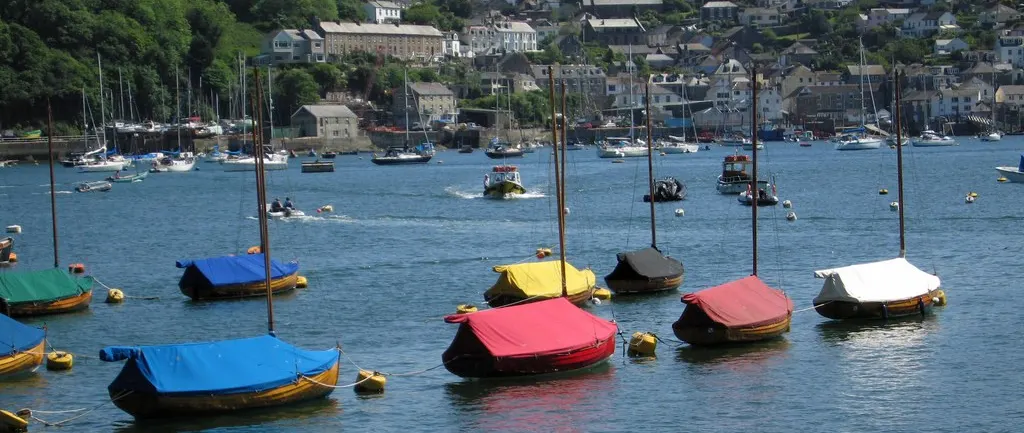
A sensible Fowey itinerary can combine an agreed mooring arrangement, a town day and a separate Hall Walk or Polruan visit, with another day allocated to the surrounding region. Par is the nearest mainline passenger railway station according to Visit Cornwall; confirm the current rail and onward transport arrangements for guests joining by land. The captain must consult current authoritative nautical information and the responsible harbour operators before undertaking any passage or arrival. The photograph accompanying this feature records boats in Fowey harbour and is licensed for editorial display. It does not indicate current berth availability. A thoughtful visit is one in which the yacht provides privacy and comfort while the guests have the freedom to discover the river's literary character, independent makers and communities on their own terms.
Sources and photograph
Source documentation: https://www.visitcornwall.com/destinations/fowey. Photograph: Boats in the harbour at Fowey — Dave Croker / Wikimedia Commons, CC BY-SA 2.0. Resized for web display under CC BY-SA 2.0.