Hvar without the loudest harbour
Hvar has a reputation for sunlit waterfronts and glamorous arrivals, yet the island rewards visitors who venture beyond its most photographed quays. Stari Grad, on the northern side, offers a different first impression: a long bay leading towards an established town, stone-fronted streets and a landscape that reaches far beyond the marina. For owners of a 14-metre sailing yacht or guests on a 22-metre cruiser, this is a destination where the pleasure is largely in slowing down. The yacht remains close to the town, but an afternoon need not be organised around bars or a rapid transfer to the next anchorage. The local tourism office describes a functioning nautical harbour, and UNESCO recognises the agricultural plain behind it. Together those facts suggest a more rounded stop: sailing, history, food and a living local landscape within one carefully planned visit.
A long approach that changes the mood
The entrance is part of the experience. Stari Grad's tourism office describes the bay as extending around six nautical miles into Hvar, an unusual inland reach that gives a arriving yacht time to leave open water behind. The coast gradually narrows the view, with slopes and smaller coves rather than a single exposed urban frontage. That scenic enclosure should not be mistaken for a guarantee of uniform shelter. Local nautical guidance identifies different effects from the northwest maestral, bora, jugo and other winds along the approaches. A skipper should therefore treat the cruise up the bay as a navigational passage deserving a current chart and weather check. For guests, the reward is the gradual reveal of a town at the water's end; for the captain, the priority remains an arrival with enough light, depth and manoeuvring room.
The port information that matters
According to the town's official visitor guide, the nautical port offers 120 sea berths and a further 30 dry berths, with shoreside facilities close to the historic centre. It lists reception and practical services along with cafés, restaurants and everyday shops. Those numbers are an orientation, not a promise that a particular 20-metre berth will be free or appropriate. Berth dimensions, maximum draft, electrical provision, reservation procedures and fees must be confirmed with the port authority before arrival. That applies especially to wider modern flybridge yachts, which may require more room than their length suggests. The tourism office also places berths on the New Waterfront near the Port Authority office. Having a precise arrival instruction and a fallback makes the transition from a busy summer channel to a secure overnight berth considerably easier.
The town is the itinerary
Stari Grad is a place to explore on foot once lines are secure. Rather than treating the quay as a brief supply stop, walk away from the water to see how the historic buildings and lanes connect with the sheltered harbour. The town's connection with the poet Petar Hektorović and his Tvrdalj is a particular reason to linger; the tourism office identifies that historic complex as a landmark beside the nautical port. A day ashore can be uncomplicated: a quiet breakfast, a visit to a historic courtyard or museum when open, lunch in town and a return to the boat before evening. Specific opening hours and guided-tour availability should be checked close to the date. The pleasure comes from following the town's scale. It is possible to feel engaged with the island without the logistical complexity of a long vehicle excursion.
A UNESCO landscape just beyond the quay
The great surprise for many first-time visitors is that Stari Grad's significance extends inland. The Stari Grad Plain was inscribed on UNESCO's World Heritage List in 2008 as a cultural landscape, notable for a system of agricultural plots established by Greek settlers in the fourth century BC. UNESCO's description emphasises the remarkable persistence of that field pattern over centuries. It is not a preserved theme park but a landscape that still expresses agricultural use. For a yacht itinerary, the plain adds depth to a short stop: after a morning beside the sea, guests can encounter an older relationship between settlement, cultivation and geography. A guided walk or carefully chosen bicycle route can make sense, provided access, heat and seasonal conditions are considered. The visual contrast with the harbour is striking and entirely appropriate to a more thoughtful luxury holiday.
Choosing a route through the fields
An excursion into the plain should be organised sensitively. The long history of its parcels and stone boundaries is the point, so an experience that treats them merely as a shortcut or a backdrop for off-road vehicles would miss the character of the site. Seek locally authorised routes, remain on roads and paths intended for visitors, and book a guide if the stories of the land are important to the group. During warm months an early outing is more comfortable than a midday departure from the yacht. A small party may enjoy a slower cycling circuit, while other guests will prefer a vehicle transfer and limited walking. None of this requires a packed schedule. It creates the sort of cultural encounter that justifies staying two nights instead of racing between anchorages. The yacht supplies flexibility; the landscape supplies perspective.
Nearby coves are not interchangeable
Hvar's north shore offers tempting indentations for a swim, but the local nautical guide makes a distinction between scenic coves and places appropriate for overnight shelter. It describes the section around Tiha and several other bays, noting how protection changes with wind direction. In some coves a boat can appear perfectly comfortable at midday and be exposed as the conditions turn. The shore party should not assume that a pretty beach or green water means an anchorage is suitable for a yacht of 18 or 23 metres. The captain must consider the forecast, depth, holding, other vessels, protected zones and any concession-managed mooring requirements. An afternoon stop with a return to confirmed harbour accommodation can be more luxurious than a poorly judged night at anchor. Good destination writing should encourage a visit, never substitute for the vessel's passage planning.
A useful base for different guests
Stari Grad accommodates contrasting holiday styles. A couple on a sailing yacht may favour a harbour walk and an unhurried dinner; a family aboard a motor cruiser may appreciate easy access to supplies and the possibility of a shorter excursion into the plain. Guests keen on photography can spend the morning in the changing harbour light, while others make an appointment for a local historical tour. Those different activities work because the boat is not remote from the settlement. Even so, owners should avoid assuming that restaurants, transport or specialist services operate on identical hours throughout the year. The Adriatic's seasonal pattern changes markedly outside its peak holiday weeks. A thoughtful captain or concierge confirms the essential arrangements and leaves the rest of the day pleasantly open. Comfort often lies in avoiding unnecessary transfers and waiting.
The connection with the wider Hvar coastline
Stari Grad can anchor a larger Hvar programme without requiring every guest to follow the same route. The island's well-known southern communities and north-coast bays may form part of a longer passage, but the distances and safe sea conditions need real planning rather than an itinerary lifted from a promotional photograph. The local tourism office publishes nautical notes covering approaches and prevailing wind effects, useful background to be read alongside current hydrographic information. One workable rhythm is to devote a full arrival day to the harbour, use the following morning for the UNESCO plain and decide the next departure according to weather. If a sea breeze makes an exposed lunch anchorage undesirable, the alternative can simply be more time ashore. This flexibility is one of the strongest reasons to travel by yacht rather than follow a rigid overland schedule.
A responsible visit to a busy heritage harbour
Beautiful small ports are not unlimited resources. A yacht consumes quay space, shore power and water, while its guests share narrow streets with residents and other visitors. Stari Grad's official tourism page describes thousands of vessel visits each year, reinforcing the need for considerate arrivals. Advance berth enquiries and accurate vessel dimensions are simple courtesies. So are managing shore waste properly, keeping deck noise in check and respecting the privacy of homes that face the waterfront. Heritage areas benefit when visitors use local services and learn something about the place instead of treating it as a set. On the water, holding and anchoring decisions should follow local regulations and environmental advice. In a port whose appeal depends so heavily on its intact townscape, good manners are part of the experience, not a separate obligation.
A two-night stay makes more sense than a quick call
Consider a simple two-night approach rather than a complicated checklist. On the first afternoon, arrive with sufficient daylight, settle into a confirmed berth and spend time walking the waterfront before dinner. On the next day, explore the old town in the morning and the Stari Grad Plain when the weather and the group's energy allow. Keep the late afternoon free for a swim, reading aboard or another short walk. Before departure, check the latest forecast and use the port's current information for the outward passage. This is a suggested hospitality rhythm, not a navigational plan. Its strength is that no day depends on impossible timing or a long series of transfers. A relatively modest distance travelled can provide an unusually rich sense of place.
Luxury measured by time and place
Stari Grad brings together the assets that make smaller-yacht cruising rewarding: an approachable harbour, a walkable community, an ancient landscape and a coast that still demands respectful seamanship. The presence of an established nautical port is helpful, but the destination's real distinction is not a berth count. It is the ability to step from a comfortable boat into an island town whose history can be felt beyond its most polished waterfront. The UNESCO-listed plain gives the visit a point of difference that no marina restaurant alone could provide. For visitors prepared to organise their berth carefully and leave room for weather, Stari Grad makes a persuasive case for a slower Hvar. The luxury is the chance to pay attention rather than hurry away.
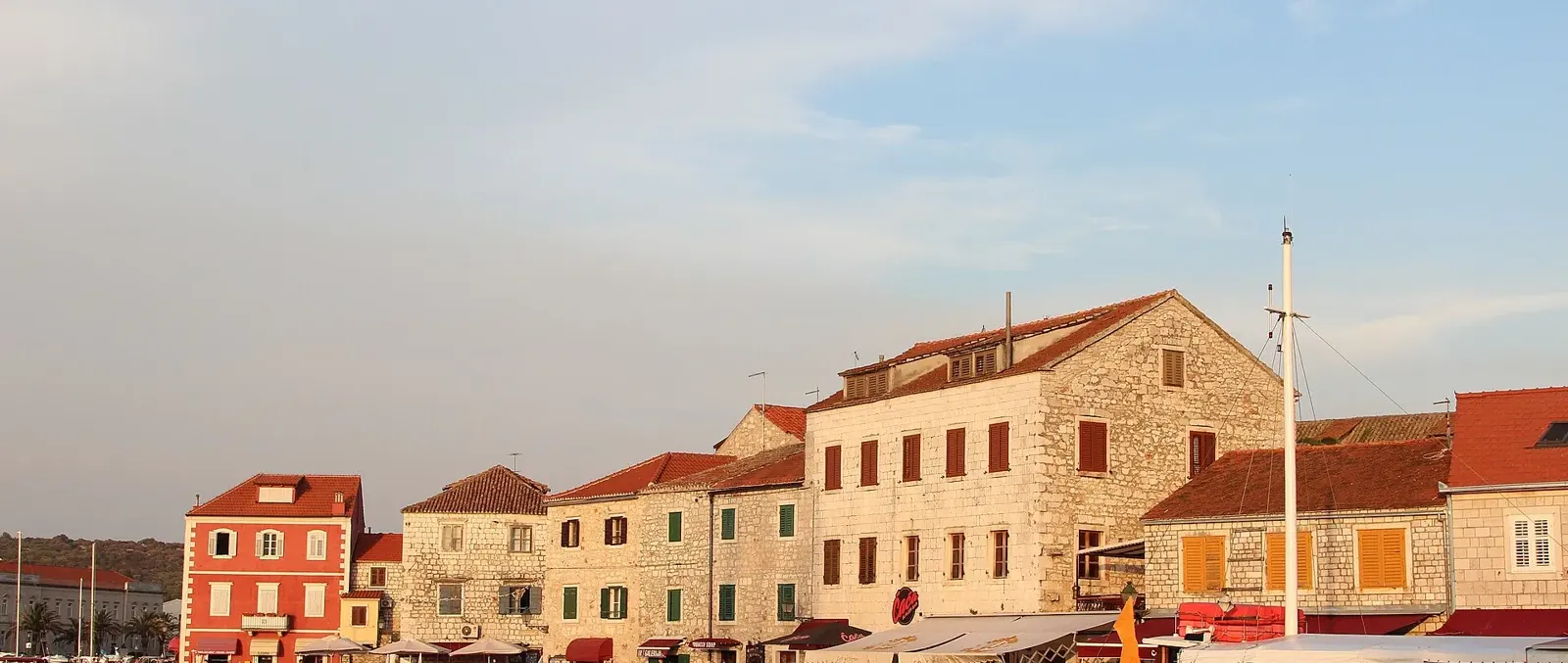
Photograph: Stari Grad harbour on the island of Hvar, by Fallaner (27 August 2017), Wikimedia Commons, CC BY-SA 4.0; resized and converted to WebP.