A Clyde destination with a remarkable architectural inheritance
The Isle of Bute offers a distinctive alternative to a holiday built entirely around moving from one Scottish anchorage to the next. Rothesay's harbour is part of the island's transport and commercial infrastructure as well as its visitor experience. For a yacht of between twelve and twenty-four metres, the most rewarding arrangement may be a suitably organised stay afloat combined with trips to the island's architectural and cultural attractions. Mount Stuart, the great house and gardens managed by Mount Stuart Trust, is a particularly compelling reason to allocate time ashore. Its current visitor information is also relevant to planning a winter trip: the 2026 general visitor season ended on 18 October, but private tours remain available during the winter by prior arrangement. A yacht owner should therefore distinguish between the opportunity to arrange a specific private visit and a general assumption that all the estate's attractions are open.
Considering Rothesay as a working harbour
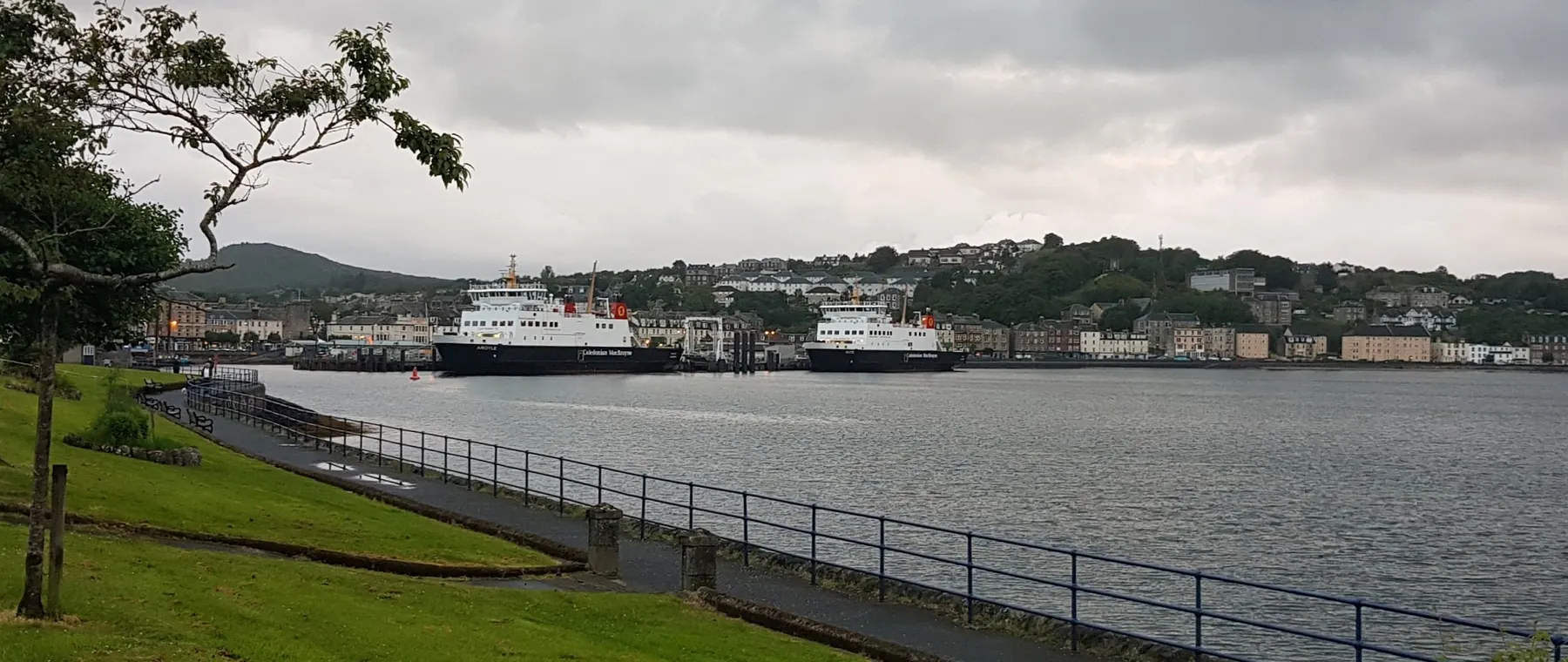
A yacht entering a harbour used by scheduled ferry services encounters a different operating environment from a secluded anchorage. The movement of commercial vessels can influence access, turning space, wash and the timing of arrival and departure. The photograph accompanying this feature shows the CalMac ferries Argyle and Bute at Rothesay. It illustrates a real aspect of the harbour environment, rather than identifying a particular berth for a visiting yacht. Before arranging a stay, the captain should give the relevant harbour operator the yacht's actual dimensions, including beam, draft and any projection affecting overall length. Request specific information about the visiting space, any approach restrictions and the arrangements for communicating on arrival. A berth described as appropriate for a visiting pleasure boat may have limitations that only become apparent when the operator knows the details of the yacht. Confirm the availability of essential services independently of the attractiveness of the location.
The attraction of architecture approached from the water
A town developed around a waterfront can be experienced in different sequences depending on how a visitor arrives. A yacht journey gives passengers an initial impression of the relationship between the shoreline, the buildings and the surrounding landscape. Walking ashore then reveals details not apparent from the water, including the scale of streets, the form of entrances and the way older buildings relate to the public areas around them. Rothesay's Victorian heritage is a useful starting point for such exploration. Rather than spending a short period ashore photographing the most prominent buildings, an owner can allow the group time to consider how the town served generations of people travelling between the mainland and the island. The continuing role of ferries is a visible reminder that the waterfront is not preserved solely as a historical scene. It remains a practical connection for people who live and work on Bute.
Mount Stuart: a major design experience in its own right
Mount Stuart Trust describes the mansion as an outstanding example of Scotland's Neo-Gothic architecture, situated within an estate extending to approximately 300 acres. The scale of the house and the collection of architectural details make a planned visit worthwhile for people concerned with decorative arts and interiors. A historical interior offers an opportunity to observe how materials, ornament and the organisation of rooms work together. What may appear elaborate when viewed as a single image can become more coherent when one follows the intended sequence through the spaces. For yacht owners considering an interior commission, this is an instructive experience even though the structural and operational requirements of a country house and a vessel are fundamentally different. The value is in observing spatial relationships, workmanship and the use of light, rather than attempting to reproduce architectural features without regard for their original context.
Arranging an out-of-season private tour
The trust's announcement following the close of its October 2026 visitor season states that private house tours are available between November and March, Monday to Friday by prior appointment. For a small group travelling together, the possibility of a prearranged visit is relevant because a yacht's guest programme can sometimes be adjusted to a mutually convenient date. Confirm the precise duration, meeting point, accessibility and cost of the tour with the estate before arranging transport. A private tour of the house is not necessarily a commitment that garden areas, temporary exhibitions, cafés or every part of the broader visitor facilities will be operating. Owners should be clear about which aspects of the estate they wish to experience, particularly if a member of the party is interested in a particular object or room. Travel outside a normal visiting season can offer a different atmosphere, but it also requires more deliberate arrangements than a general summer visit.
Understanding the estate beyond the main building
The trust identifies the gardens and grounds as important in their own right, with plant collections and views across the wider landscape. It also describes an arts programme, learning activities and work intended to contribute to the island's rural economy. These elements provide a more complete account of the organisation operating the estate than a description of the mansion alone. Historic properties require continuing decisions about conservation, access, maintenance and the appropriate use of resources. Guests interested in heritage patronage may find those responsibilities as significant as the experience of seeing the building. While general visitor access is closed for the winter at present, a future visit during the normal season could allow more time for the grounds and any announced cultural programme. Establish what is actually available rather than assuming that the trust's description of its year-round activities is a list of attractions open on the chosen date.
Planning a private journey across Bute
For guests arriving aboard a yacht, Mount Stuart is an excursion requiring separate arrangements for transport rather than a destination to be approached directly from the sea. A captain or concierge can establish the time required to meet the booked tour and arrange a suitable vehicle for the party. When a group includes people with different mobility requirements, confirm the actual accessibility of the route through the property with the estate. A flexible itinerary is useful if some visitors prefer a shorter excursion or wish to spend additional time in Rothesay. The yacht itself can remain a comfortable place to withdraw to between activities provided the berth and shore access suit its occupants. This is one of the practical advantages of cruising with private accommodation rather than planning every night around a different hotel. It also avoids overloading a short stay with attractions simply because they happen to be on the same island.
Provisioning and the conditions of a winter visit
Bute's connection with the mainland is part of its visitor infrastructure, but that should not be taken to mean that every marine supply or technical service can be obtained at short notice. The yacht's operating team should identify which requirements need to be met before arrival, and which arrangements can reasonably be made during a stay. For a quieter season, heating, ventilation and protected access to shore may be particularly important. Consider the effect of weather on planned walks and vehicle transfers, and allow an alternative activity if the group cannot comfortably undertake the original programme. The captain should consult current nautical information and the harbour authorities rather than decide on a passage because a tour is booked. A family whose most important activity is a visit to the house can preserve that experience by travelling to Bute by an appropriate land-and-ferry arrangement if yacht conditions are unsuitable.
A more considered form of Clyde cruising
An enjoyable Bute itinerary can combine the character of Rothesay's waterfront with a separately arranged architectural excursion. Guests who enjoy history can devote time to the town, while those concerned with art, design or collections may prefer a longer engagement with Mount Stuart. The house's ongoing conservation, educational and cultural activities provide further context for the significance of such a visit. The published winter arrangements establish a specific opportunity to request a private tour, not automatic admission. In preparation for a later summer cruise, consult the trust's updated seasonal programme and obtain confirmation of the intended yacht berth. The pleasure of this type of destination is that the experience ashore retains its own identity even if the route or length of the boat trip changes. Rather than treating Bute as a single short stop within a crowded Clyde itinerary, an owner can build a stay around the island's architecture and maritime life with enough time for both.
Sources and photograph
Source documentation: https://www.mountstuart.com/, https://www.mountstuart.com/whats-on/private-house-tours-november-march. Photograph: CalMac ferries Argyle and Bute, Rothesay harbour — Rob Farrow / Wikimedia Commons, CC BY-SA 2.0. Resized for web display under CC BY-SA 2.0.