A maritime destination at the southern end of Kintyre
Campbeltown has a distinctive place in a yacht itinerary around western Scotland. It is not merely a service stop on the way to the islands, but a town whose economic and cultural history is intimately connected with its position beside Campbeltown Loch. VisitScotland includes it in the Kintyre 66 itinerary, a land-based route through the peninsula that brings together industrial heritage, beaches, golfing landscapes and the small settlements of Argyll. For owners of twelve-to-twenty-four-metre yachts, the opportunity is to combine a stay afloat with selected experiences ashore without treating every point on a road itinerary as a possible yacht destination. The following suggestions are for planning a future visit, not a statement that a particular berth, distillery tour or golf tee time is available today. The skipper should arrange an appropriate berth before the guests make commitments dependent on the yacht's arrival.
Understanding the town's relationship with the loch
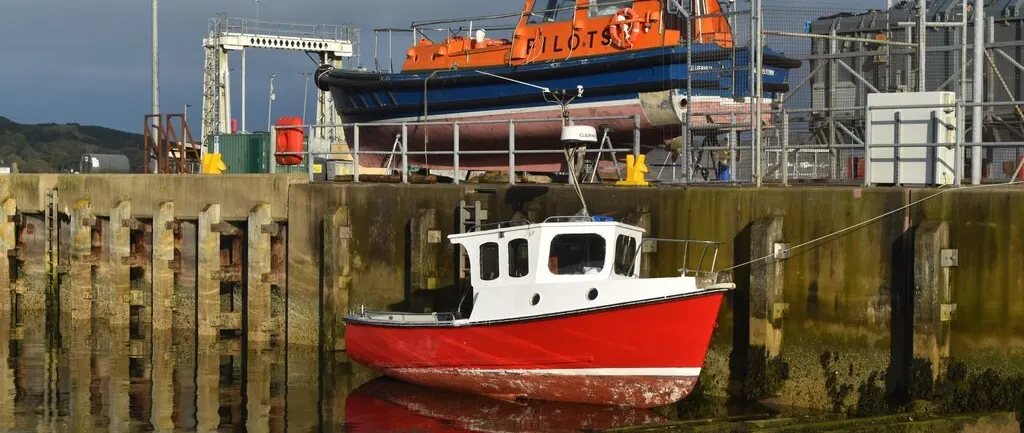
The waterfront illustrates the different activities that can coexist in a Scottish harbour. Fishing and recreational boating have different demands on space, access and shore facilities, and their presence is part of the character of the town. A yacht owner may be interested in the view from the accommodation, but the captain must also consider the actual requirements of securing a vessel and allowing other harbour users to continue their work. A wide expanse of sheltered-looking water does not mean that every mooring is suitable for a heavy motor yacht or a deep-draft sailing vessel. Before travelling, provide the harbour operator with the yacht's length overall, beam, draft, displacement and preferred dates. Establish how to make contact on arrival and whether any particular requirements apply to the intended berth. A photograph of the harbour provides useful geographical context but cannot establish current depth, tidal conditions or an available space.
Campbeltown Museum and a coastal painter's perspective
VisitScotland identifies Campbeltown Museum as a place to investigate the region's archaeology, natural history, art and social history. Among the objects mentioned in its itinerary are a Bronze Age jet necklace and a seascape by William McTaggart. The two works invite quite different approaches to the landscape. An archaeological object can illuminate material choices, exchange and practices that long preceded the modern town, while an artist's treatment of the sea can express something of the experience of living and working beside it. A yacht guest who has watched the changing light across the loch may find the latter particularly resonant. It is worth allocating enough time to consider the exhibits without trying to compress the museum into the interval between provisioning and a planned departure. Confirm current opening arrangements independently, particularly outside the summer season. The visitor guide identifies the collection but does not guarantee that each individual object will be on display on a chosen date.
Cinema as part of an evening ashore
Campbeltown Picture House is another unusual element of the town's visitor experience. The tourism authority dates the cinema's opening to 1913 and describes its continued role in showing contemporary films alongside other programming. For a yacht itinerary, the existence of such a venue offers a different sort of evening from the traditional routine of eating aboard or visiting a waterside restaurant. A film can become an independent activity for some guests while others spend time on the yacht or walk in the town. The history of the building itself is worth considering, particularly for those interested in the preservation of architectural interiors and the ways in which a cultural institution evolves while retaining its original purpose. Check the actual programme and book directly if a screening is an important part of the visit. A historic cinema's presence in a tourism itinerary should not be taken to imply a daily schedule throughout the year.
The industrial story behind Campbeltown's whisky
The Campbeltown Heritage Centre is identified by VisitScotland as a way to explore roughly three centuries of local history, including mining, fishing, farming and distilling. These activities help explain the relationship between the town and its wider hinterland. Whisky is often approached by collectors through individual releases, but a visit to the region where a spirit is produced can put those objects into a different context. It offers the opportunity to examine the skills, economic circumstances and physical infrastructure associated with manufacture. The tourism authority specifically identifies Springbank Distillery as offering tours. A prospective visitor should consult the distillery's own programme, age restrictions and booking conditions before making arrangements. The attraction should be considered independently from any expectation of being able to purchase a particular rare bottle. Neither the tourism itinerary nor an ordinary tour guarantees access to limited releases. Guests who are operating the yacht or driving ashore should organise their activities to avoid alcohol-related impairment.
Machrihanish and golf on the Atlantic side of Kintyre
A short land excursion can bring the guests to a setting quite distinct from Campbeltown Loch. VisitScotland describes Machrihanish Golf Club as having been founded in 1876 and subsequently redesigned by Old Tom Morris. Its links landscape is associated with open coastal views and exposed conditions. For golfers who enjoy courses where weather and terrain influence the character of play, a visit can become one of the central activities of a stay in Kintyre. Other members of a travelling group may prefer the coast or the town's museums. The owner should arrange transport and establish whether the desired tee time, equipment and any appropriate practice facilities are available. Weather can affect the enjoyment of a round, so a flexible programme with an alternative activity is sensible. There is no reason to move the yacht simply to bring the guests closer to a course when a comfortable, properly arranged transfer from the harbour can serve the purpose.
Davaar Island and the importance of local conditions
Davaar Island forms a particularly interesting feature of Campbeltown's coastal setting. The official visitor itinerary identifies a tidal causeway, caves and a painting of the Crucifixion among its attractions. The causeway is an example of why a coastal walk cannot be planned in the same way as an ordinary inland visit. Access depends on the tides and actual conditions, and the ability to reach a place does not establish that the return will be equally straightforward. Visitors should obtain current local advice and assess the complete excursion before setting out. Those who wish to examine the caves should also take account of uneven surfaces, weather and their own physical capabilities. A view of the island from a yacht may be a perfectly satisfactory alternative when a landing or walk cannot be undertaken safely. The local wildlife is another reason to visit the area carefully, without disturbing animals or assuming that any individual species will be seen.
Preparing the yacht for a stay in western Scotland
A comfortable stay afloat requires consideration of weather protection, heating, ventilation and practical storage for wet clothing. These can influence guests' enjoyment as much as the formal accommodation plan. The crew should establish what provisions and technical supplies can be obtained locally and which are better brought from an earlier port. It is equally important to distinguish an essential service, such as a suitable electrical connection required for normal vessel operation, from optional conveniences. Do not assume that a facility advertised for recreational boats necessarily supplies every required connection or service for a much larger vessel. Passage planning should use current charts, notices and forecasts, with the captain retaining discretion to delay or alter movements. This is especially important where guests' land-based arrangements involve fixed dates. Flexible booking terms and an independently accessible transfer option can help prevent pressure to undertake a voyage in unsuitable conditions.
Designing a stay around the interests of the family
A rewarding visit might place the museum, cinema and heritage centre within a town day, with a separate outing to Machrihanish or another part of the peninsula. A distillery tour can be included for interested adults, while the coastal landscape provides a different experience for people less concerned with the history of whisky. Davaar should be approached as a distinct excursion with its own access considerations, not a casual addition to a busy schedule. The arrangement need not follow a rigid sequence. The town's facilities and the yacht's private accommodation can complement one another, giving guests freedom to participate in different activities at different times. The best use of Campbeltown in a western Scottish itinerary is to allow its working waterfront, cultural institutions and surrounding landscape to be appreciated without making the boat's movement the central activity of every day. The accompanying licensed harbour photograph records local boats and a slipway, rather than suggesting that a berth suitable for a particular luxury yacht is available.
Sources and photograph
Source documentation: https://www.visitscotland.com/planning/travel-in-scotland/driving-road-trips/kintyre-66. Photograph: Boats and slipway, Campbeltown harbour — David Martin / Wikimedia Commons, CC BY-SA 2.0. Resized for web display under CC BY-SA 2.0.