A bespoke Phantom whose design language comes from the Solent
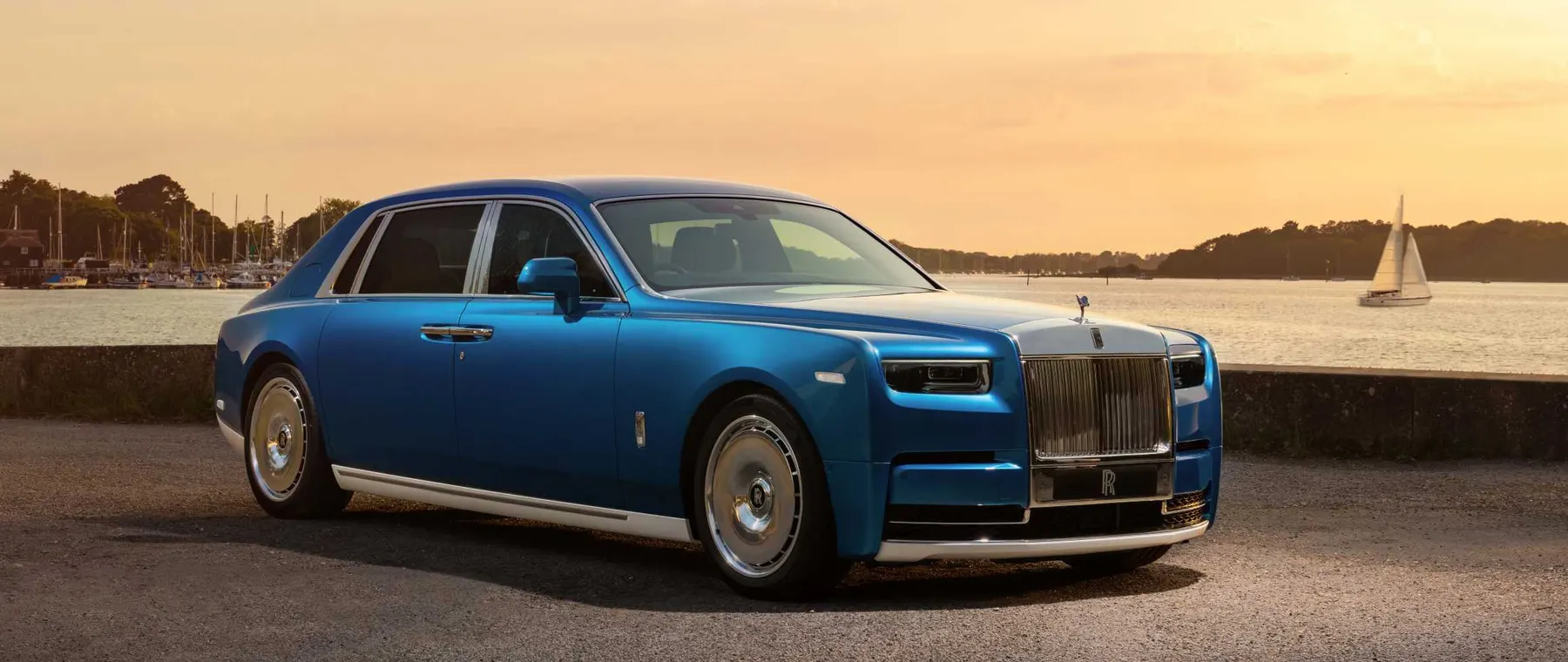
Rolls-Royce Phantom Regatta is an unusually direct meeting of British coachbuilding and the design traditions of sailing yachts. Created as a one-of-one Phantom Extended, the commission takes its cues from the Solent, Cowes and Chichester Harbour, translating marine colours, decking patterns and tidal movement into a motor car whose details are deliberately intended to reward close inspection.
The marque unveiled the car in connection with the 2026 Goodwood Festival of Speed, with its own headquarters and Goodwood Estate situated close to the south coast that inspired the commission. It is not a general-production special edition, and prospective clients should distinguish a singular commissioned vehicle from an open catalogue of options. What makes the project valuable to study is how specific personal and geographical references can shape an entire design.
For a yacht owner, the interest goes beyond matching a car to a vessel’s paint scheme. The commission demonstrates how a story can travel through every material choice without relying on an obvious anchor motif or nautical badge. Its most convincing details are subtle enough to be noticed only by someone taking time to sit, look and touch.
Regatta Blue and the line between hull and sea
The exterior combines a deep Regatta Blue upper finish with an English White lower treatment, a separation that evokes the meeting of a yacht’s painted hull and the water. It is a considered use of two-tone paint rather than a literal reproduction of any particular racing yacht. The effect depends on proportions and the continuity of the colour break along Phantom Extended’s large body.
Fully polished disc wheels add another marine suggestion: the gleam of metal deck fittings and racing-yacht winches. That association is especially fitting because a working sailing yacht often gains its beauty from highly functional hardware. On the Phantom, the polished surfaces serve a primarily visual purpose, yet the reference to precision engineering remains readable.
The decision to use an established Phantom silhouette also shows why bespoke design need not mean redesigning everything. A singular commission can be made distinctive by the discipline of its palette and the quality of smaller interventions. For owners contemplating a coordinated tender, helicopter interior or waterside car collection, that restraint is arguably the more useful lesson.
A cabin informed by sailing cloth and the depth of water
Inside, the colour contrast reverses between zones, with Navy Blue leather in the front and Grace White in the rear, suggesting deep water beneath a yacht’s light sails. Rolls-Royce says the stitching, piping and steering wheel combine the two shades, while embroidered monograms introduce turquoise accents. These details are carefully integrated rather than used as independent decorations competing for attention.
Wood selection supplies a second layer of meaning. Piano Milori is paired with open-pore Royal Walnut, offering a dialogue between a polished interior surface and the warmer, more tactile character of satin-finished timber. On board a well-designed yacht, varying the sheen and grain of wood can help distinguish formal rooms from intimate spaces without altering the fundamental material palette.
The rear picnic tables are perhaps the most persuasive yacht-inspired element. Rather than imitating teak with a printed pattern, the craftspeople constructed a miniature decking composition from matched strips of Royal Walnut and narrow inlays of Black Bolivar. The arrangement recalls planking and caulking, but the materials and refined finish belong unmistakably to the car’s bespoke cabin.
The craft behind the decking and the painted sea
Rolls-Royce says each picnic tabletop uses matched pieces cut from the same section of wood, then carefully arranged so the grain remains visually coherent. The manufacturer places the work on the tables at approximately 120 hours, a figure also reported in the Goodwood event’s coverage. The significance is not the number alone but the decision to devote detailed handwork to a surface that occupants might overlook on a short journey.
The Phantom’s Gallery, extending across the dashboard, carries an artwork named Watercolour. The composition depicts the energy and movement of coastal water using paint applied to an open-pore wooden substrate. According to the brand, its in-house artist developed a blending method through extensive tests before committing to the finished work. It is a subtle reminder that experimental making often precedes seemingly effortless luxury.
There is a useful parallel with specialist yacht craftsmanship. A beautifully executed veneered panel or marquetry inlay can require rigorous selection, sequencing and finishing before installation. The result may appear natural and calm, but its simplicity is often manufactured through painstaking decisions. Phantom Regatta exposes that hidden process and makes it part of the commission’s identity.
A starlit interpretation of moving tidal water
The Starlight Headliner adds a surprising interpretation of the coastal theme. Instead of arranging fibre-optic points in a conventional celestial pattern, the craftspeople developed a composition inspired by tidal currents moving around the Isle of Wight. Rolls-Royce specifies 1,307 individual light points; the exact layout turns the cabin ceiling into a restrained map of motion rather than a scientific chart.
Illuminated doors complement the headliner, while a more private set of references is engraved into the adjustable air vents. Their coordinates identify Goodwood House and the Home of Rolls-Royce, and are revealed only when the vents are moved. This is the kind of detail that would be easy to remove from a cost-led design review but can give a one-of-one commission its enduring emotional value.
Yacht designers are familiar with the power of similarly discreet personal references: a contour borrowed from a family sailing ground, an abstracted seabed pattern or a piece of artwork linked to a home port. The strongest result does not need to explain every symbol to every visitor. It is sufficient that the owner recognises the story while other guests enjoy the composition as design.
What Phantom Regatta says about modern private commissions
High-end automotive customisation is sometimes reduced to unusual colours and initials, yet this commission is built around a more coherent brief. The exterior finish, timber techniques, painted artwork, illuminated ceiling and engraved coordinates point back to the same British coastal setting. Because they reinforce one another, the details form a design language rather than a catalogue of unrelated expensive options.
The project also illustrates an important boundary between inspiration and imitation. A Phantom is not a yacht and should not try to behave like one. The car’s purpose, proportions, seating and materials differ radically from those of a vessel, so its marine influences must be translated through automotive construction. That act of translation is what makes the commission distinctive.
For owners considering yacht interiors, private aircraft, residential commissions or bespoke cars, Phantom Regatta provides a useful question to ask at the start of a project: what place, memory or experience should the finished object quietly recall? A design team can then establish material, colour and technical rules that make each detail part of one story. The result can feel more personal than something merely rare.
Phantom Regatta ultimately belongs to a longstanding tradition of objects commissioned for one individual, where the best workmanship is inseparable from the patron’s brief. Its South Coast inspiration is immediately accessible, but the deeper achievement is that no single decorative feature has to carry the idea alone. In that respect, it offers as much to those who love yachts and design as to enthusiasts of the Rolls-Royce marque.
Sources and official photography
The primary account and specification of this commission come from Rolls-Royce Motor Cars’ 2 July 2026 official release, with the Goodwood Festival of Speed’s independent event coverage used to cross-check the unveiling and specialist table-making detail. Hero image: Rolls-Royce Phantom Regatta, official Rolls-Royce Motor Cars PressClub photograph, image P90648606, reproduced for editorial reporting with source attribution.