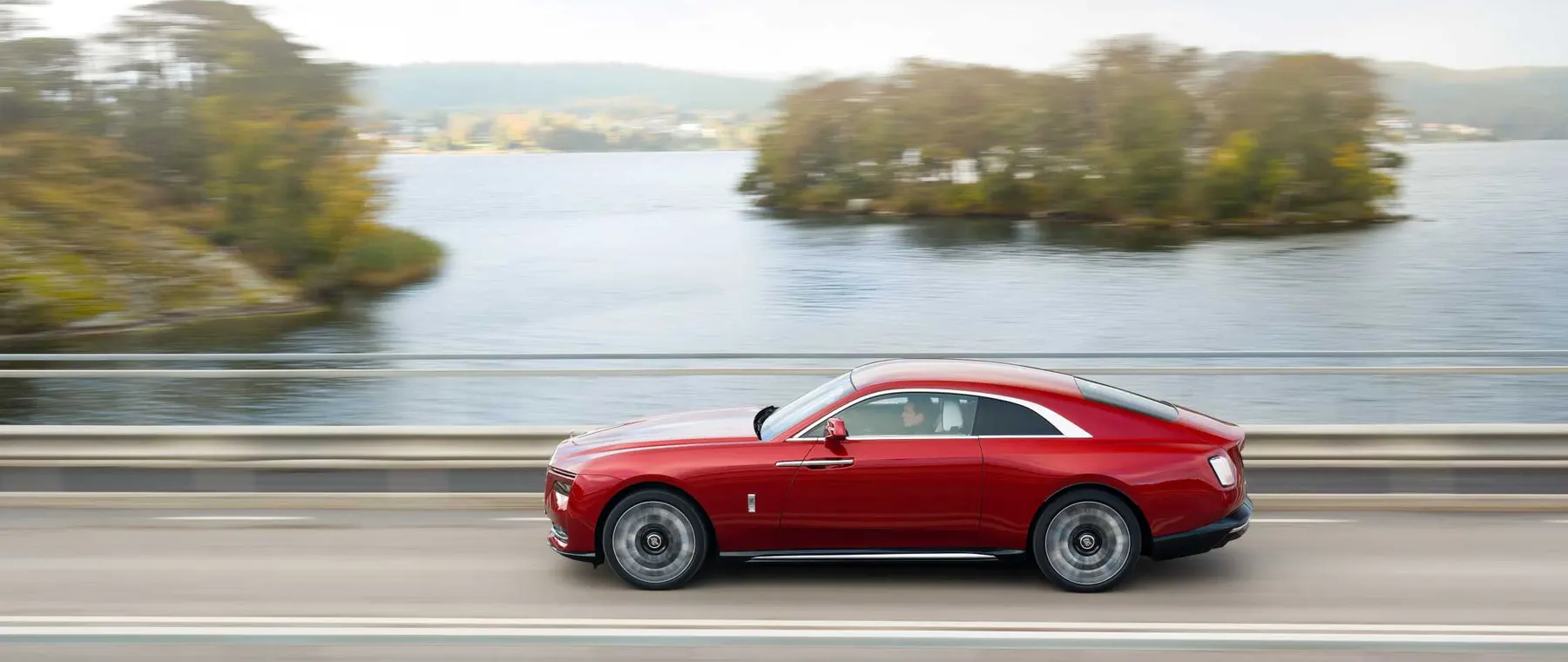
An electric grand tourer meets Stockholm
Rolls-Royce has taken the Spectre Series II onto European public roads in Stockholm, using the Swedish capital as the setting for a new presentation of its electric grand touring coupé. The 23 October 2026 announcement is a public-road debut rather than the unveiling of an entirely new model: Spectre Series II was introduced in June. That distinction matters to buyers following the pace of changes in a car whose appeal lies as much in refinement and personal commissioning as in headline performance.
The Stockholm appearance also connects the model to a broader regional strategy. Rolls-Royce points to a recently opened showroom in Copenhagen and to Northern Europe's appetite for design-led luxury. A city known for architecture and considered contemporary interiors is a plausible setting for a car whose new features lean heavily into materials, colour treatments and client choice. The setting is brand positioning, however, not evidence of a change in European sales or demand.
Range, torque and charging: what the figures say
The manufacturer's headline engineering claim is an increase in range of up to 18 per cent, with a stated maximum of 628 kilometres or 390 miles under the WLTP test procedure. That is the upper end of its declared range rather than a fixed distance every owner should expect between charging stops. Temperature, vehicle configuration, speed, tyres, payload and charging habits affect what an individual car achieves, particularly on long continental journeys.
Rolls-Royce also reports charging times reduced by up to 14 per cent. The press statement does not turn that percentage into a universal stop duration, so it would be misleading to promise a particular journey time without knowing the charging station, battery state and test conditions. For an owner planning trips between city residences, country properties and marinas, the sensible question is how the car performs across the complete intended route rather than how one maximum figure looks in isolation.
Maximum torque rises to 1,015 Nm for Spectre Series II. Rolls-Royce gives the Black Badge version up to 1,100 Nm in its Spirited Mode, making clear that the two figures apply to different variants and operating conditions. Torque is only one component of how a heavy grand tourer feels on the road; suspension calibration, response, acoustic refinement and driver expectations determine whether the result is genuinely effortless.
Electric propulsion has particular appeal in a luxury coupé because its quiet running suits unhurried arrival and departure. That does not remove the need to consider access to reliable charging at private homes, hotels and destinations. Owners moving between several countries should confirm practical charging infrastructure and vehicle specifications for their market before using a promotional driving range as the basis of a schedule.
Bespoke colour and tactile craftsmanship
In its Stockholm announcement, the company highlights expanded Bespoke possibilities, including a Gradient Two-Tone exterior finish and two interior techniques now available for Spectre: Duality Twill and Placed Perforation. These additions make the refresh as much about the experience of specifying a personal car as about the change to electric hardware. A commission can be treated as an exercise in visual coherence, with exterior tone, upholstery, trim and details developed around an owner's preferences.
The longer June launch release also describes a new clock treatment inspired by aviation instruments and a revised forged 23-inch wheel design. Such touches may seem minor beside an electric drivetrain, yet they are encountered repeatedly during ownership. They matter most when they form a consistent design language and continue to feel appropriate after the immediate novelty of delivery has passed.
There is a useful difference between personalisation and spectacle. A highly visible finish might give one commission its distinctive identity; another owner may prefer quieter colours and materials that echo a residence, art collection or favourite destination. Rolls-Royce's stated philosophy is to expand the latitude available to clients, but a responsible commission still requires clear decisions about how a car will be used, cared for and eventually maintained.
The Scandinavian context
Stockholm supplies an architectural backdrop that allows the Spectre's restrained fastback profile and surfacing to be judged away from a motor-show stand. The company has not presented the drive as an independently controlled comparison test. Its announcement is a manufacturer account of public-road activity, accompanied by technical and specification claims that prospective owners should compare with the final documents for the exact car they order.
The Copenhagen showroom opening is an additional piece of the story, because high-value Bespoke purchases involve a continuing relationship with a retailer and aftersales specialists. For a buyer whose life includes multiple homes or frequent travel, the quality of that relationship may matter as much as the initial specification meeting. Service arrangements, warranty terms and charging guidance are more useful questions than asking whether a launch photograph captured the most flattering angle.
Where Spectre Series II fits in a private fleet
The familiar comparison for a yacht owner is not between a motor car and a vessel's engineering. It is between two forms of privately commissioned transport in which space, comfort, provenance, materials and the character of arrival take priority. The idea of a silent, tailored coupé waiting at a waterfront residence is attractive, but whether it suits a particular owner depends on the practicalities of local roads, parking, charging and onward journeys.
Rolls-Royce's published WLTP figures for Spectre Series II include an electric range of 582 to 628 kilometres, depending on version and test configuration. The Black Badge Series II is listed at 578 to 628 kilometres. These are official laboratory-derived figures, not verified real-world results from the Stockholm presentation, and the company expressly warns that actual performance varies. Making that distinction keeps the car's technical progress in perspective.
The main news from Stockholm is therefore straightforward. Spectre Series II is now being shown on European public roads with a stronger engineering specification and broader possibilities for individual design, while Rolls-Royce develops its Northern European presence. For prospective clients, the next useful step is to examine the final configuration and ownership arrangements rather than regard a presentation drive as a substitute for personal evaluation.