A car that brings history back into view
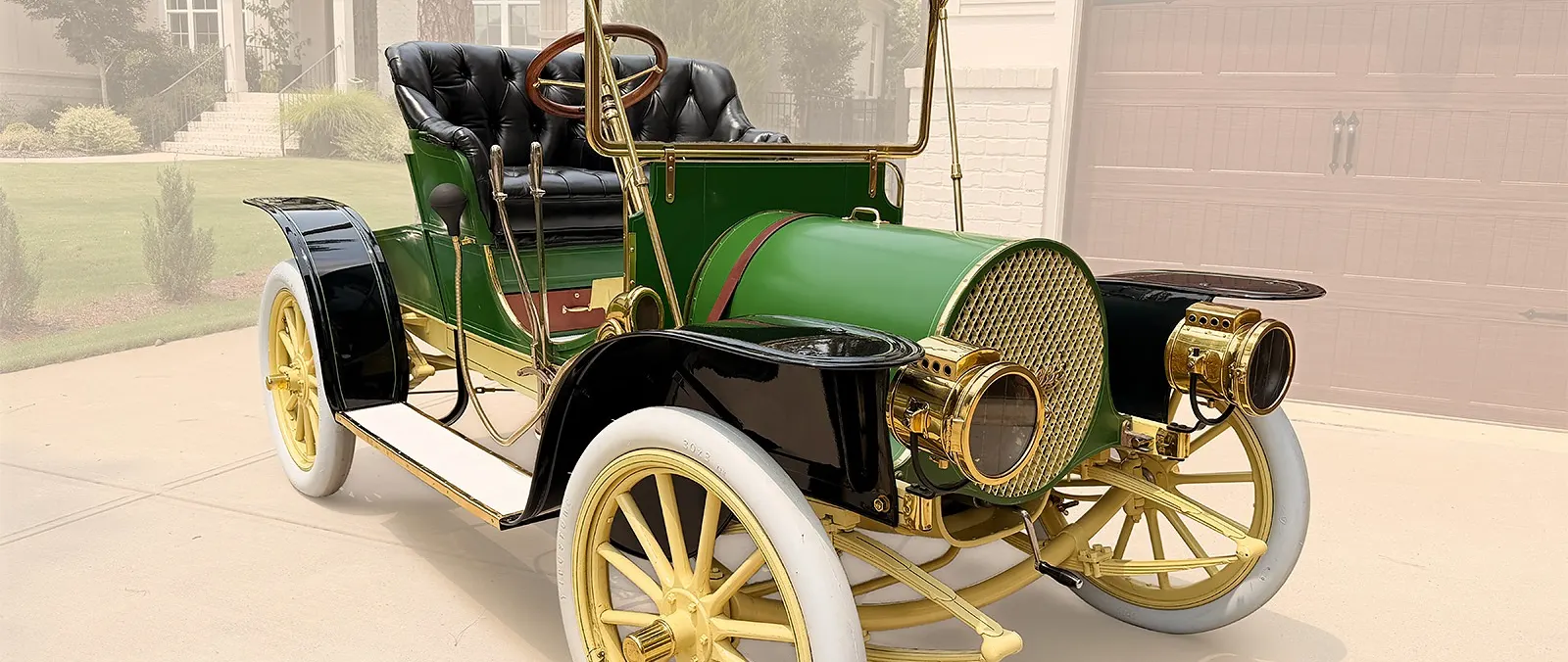
The green bodywork, exposed brass fittings and pale wheels of the 1907 Franklin restored by Mumford Restoration make it a particularly evocative object. Its appearance belongs to an era when motoring was only beginning to develop the familiar conventions of the modern car. In November 2026, the North Carolina restoration business chose the automobile as the central feature of its third annual Antique Craftsman Showcase, scheduled for 14 November at its Raleigh workshop. Its 12 November announcement presented the project as an example of the different kinds of knowledge needed to preserve objects with personal or historical value.
The company's event material identifies the owner as Michael Ortiz and explains that the collaboration began with a pair of deteriorated headlights before expanding into a project lasting years. That account is especially interesting because it illustrates how restoration can develop gradually out of the condition of an individual object and the intentions of its owner. The public announcement scheduled an unveiling and discussion at the showcase; it does not establish the attendance or the outcome of that event, which has now passed.
There is a broader lesson for enthusiasts who enjoy classic cars without necessarily aspiring to collect vehicles of exceptional rarity or value. A carefully preserved object can provide a more personal connection with the past than one acquired solely because of a fashionable market valuation. The craftsmanship required to keep it in service or preserve its appearance is itself part of the story.
Why the early motor car is a different collecting experience
A vehicle from the first decade of the twentieth century presents a rather different proposition from a classic sports car of the postwar years. The driver is not surrounded by familiar modern equipment, and the arrangement of the car's components can reflect practices that changed considerably as automobile production developed. Even an enthusiast who is familiar with more recent vehicles may find that the visual and mechanical character of an early motor car requires a different kind of appreciation.
The Franklin photograph is particularly effective as a reminder of the relationship between automobile design and the trades that preceded it. The shape of the seating, the exposed hardware and the treatment of the body are as interesting as the propulsion equipment. A historian of industrial design may look at the vehicle differently from a person who is primarily interested in mechanical performance. Neither perspective requires every visible detail of the car to be treated merely as decoration.
Mumford's announcement does not publish a complete inventory of the work undertaken, distinguish original parts from replacements or provide a technical condition report. Consequently, the appearance of the finished vehicle cannot establish the originality or mechanical condition of every component. A collector evaluating such a car should seek documentation and appropriate specialist inspection.
The attraction of a restoration project often includes learning about the object as well as obtaining a finished result. A vehicle connected to the beginning of mass motoring can prompt questions about the methods used to manufacture and maintain it, and about the people who first used similar cars.
Preservation is not simply making an object look new
A restoration decision often begins with the question of what should be preserved. The owner of an old vehicle or piece of furniture may attach value to signs of use that would be unwanted on a newly manufactured item. A later modification might be part of the object's documented history, even if it differs from its configuration when first made. There is a distinction between repairing an object for continuing use, conserving existing material and returning it to a reconstructed earlier appearance.
The appropriate approach depends on the intentions of the owner, the history of the object and its condition. It may also depend on the evidence available concerning the appropriate materials and construction. An old photograph or a surviving example can sometimes help resolve a question, but the circumstances in which a reference is used need to be considered.
Those considerations are relevant to a classic car and equally applicable to a family chair, an inherited chest or a lamp retained from an earlier home. They help explain why the Raleigh showcase was designed around conversations with specialists and work at different stages, rather than a display exclusively devoted to finished pieces. An object that has been disassembled for assessment may offer a particularly useful view of how it was originally constructed.
For an owner commissioning restoration, it is useful to agree at the beginning on the desired outcome and the treatment of original material. A contractor's proposal should be understandable enough that changes arising during the work can be assessed in relation to the original objective.
The trades behind the visible result
The published programme for the 14 November showcase brought together a broad range of traditional restoration disciplines, including woodworking, preservation carpentry, caning, upholstery, metalwork and the restoration of period lighting and musical equipment. It also listed crafts concerned with books, artworks and other specialist objects.
There is a practical reason for bringing different trades together. A piece of antique furniture may involve joinery, textiles, metal fittings and a surface finish, each of which can have different conservation requirements. A classic car may similarly require the attention of people who understand particular materials and assemblies. Identifying the appropriate specialist is sometimes as important as selecting the business that coordinates the work.
Skills used on historic objects are not necessarily identical to those needed to produce their modern equivalents. The task may involve working around fragile existing material, understanding a construction technique that is no longer common in mass production or finding an unobtrusive means of supporting an original component. The work can also require patience and judgement when the appropriate next step is not immediately apparent.
The company invited representatives of the American College of the Building Arts and USModernist to discuss traditional craftsmanship and architectural preservation. That planned combination of speakers reflects the connection between the preservation of individual objects and the survival of knowledge that can be used on future projects. It is a theme likely to resonate with anyone who has struggled to find a service business capable of working on an unusual inherited item.
A practical approach to commissioning work
An owner contemplating an antique restoration does not have to begin with a rare motor car. A much smaller project can be an engaging way of learning what a craft involves. It might concern the seat of an old chair, a damaged cabinet or an item of decorative metalwork. The decision to restore it should reflect both its condition and its usefulness or significance to the person who owns it.
A prospective client should distinguish a preliminary estimate from the eventual cost of work. Some problems may not become apparent until an object has been carefully examined, and it is helpful to establish how the business will communicate additional findings. Photographs of the condition before work and records of changes can also have value, particularly if the item is later transferred to another owner.
Where originality is an important consideration, the documentation accompanying an object after restoration can be as significant as the visual outcome. It should identify what work was undertaken and, where possible, what original material was retained. A purchaser of a restored car should additionally obtain an appropriate assessment of its safe operation rather than assume that cosmetic condition establishes mechanical suitability.
Mumford Restoration, founded in 1982, describes its work as extending to families, museums and historical societies. The November release does not disclose the cost or valuation of the Franklin project. Its relevance to readers is not a suggestion that they should expect a similar restoration at a particular price, but an illustration of the kind of specialist collaboration that can be involved.
Passing knowledge to the next generation
The announcement also drew attention to Historic Restoration Apprenticeship, an independent Raleigh nonprofit concerned with practical training and mentorship. Preserving an object is only one part of the preservation of craftsmanship. Someone must acquire enough practical experience to understand why traditional methods were used, when they remain appropriate and how they can be applied responsibly to a specific item.
That process is particularly important at a time when many ordinary products can be replaced more readily than they can be repaired. For some objects, replacement may indeed be the sensible choice. For others, it may overlook the historical or personal significance that made them worth retaining in the first place. The owner of a cherished object can contribute to the continuing use of specialist knowledge by commissioning responsible work when the condition of the object justifies it.
There is a connection here with the experience of maintaining a good yacht. Skilled work that remains largely invisible after completion may determine whether an owner can continue enjoying a vessel or an object for years. Those judgements seldom attract the attention given to a dramatic new design, but they can matter just as much to the person responsible for its care.
The Franklin featured in Mumford's November programme is a particularly striking example of the continuing appeal of well-preserved craftsmanship. Its story provides a reason to consider the people, materials and decisions behind the appearance of a finished restoration, whether the object in question is an early automobile or a much more modest family heirloom.
Sources and lead image
Source documentation: https://www.prnewswire.com/news-releases/restored-1907-franklin-headlines-raleigh-showcase-celebrating-craftsmanship-and-the-history-worth-saving-302937924.html, https://mumfordrestoration.com/mumford-restoration-craftsman-showcase-2026. Lead image: The restored green 1907 Franklin automobile — Mumford Restoration, official photograph of the 1907 Franklin supplied with its 12 November 2026 press announcement.. Official issuer-supplied press photograph, reproduced for editorial coverage of the specific announcement and resized for web display.