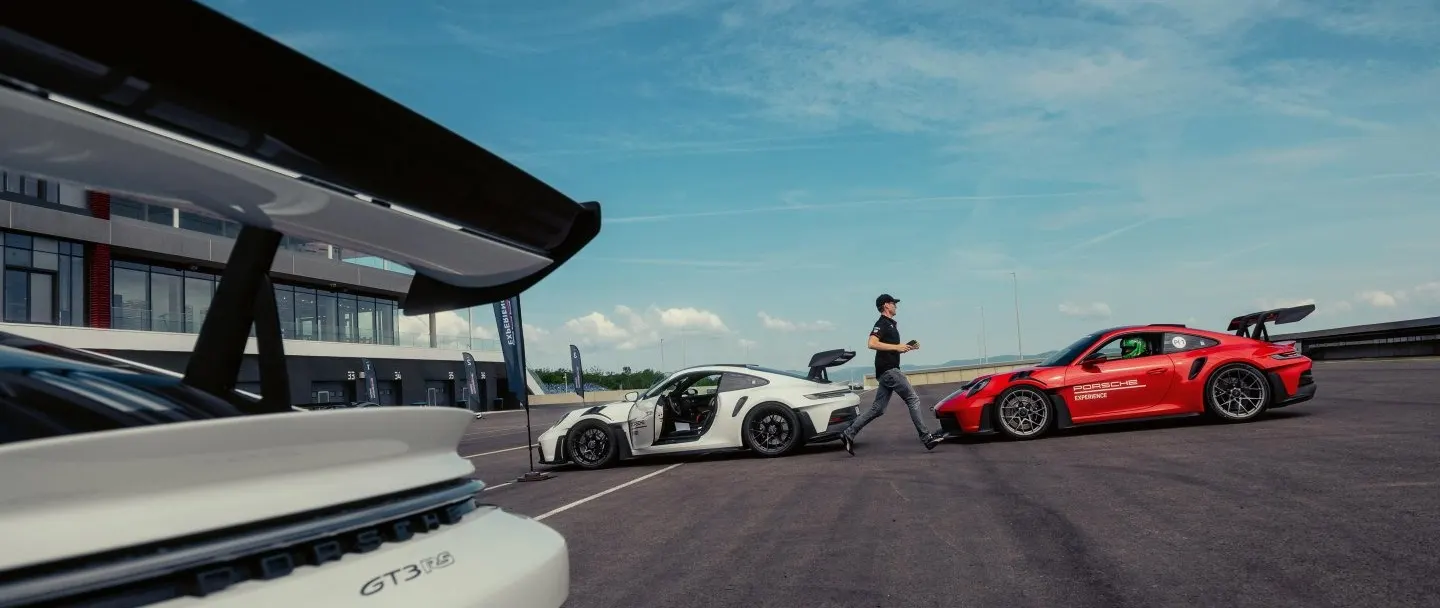
The Porsche Track Experience has offered a compelling example of how high-performance car ownership can extend beyond buying the vehicle. In a feature published on 17 November 2026, Porsche follows American entrepreneur Bruce Dereschuk as he brings a 911 GT3 RS to the Hungaroring outside Budapest for a personalised course with former professional racing driver Jörg Bergmeister. The setting is a demanding circuit, and the story centres on learning rather than a competition result. Over a programme incorporating lead-and-follow laps, observation, telemetry and discussion, Dereschuk explores what separates his driving from the technique of an experienced racing professional. For collectors who own sophisticated sports cars but want to understand them more deeply, that can be a meaningful luxury experience.
A racetrack is a different environment from the road
The Hungaroring is known internationally as a Formula One venue, but its appeal to a private owner goes beyond that association. The circuit has a dense succession of corners and relatively few opportunities to relax between them, making it particularly revealing of line choice and consistency. Porsche describes it as approximately 4.3 kilometres long. Its technical layout can reward patience and planning more than dramatic late braking or aggressive acceleration. Driving there requires a formally organised session, appropriate safety precautions and competent instruction. Nothing about a professional track course should be mistaken for permission to practise high-speed techniques on public roads. An important part of the experience is working in an environment specifically equipped for performance driving.
The first lap did not go as planned
Porsche's account begins with Dereschuk running onto the grass after the rear of his car stepped out on an early lap. The situation ended without the collision that might have occurred had the car continued into the barrier. The incident is relevant because it challenges the assumption that familiarity with expensive, powerful vehicles automatically makes someone an expert on a new circuit. Cold tyres, unfamiliar surfaces and an unexpected driving line can all affect what a driver experiences. It should not be romanticised as an exciting rite of passage. The lesson is that a course can expose mistakes in a controlled setting where an instructor is able to explain them. Good private instruction is valuable precisely because it supports judgment and restraint rather than encouraging unnecessary risk.
Why an owner seeks individual instruction
Dereschuk, a California-based entrepreneur, had attended previous Porsche Track Experience programmes in Europe. Porsche reports that his earlier visits included Barcelona, Monza, the Red Bull Ring and the Nürburgring. On this occasion he wanted individual guidance from Bergmeister, who has competed extensively in Porsche machinery and contributed to development work on the modern GT3 RS. A one-to-one arrangement can give the instructor the time to examine a driver's habits, answer specific questions and adjust the schedule to match genuine learning needs. That degree of personal attention is often what differentiates an exceptional private experience from a standard group event. It does not guarantee a particular performance result, but it allows the process to be tailored rather than rushed.
The structure of the Master GT3 RS experience
The Porsche article describes a two-and-a-half-day Master GT3 RS course with theoretical sessions and two days of driving. Participants work through lead-and-follow exercises, in which the instructor drives ahead, and shadow-driving sessions, when the instructor follows to assess technique. The private arrangement featured in the story had additional flexibility. This distinction matters when considering future bookings: a personalised lesson with a particular professional may not be available in every standard course. The correct source for current prices, dates, qualifications and instructor assignments is Porsche's official Track Experience programme. A magazine account of one participant's journey should not be treated as a current booking offer or a guaranteed package.
The value of a professional reference lap
An experienced instructor can demonstrate something that is difficult to understand from a video alone: how consistently a car should be positioned and balanced through each turn. Porsche describes Bergmeister explaining that a fast entry to one corner may damage the exit from the next. At a circuit where turns arrive in rapid succession, the overall sequence can matter more than the impression of speed at one point. For a participant, the lesson is partly psychological. The urge to improve a lap time can lead to extra inputs and hurried decisions that undermine consistency. A professional reference lap provides a clearer goal: smooth, repeatable use of the vehicle within safe limits, rather than an isolated heroic manoeuvre.
Telemetry turns impressions into evidence
The course used data from a VBox recorder mounted in the car, with Bergmeister comparing his information to Dereschuk's. Porsche lists examples of data examined, including throttle position, brake pressure, steering angle, lateral acceleration, gear selection and speed. Telemetry provides a different kind of feedback from a driver's memory. A participant may believe a corner was executed well because the entry felt fast, while the recorded information shows a slower exit or unnecessary correction. Data should still be interpreted by someone who understands the vehicle, circuit and conditions. A single graph does not explain everything, and comparing laps recorded under different circumstances can be misleading. The advantage is a disciplined conversation based on observable evidence.
Personal coaching makes the technology useful
Modern performance cars can record an extraordinary quantity of information. The challenge is deciding which measurements matter to a particular driver at a particular stage of learning. Porsche's feature notes that Bergmeister focused on selected signals rather than overwhelming his student with every available sensor. That approach is relevant to anyone learning a demanding skill, whether handling a car, sailing competitively or operating a complex yacht. Advanced instruments are only helpful when the user knows how to respond to them. A knowledgeable coach can identify the most important habit to work on and assess progress in context. The value lies in understanding, not in creating an impressive collection of data that nobody uses.
The modern GT3 RS changes the conversation
The 911 GT3 RS is designed for focused performance, and its chassis and aerodynamic systems offer significant adjustability. Porsche's article describes steering-wheel controls for parameters including damping, differential behaviour, traction and stability management and active aerodynamics. The prospect of adjusting such systems can be exciting to an enthusiast. It also demands respect for the interaction between vehicle settings, tyre condition and driver technique. Changing several things at once can make it difficult to understand why the car behaves differently. In a supervised programme, professional guidance provides a framework for evaluating changes methodically. An owner should never assume that settings used by a racing driver on a particular circuit are automatically appropriate for other conditions.
A masterclass should improve judgment
The story includes moments of technical guidance on braking and the relationship between different corners, but the broader lesson is not a set of instructions for readers to copy. Techniques that are appropriate during a supervised session may be unsafe elsewhere, and their implementation depends on experience and equipment. The worthwhile outcome of an advanced course is an owner who can recognise limitations, communicate with specialists and make calmer decisions. A skilled driver should be able to assess when conditions or concentration have deteriorated and when to stop. Luxury performance experiences are at their best when they combine excitement with a clear culture of safety and personal responsibility.
The appeal of driving alongside a racing professional
Jörg Bergmeister brings the credibility of a long competition career to the programme. Porsche notes his achievements in endurance racing and his work as a test driver on the current GT3 RS. That background can make small observations more persuasive: a participant can watch how an experienced driver manages the same vehicle on the same circuit rather than rely on abstract advice. The relationship also creates opportunities for questions about car development, racing preparation and the difference between consistency and outright speed. An individual course should not be described as training that turns a customer into a professional racer. It offers a chance to learn from experience, not to inherit an instructor's career or judgment.
Travelling for an experience rather than a possession
For many affluent car owners, the additional purchase of another vehicle may be less satisfying than learning to use a prized one more effectively. A carefully organised track trip can combine a destination, a professional relationship and a memorable technical challenge. The Hungaroring's proximity to Budapest also makes it possible to build a wider cultural itinerary around the course, although transport, schedules and accommodation must be arranged independently. The event itself is physically and mentally demanding, and travellers should allow adequate time for rest. Owners who cross borders with vehicles need to investigate transport, registration, insurance and circuit requirements in advance. An impressive car does not remove those obligations.
A connection with yachting expertise
The comparison with luxury yacht ownership is revealing. A yacht may contain advanced navigation, stabilisation and propulsion systems that remain poorly understood by an owner who rarely participates in their operation. A good captain or instructor can explain capabilities and limitations in a structured way. The same applies to sports cars with adjustable aerodynamic and chassis systems. In both cases, equipment should support informed decisions, not replace them. The best learning experiences involve preparation, clear roles and supervised practice rather than an invitation to take unnecessary risks. A yacht owner who enjoys understanding machinery may therefore appreciate a professional driving course as a parallel exercise in craftsmanship, control and respect for complex engineering.
Questions to ask before arranging private coaching
An owner considering a future Porsche Track Experience should start with the current organiser's programme, not an assumption based on a single magazine story. Confirm the specific circuit, dates, available vehicle, required qualifications, instructor arrangement and insurance terms. Ask what protective equipment is provided, how safety briefings are handled and whether the course is appropriate for the participant's present level. The availability of personalised instruction with a named racing driver may be limited, and published prices or inclusions can change. Those details should be documented before travel and transport are booked. It is also worth establishing the procedures for severe weather and mechanical problems. A well-organised premium experience is one in which practical preparation receives as much care as the glamorous aspects.
A more lasting reward than a fast lap
The Hungaroring feature illustrates the satisfaction of gaining real knowledge about a machine that is already extraordinary. Dereschuk's sessions with Bergmeister were not presented as a race victory, but as a process of comparing experience, confronting mistakes and improving technique. The data, instruction and demanding circuit gave that process a structure. For an owner who values performance as well as collecting, such a programme can provide a deeper relationship with the vehicle and a memorable encounter with someone who understands it exceptionally well. The story's lasting relevance is the idea that expertise is itself a luxury. Time spent learning carefully may become more valuable than one additional accessory or a faster lap recorded without understanding how it was achieved.
Sources and image credits
Reporting based on Porsche Newsroom original 17 November 2026 Jörg Bergmeister / Bruce Dereschuk Track Experience report.
Lead photograph: Porsche 911 GT3 RS on the Hungaroring during official Porsche Track Experience, original 2026 Porsche AG press photograph. Porsche AG original Hungaroring private Track Experience press photograph depicting Bruce Dereschuk and Jörg Bergmeister, shared by Porsche Newsroom for editorial reporting Original official image source.