At Lake Starnberg in Bavaria, architect and entrepreneur Thomas Schlereth has created a remarkable home for the machines, objects and stories that fascinate him. The Banzai Legacy Lab is part collector-car space, part social setting and part expression of the relationship between design, movement and personal memory. In a Porsche Newsroom feature published on 12 November 2026, Schlereth describes a collection containing a Porsche 962 C with Le Mans history, a rare 911 GT2 from the 993 generation and a 1974 Carrera RSR 3.0, alongside skateboards and a Porsche 928 transformed into an artwork by designer Paula Scher. For private collectors, the space suggests an alternative to a conventional garage: an environment where objects continue to be used, discussed and interpreted.
Why a collector chose to build a theatre
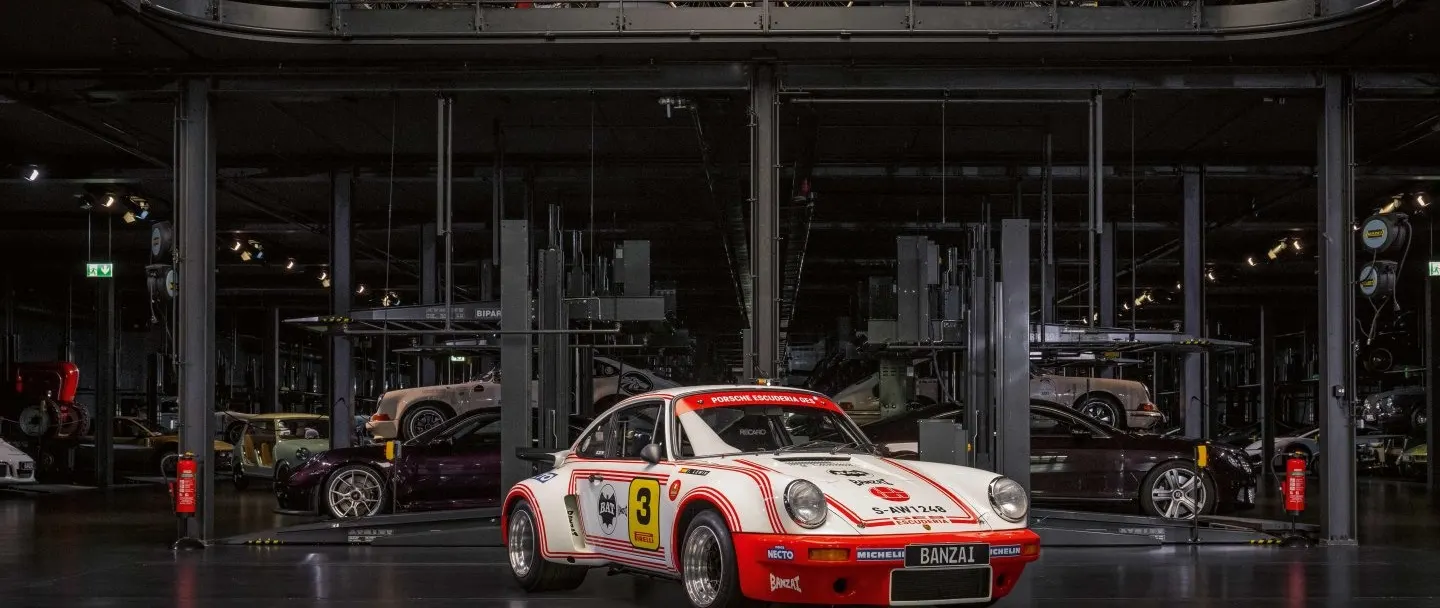
Schlereth approached the building as an architect rather than simply as an owner who needed parking spaces. He describes a room without windows, with intentional lighting and a mirrored wall that changes the perceived depth of the interior. The cars are treated as the principal actors in a theatre. That decision is visually dramatic, but it also alters how visitors experience the collection. Rather than competing with the landscape outside, each object becomes a point of attention. A successful private collection space often depends on this sort of restraint. Good architecture directs the eye and creates room for stories to be told. The larger lesson is not that every collector should hide a garage behind mirrored walls, but that the spatial design ought to support the owner's particular relationship with the objects.
A home for machines with histories
Schlereth does not seek a perfectly complete collection arranged only by year, badge or estimated market value. The Porsche story emphasises that he is drawn to cars with a sense of history, including evidence of use and less familiar chapters in their lives. This approach challenges one of the assumptions common in high-value collecting: that the most desirable item is always the least used. For a race car, competition damage, period modifications and documented repairs may contribute to the object's history, even when they complicate restoration. Such details need careful evaluation rather than romanticising every scratch. A discerning owner should distinguish genuine provenance from poorly documented claims, and conservation decisions should be made with specialist advice.
The 962 C and an unfinished Le Mans story
Among the vehicles is Porsche 962 C chassis 962-143, acquired by Schlereth in England in 2015. Porsche's feature says the car competed in the 1989 24 Hours of Le Mans with the Schuppan Takefuji customer team. Jean Alesi, Will Hoy and Dominic Dobson shared driving duties, but the car retired after 69 laps. Its record does not include a fairytale victory, and that is part of what makes the story interesting. The owner has sought connections with people who were there, including Dobson, with whom he later returned to Le Mans. A historical car can become a medium for encounters that are otherwise difficult to arrange. Such experiences add a dimension that no auction estimate can capture, although the underlying facts should always be supported by records.
A 993-generation GT2 connects people
The story of Schlereth's bright yellow 911 GT2 from the 993 generation illustrates how collecting can lead to unexpected relationships. Porsche reports that its original owner was racing driver Jochen Rohr. Schlereth bought the car during an online auction in 2023, despite having seen it only in photographs. He subsequently contacted Rohr, beginning a friendship built around the vehicle's history. The car has since accompanied them to Porsche Rennsport Reunion in the United States. The episode demonstrates why provenance can matter for more than authenticity or resale. A previous owner may help explain how a car was used and modified, what challenges were overcome and why it holds personal significance. A story should not substitute for a proper mechanical inspection, but it can enrich the ownership experience.
A long search for a 1974 Carrera RSR
Schlereth spent more than a decade looking for a 911 Carrera RSR 3.0 from 1974. He eventually found an opportunity when several seized cars were offered at auction near Le Mans. According to Porsche's account, the car had been associated with racing driver Julio Gargallo, and Schlereth travelled to Madrid to meet the driver's widow. That search is an example of collecting based on a historical narrative, not simply on checking a model from a list. A rare racing Porsche requires serious attention to identity, original parts, ownership records and the legality of any transaction. The news feature describes a particular personal journey; it should not be read as guidance to purchase unusual auction lots without due diligence.
A 928 becomes a work of graphic art
The collection includes a Porsche 928 transformed by American artist and designer Paula Scher. A dark-bodied car was reworked with blocks of colour and a map of the United States drawn across its surfaces, according to Porsche's feature. Scher's background in graphic design and her association with cartography bring a different visual language to the object. The finished vehicle has been displayed at Munich's Pinakothek der Moderne, with an exhibition period extended beyond its original plan. It demonstrates how a familiar manufactured form can become a distinctive artistic medium. For collectors of both cars and contemporary art, the work raises intriguing questions about authorship, conservation and the balance between functioning machine and museum object.
The relationship between use and preservation
Schlereth's approach emphasises driving rather than merely guarding vehicles behind ropes. That choice has obvious attractions, but it brings practical responsibilities. Historic racing cars require mechanical specialists, safe operating procedures, consumables suited to their design and appropriately selected events. A vehicle that is occasionally driven may demand more attention than one maintained solely for display. Owners must also consider the effect of any modern alterations on historical authenticity. There is no universal answer to whether a rare car should be driven or conserved without use. The decision depends on the individual vehicle, its significance and its condition. The Lab's philosophy makes that tension visible rather than pretending that collections can be both untouched and actively used without compromise.
Banzai skateboards connect another generation
The facility's name comes from Banzai, a skateboard brand that Schlereth admired during his youth. Porsche says the original business ceased operations in the late 1970s and that Schlereth revived it in 2020. Skateboards, surfboards and sports cars may seem unrelated in price and scale, but they share an interest in movement, balance and design. For a collector, connecting these objects can create a more personal and less predictable environment than a room organised entirely around high-value automobiles. The skateboards also introduce a different set of visitors and conversations. A private collection can gain depth when it acknowledges the wider culture that influenced its owner instead of presenting every item as an isolated investment.
Ten seats, one light
The Banzai Legacy Lab is also a setting for intimate gatherings. Porsche describes a concept called Ten seats, one light, with an invitation-only dinner for ten people around a shared table. That format is closer to a private salon than a conventional automotive exhibition. The cars provide a reason for people to meet, but the smaller group is designed to encourage uninterrupted conversation. In an era of very large luxury events, such a setting has its own appeal. Exclusivity here is not merely a matter of access; it also concerns time, attention and the quality of an exchange. The invitation-only nature is important, however. The Lab should not be described as a public restaurant or museum with regular admission arrangements.
Designing the environment around stories
Collectors sometimes underestimate the work involved in presenting a collection well. A private space must address climate control, security, ventilation, fire precautions and the practical movement of valuable vehicles, but it also needs a sense of purpose. The Lab's lighting and mirrored wall are visible examples of presentation choices, not substitutes for the less glamorous engineering requirements. Museums and private owners alike should consider how people will circulate, how historical documents are displayed and whether objects can be examined without damage. Digital labels and archival materials may help, but they should not overwhelm the collection. The strongest environments allow someone to leave with a memorable story rather than merely a list of specifications.
Lessons for a yacht or art collection
The underlying philosophy has relevance beyond historic cars. A private yacht, a collection of paintings or a set of rare watches can also be experienced as an accumulation of stories. A yacht's design drawings, voyage records and restoration photographs may be as fascinating to future owners as its polished finish. Art collectors face similar questions about documentation, conservation and the significance of an object's previous life. The Banzai Lab shows how thoughtful presentation can enrich ownership without requiring a conventional museum. It should not imply that every private collection must become a public cultural institution. The owner's preferences, privacy and resources determine what is appropriate, while accurate records protect the integrity of the objects over time.
Reflection and the experience of movement
Schlereth also describes a personal interest in yoga, Buddhism and the Taoist principle of wu wei, often interpreted as acting without unnecessary force. Porsche's feature links that outlook with his wish to create a space that can serve several purposes without imposing one rigid function. This is his personal philosophy, not a general claim that high-speed driving or collecting produces spiritual insight. Nevertheless, the contrast is suggestive. A racing car demands intense concentration, while a quiet conversation or a moment looking at a piece of art involves a very different pace. Bringing those experiences together can help an owner appreciate the human context of a collection rather than focusing entirely on performance or price.
A private collection that refuses to stand still
Banzai Legacy Lab is a contemporary example of collector culture becoming more personal, interdisciplinary and experiential. Historic Porsche racing cars, a modern art car, skateboards and small dinners share a setting shaped by an architect who cares about the stories behind objects. The emphasis on active use creates maintenance and conservation challenges, but it also gives the collection a continuing purpose. Visitors should not assume open public access, and anyone considering a comparable facility should start with practical preservation and security requirements. For enthusiasts of rare machines and fine design, the more lasting idea is that ownership can be about learning, encounters and memory. A well-loved object can remain a source of new experiences long after the moment it was acquired.
Sources and image credits
Reporting based on Porsche Newsroom original feature on Thomas Schlereth and Banzai Legacy Lab, 12 November 2026.
Lead photograph: Historic Porsche 911 Carrera RSR 3.0 at Thomas Schlereth Banzai Legacy Lab, original 2026 Porsche AG official photograph. Porsche AG official Banzai Legacy Lab photograph, source image made available on Porsche Newsroom for journalistic editorial reporting; copyright Porsche AG and credited photographer Original official image source.