A river town whose maritime connections extend inland
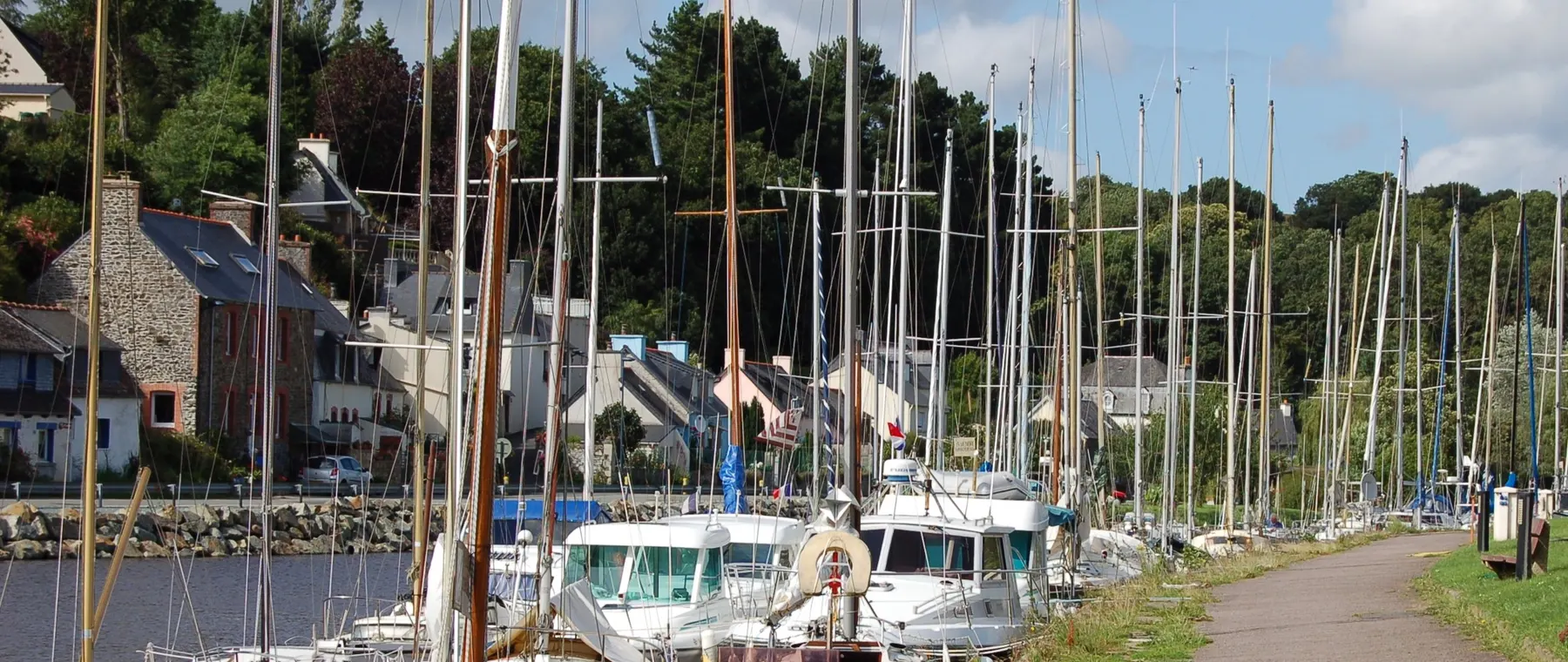
Pontrieux lies on the Trieux in northern Brittany, where the relationship between a navigable river and the land around it shaped a distinctive settlement. Brittany Tourism describes the small town of character through its two squares, tall houses, bridges, viaduct, marina and remarkable collection of washing places. It was once an important link between the surrounding inland communities and seaborne commerce. For a family using a substantial recreational yacht as its accommodation, the town's appeal does not necessarily require navigating the private vessel to Pontrieux. Its actual dimensions, the available depth, restrictions and characteristics of the river must be assessed independently. A confirmed coastal berth and a land-based excursion may be the more appropriate arrangement. The licensed photograph accompanying this feature depicts the port of Pontrieux, providing context for the maritime setting rather than a statement of current capacity.
The bridge that gave a settlement its name
According to Brittany Tourism, the inhabitants of an earlier settlement farther upstream established a new village after the destruction of the fortress of Châteaulin-sur-Trieux in the early fifteenth century. The new houses occupied the banks and a bridge connected them, contributing to the name Pont-Trieux. This is a particularly interesting way to approach the history of a small maritime community. It was not simply proximity to the sea that determined its development, but the relationship between land routes, a river crossing and the ability to move goods.
A walk between the banks offers visitors a different perspective from that obtained in the narrow waterways of a coastal marina. The crossing can be considered as an essential element of the town's historical geography, connecting households, businesses and routes through the surrounding countryside. The modern visitor is free to cross the river as a pedestrian where access permits, but an earlier traveller's options would have depended considerably on the available infrastructure. The historical significance of the bridge is therefore best understood within the network of routes that once converged on Pontrieux.
The port of Guingamp and a changing network of trade
The regional tourism authority describes Pontrieux as a trading site and a port serving Guingamp. Before the development of newer transport connections, goods moving through the region were brought together at locations where land and water transport could be linked. The construction of the Lézardrieux bridge in 1840 changed that relationship, since certain travellers no longer needed to pass through Pontrieux.
The subsequent arrival of the railway towards the end of the nineteenth century brought different opportunities, including industries associated with wood, cardboard and linen production. Their goods could be transported to European destinations. The tourist board records the presence of British and Danish schooners as well as boats associated with voyages to the Icelandic fishing grounds. These connections place the apparently quiet inland town in a much wider maritime context.
For yacht owners interested in historical trade, this is a particularly worthwhile subject. The operation of a port depends on what is produced, transported and consumed around it, and those relationships can change even when the physical river remains in the same place. A small harbour today may have played a greater role within an earlier transport system than its current appearance suggests.
Two squares and the character of the tall houses
The town's unusual layout includes two triangular squares linked by a succession of tall houses. Brittany Tourism highlights surviving timber-framed and stone buildings dating from the sixteenth to the nineteenth centuries. A walk between the squares offers the opportunity to appreciate how a relatively small area can contain an interesting range of architectural forms.
The visitor may wish to examine the proportions of the individual houses, the treatment of their street fronts and the relationship between their routes of access and the river. Among the distinctive buildings identified by the tourist board is a sixteenth-century house nicknamed the Tour Eiffel. The name is not an indication that it was designed by the nineteenth-century engineer, but a local reference associated with its appearance. An eighteenth-century granite fountain offers a further point of interest.
A family with an interest in design can approach these features through a relaxed walking route. They do not need to enter privately occupied premises to appreciate their contribution to the townscape. A guided visit may help establish the history of particular buildings, and current access conditions should be checked before including any interior in the itinerary.
Fifty washing places and a different perspective on private life
The fifty washing places along the Trieux are perhaps Pontrieux's most distinctive attraction. The tourism authority explains that many belonged to individual households, allowing families to carry out their washing without depending entirely on shared public facilities. The structures provide an unusually tangible connection with the everyday life of those households.
Their significance extends beyond their attractive floral presentation. Where a water supply was readily accessible from the riverbank, domestic activities could be organized around it. The shape of the buildings and the provision of an appropriate working surface reflected the requirements of washing by hand. For today's visitor, who may rarely need to consider the infrastructure behind a laundry service either at home or aboard a yacht, these small constructions reveal a different organization of domestic work.
Brittany Tourism recommends discovering the washing places by electric excursion boat. This provides a view of the riverbank that is difficult to reproduce from the surrounding streets. The actual service dates, operating conditions and boarding arrangements should be confirmed before travelling.
An illuminated route rather than a conventional museum visit
The town's lighting trail offers another way of seeing Pontrieux. The visitor authority describes illuminated washing places and the possibility of both daytime and evening boat excursions. Lighting can draw attention to elements of a building or waterfront that are easily overlooked during ordinary daylight. It also creates a different relationship between a structure and its reflections in the river.
For guests interested in photography, interior design or architecture, the experience can be planned around observation rather than the collection of familiar images. An evening walk can be combined with an earlier visit to the older streets, allowing the group to compare the same spaces under different conditions.
Current operating times should be established with the relevant visitor service. The tourism guide describes the available experiences in general terms, not a guarantee that an evening excursion operates throughout the year. A family should also consider the actual footwear, route and transport arrangements needed after dark. Where a boat excursion is unavailable, the shore-based lighting trail may remain an enjoyable alternative, subject to the conditions and access arrangements on the chosen date.
The countryside and the route towards Paimpol
Brittany Tourism identifies the historical railway excursion between Pontrieux and Paimpol among the area's visitor experiences. Its interest lies in the opportunity to examine the Trieux estuary and its hinterland from another form of transport. The relationship between the alignment of a railway, the river and the surrounding terrain can be as instructive as the machinery of the train itself.
A yacht owner who wishes to include a railway excursion should establish the current programme directly. Heritage services may operate seasonally and differ from ordinary regional rail timetables. A published description of a steam-train route does not amount to confirmation that a specific departure is available. The journey can form a separate element of a northern Brittany holiday, with an independently arranged return to the yacht's confirmed base. Where the historical service is unavailable, a conventional land excursion may still provide a satisfying opportunity to appreciate the landscape.
Discovering local crafts
The regional guide also identifies a craftsmen's circuit. An owner with an interest in decorative art may find it particularly rewarding to investigate how individual producers work rather than begin with a predetermined list of items to purchase. Visits to workshops can reveal the significance of material choice, the sequence of operations and the role of skills acquired over time.
A small object intended for use aboard needs to be considered within the actual environment of the yacht. Fragile pieces may require secure installation, and a material that performs well in a stable home interior may have different maintenance requirements afloat. Ask the maker about care requirements and provenance. Not every studio welcomes casual visitors throughout the year, so verify opening arrangements or arrange an appointment where necessary. The attraction of a craft-based outing lies partly in the opportunity to meet the people working in the town and appreciate their individual approaches.
A day inland with a distinctly maritime character
Pontrieux's value for yacht families is the opportunity to discover the inland extent of a historical maritime economy. An itinerary can combine a walk between the squares, the washing places and an independent excursion along the river valley, with time for a meal or a visit to an appropriate workshop. The private yacht's movements must remain subject to current official navigation information and confirmed operating arrangements. Where the river is unsuitable for the particular vessel, there is no disadvantage in basing the boat at an established coastal facility and travelling ashore. The experience of the historic port, its domestic buildings and wider transport connections remains the same. Allow the day to have a purpose distinct from merely increasing the distance covered aboard.
Sources and photograph
Source documentation: https://www.brittanytourism.com/destinations/the-10-destinations/saint-brieuc-bay-paimpol-les-caps/pontrieux/. Photograph: Port of Pontrieux — Colsu / Wikimedia Commons, CC BY-SA 4.0. Resized for web display under CC BY-SA 4.0.