An extraordinary table object at the centre of a new exhibition
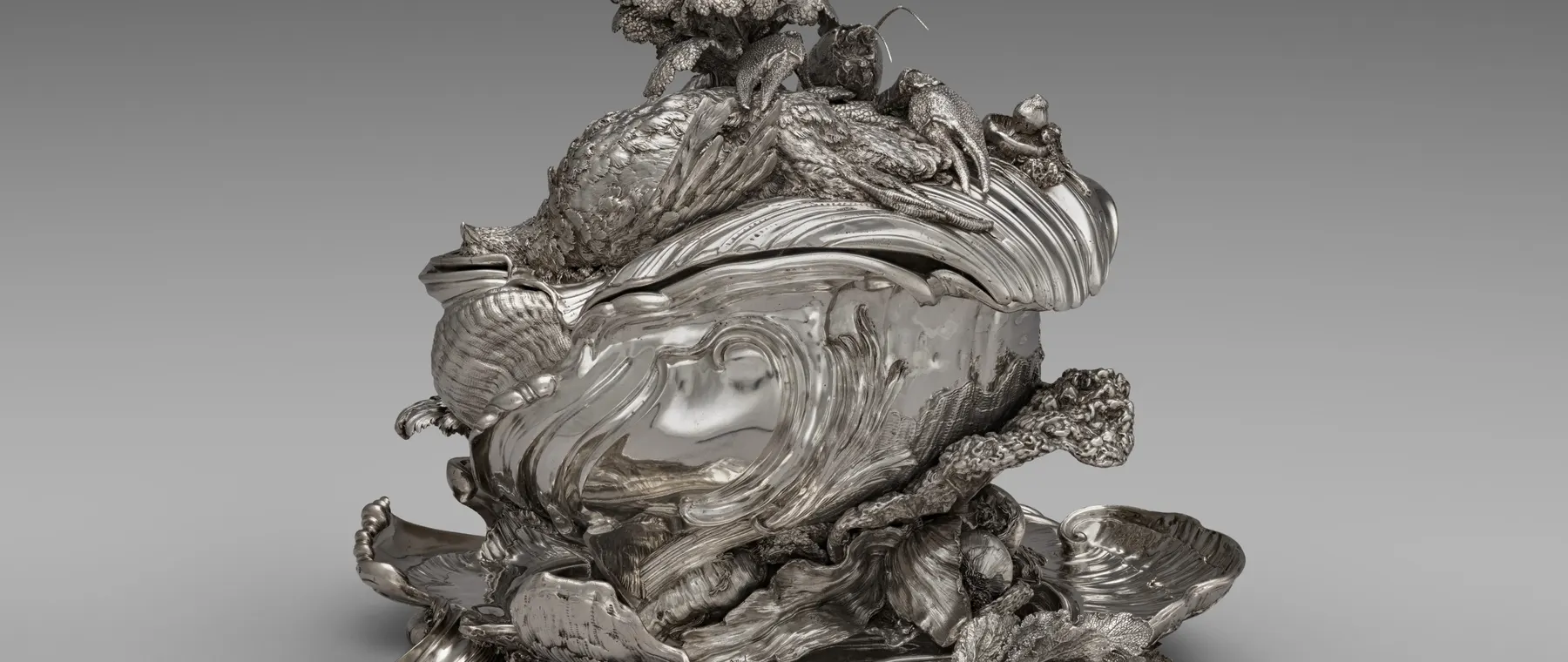
The Cleveland Museum of Art is presenting Juste-Aurèle Meissonnier: Rococo Goldsmith in Focus from 25 October 2026 to 14 March 2027. Organised around surviving examples of the artist's work in precious metals, the exhibition brings one of the museum's most celebrated silver objects into conversation with a recently acquired gold box made for the queen of Spain and loans from several other institutions. The principal silver piece, a covered tureen on a stand dating to 1735–38, was commissioned for Evelyn Pierrepont, the second Duke of Kingston-upon-Hull. It is a remarkable demonstration of the ability of eighteenth-century craftsmen to transform the practical requirements of serving a meal into an elaborate work of design.
For owners interested in hospitality aboard a luxury yacht, the exhibition offers an opportunity to consider the history of the objects placed at the centre of a table. The materials and scale of the Kingston tureen are quite unlike the practical tableware required during ordinary cruising. Nevertheless, examining why its design was developed in this particular way can provide valuable ideas about the role of dining objects in the creation of an individual experience.
A tureen that presents its contents through sculpture
The museum records the construction of the tureen in silver by Meissonnier in collaboration with Pierre-François Bonnestrenne and Henry Adnet. Its irregular shell-like form is surrounded by sculptural representations of vegetables and animals, including a bird and a langoustine, that refer to the ingredients of the dish for which the vessel was intended.
Such forms suggest an approach to the presentation of food quite different from choosing a neutral serving dish whose physical identity is distinct from its contents. The imagined ingredients become part of the exterior of the vessel. Guests can encounter them visually before the dish itself is served. The covered form creates an element of anticipation and helps the object occupy a place of particular attention during the arrangement of a table.
The natural forms should be studied for their own variety as well as their narrative significance. A reflective metallic surface introduces an additional visual element because the surrounding light changes the appearance of the modelled forms. The way individual objects are arranged in relation to the whole is particularly rewarding to examine from several different positions.
The transformation of a functional object
The tureen and stand together measure approximately 36.9 by 38.4 by 31.8 centimetres, according to the museum's published record, and the museum describes a weight close to twenty kilograms. This is a considerable concentration of silver for an object intended to form part of dining service. Its weight and dimensions demonstrate that an object can fulfil an identifiable practical purpose while at the same time far exceed the physical requirements of that purpose.
That distinction is relevant to a contemporary yacht owner choosing tableware. A vessel with an unusually elaborate shape may be visually compelling but difficult to carry, clean or store. A large object may also leave insufficient space for other elements of the table arrangement. The requirements of guests and the responsibilities of the crew need to be considered together. The reception of guests aboard a yacht does not require the reproduction of eighteenth-century ceremonial service.
The historical example instead encourages the owner to consider where an unusual serving piece or specially commissioned design might make a meaningful contribution to the meal. It may be more effective to introduce a particular piece on selected occasions than to require every object used during a voyage to have the same decorative complexity.
Asymmetry as a deliberate design choice
Meissonnier is closely identified with the development of the Rococo style. The Kingston tureen demonstrates a departure from the strict symmetry associated with many formal vessels. Areas of the object appear to develop out of the materials and forms around them, rather than fitting within a readily identifiable repeated outline.
There is an important difference between an object without a coherent organisation and an object whose organisation is not primarily based on symmetry. The designer of the latter must still establish the relationships between forms and address the physical requirements of the object. On a tureen those requirements include the relationship of its lid and body and the support provided by the stand. The visual impression of movement does not remove the need for the object to function as an assembly.
The historical object therefore offers a useful illustration of how a designer can preserve an identifiable practical purpose while introducing a highly personal visual language. A client working with a contemporary metalworker or ceramicist might find inspiration in that principle without requesting a literal reproduction of the historic piece. The particular commission can reflect the maker's own experience and the character of the intended dining environment.
The collaboration between designer and specialist makers
The museum explicitly identifies three people in the authorship and manufacture of the tureen. Meissonnier is particularly interesting because he associated himself with architectural design as well as goldsmithing. His contribution was not limited to working in a single type of material. For an owner commissioning a bespoke interior or a collection of specially made objects, his career illustrates the relationship between the generation of a visual idea and the capacity of other people to realise that idea in a suitable material.
A good commission benefits from clarity about those responsibilities. A designer can establish the overall character and intended dimensions of an object, while the metalsmith may identify practical implications associated with construction, material thickness and finishing. Decisions made during the initial conversation can substantially affect the resulting object. The client should also establish how changes to the concept will be agreed as examples or prototypes are prepared.
The exhibition's grouping of surviving works is particularly valuable because it permits the visitor to examine an approach to design through more than one object. The recent gold-box acquisition introduces a quite different scale and purpose from that of the large silver vessel. Those distinctions provide another way to understand the artist's breadth.
Provenance and an object that travelled across borders
The museum's collection documentation records an extensive history of ownership following the commission for the Duke of Kingston. The piece later passed through collections associated with Russia and continental Europe, the dealer Jacques Seligmann and the American collector John Pierpont Morgan. Its recorded provenance ultimately leads to the acquisition by the Cleveland Museum of Art in 1977.
For a collector, such a history is an important aspect of understanding the individual object, distinct from recognising its appearance or general style. Documentation may reveal where an item was made, how it was acquired and how perceptions of its significance changed over time. Gaps and qualifications in a provenance record should be examined rather than silently replaced by assumed links.
A person considering a substantial acquisition should obtain independent specialist advice concerning its authenticity, condition and the documentation accompanying its history. The presence of an important historical precedent in a museum does not establish the authenticity of a similar object offered in the market. Nor does it provide a reliable estimate of the price applicable to a particular privately offered piece.
Silver aboard a yacht and the realities of service
An owner may appreciate the appearance of precious metal tableware while also recognising the demands of its use aboard a vessel between twelve and twenty-four metres. Space for storage and the accessibility of equipment during preparation can be especially important in a comparatively compact galley. The movement of the yacht introduces further considerations for the arrangement and securing of substantial objects.
The intended service should be discussed with the people responsible for delivering it. A collection of pieces may be better organised around several practical occasions rather than the expectation that every setting will use the most elaborate objects. Existing valuable pieces should be assessed in relation to their condition and care requirements before being introduced into a marine environment. A privately owned historic tureen of great importance may be more appropriately appreciated ashore. Contemporary objects made specifically for yacht use can respond to a different set of functional requirements.
Appropriate care of silver depends on the material, construction and surface treatment of the object. Owners should seek specialist advice rather than assume that a cleaning procedure suitable for an ordinary modern article is appropriate to a complex antique. The aim is to preserve the object over time without creating an unnecessarily burdensome service arrangement for the crew.
Looking closely during the Cleveland exhibition
The museum has recently undertaken conservation and scientific study of its tureen, and the exhibition offers a chance to appreciate the specialist knowledge involved in understanding its construction. The published programme runs until 14 March 2027 in the Julia and Larry Pollock Focus Gallery. Admission is free according to the museum's announcement, although visitors should confirm its usual opening schedule and any changes to the display.
For a visitor arriving in Cleveland during a wider regional journey, the gallery provides the opportunity to spend time with a specific object rather than simply seek out an extensive display of luxury goods. The importance of Meissonnier's work lies in part in the original relationship he established between the function of an object and the imaginative possibilities of its manufacture. That relationship remains relevant to contemporary projects carried out on a far smaller scale. An individual well-designed object, chosen for a particular use and appreciated for the expertise of the maker, can bring considerable character to the hospitality offered aboard a yacht.
Sources and photograph
Source documentation: https://www.clevelandart.org/art/1977.182, https://www.clevelandart.org/about/press/cleveland-museum-art-brings-together-rare-rococo-masterpieces-first-time-history. Photograph: Covered Tureen on Stand (Pot-à-oille), 1735–38 — Cleveland Museum of Art, Juste-Aurèle Meissonnier, Pierre-François Bonnestrenne and Henry Adnet, silver, Leonard C. Hanna Jr. Fund 1977.182; CC0 Open Access.. Resized for web display under CC0 1.0.