Boston offers a more detailed journey into Paul Revere's ride
Four Seasons Hotel Boston has introduced Chasing Paul Revere, a privately guided historical experience designed for hotel guests in groups of up to five. The itinerary travels from major Boston institutions through the North End and onwards to Concord and Minute Man National Historical Park, exploring the life of the silversmith and patriot whose midnight ride became part of the American Revolution's popular memory. The announcement connects the tour with the United States' 250th-anniversary commemorations in 2026. Its value lies in treating a familiar patriotic story as something to investigate through documents, objects and places rather than simply repeat in its shortest, most dramatic form.
History often becomes simpler when retold
Many visitors know the image of Paul Revere riding through the night to warn of British troops, but the actual events involved other messengers, complex networks and a changing political situation. A guided tour can help explain those relationships and distinguish documented history from later legend. The hotel notes that Revere was captured before reaching Concord, a detail that challenges the version many people encounter in childhood. Such clarification does not diminish the historical importance of the ride; it makes the story more human and more revealing. A good historical experience encourages questions about what happened, who recorded it and how the narrative changed over time.
Begin with a portrait and a piece of silver
The itinerary starts at the Museum of Fine Arts, Boston, where guests are introduced to John Singleton Copley's portrait of Revere and the Sons of Liberty Bowl. The painting can be studied as both an artwork and a representation of professional identity: Revere appears in relation to his craft rather than only in the later image of a mounted messenger. The silver object offers another route into the political and social world of the period. A guide should explain what scholars know about these works and which interpretations remain debated. An original object often raises richer questions than a reproduction or a dramatic quotation used without context.
A silversmith occupied more than one public role
Revere was a craftsman, merchant and political organiser as well as a courier. Those activities overlapped in eighteenth-century Boston, where networks of trade and association helped people exchange information. A traveller who considers only the ride misses the professional and social world that made it possible. The hotel's tour is designed to explore different facets of his life, allowing participants to connect craftsmanship with politics. This is particularly relevant to visitors who value the history of objects and the skill of makers. Fine workmanship becomes evidence of a period's technology and values rather than merely a sign of wealth or decorative taste.
The Massachusetts State House adds another chapter
The hotel's itinerary includes the Massachusetts State House, where Revere is associated with the building's cornerstone and historical time capsule. The site helps connect revolutionary-era figures with the institutions that developed in the new United States. A building can embody several generations of civic history, and the work of a guide is to show how the different layers relate. Visitors should not assume that every part of a government building is freely accessible on every date. Security rules and opening arrangements can change, particularly during public events. The value of the stop lies in understanding the connection between an individual's life and the longer development of public institutions.
Boston's North End still offers a tangible setting
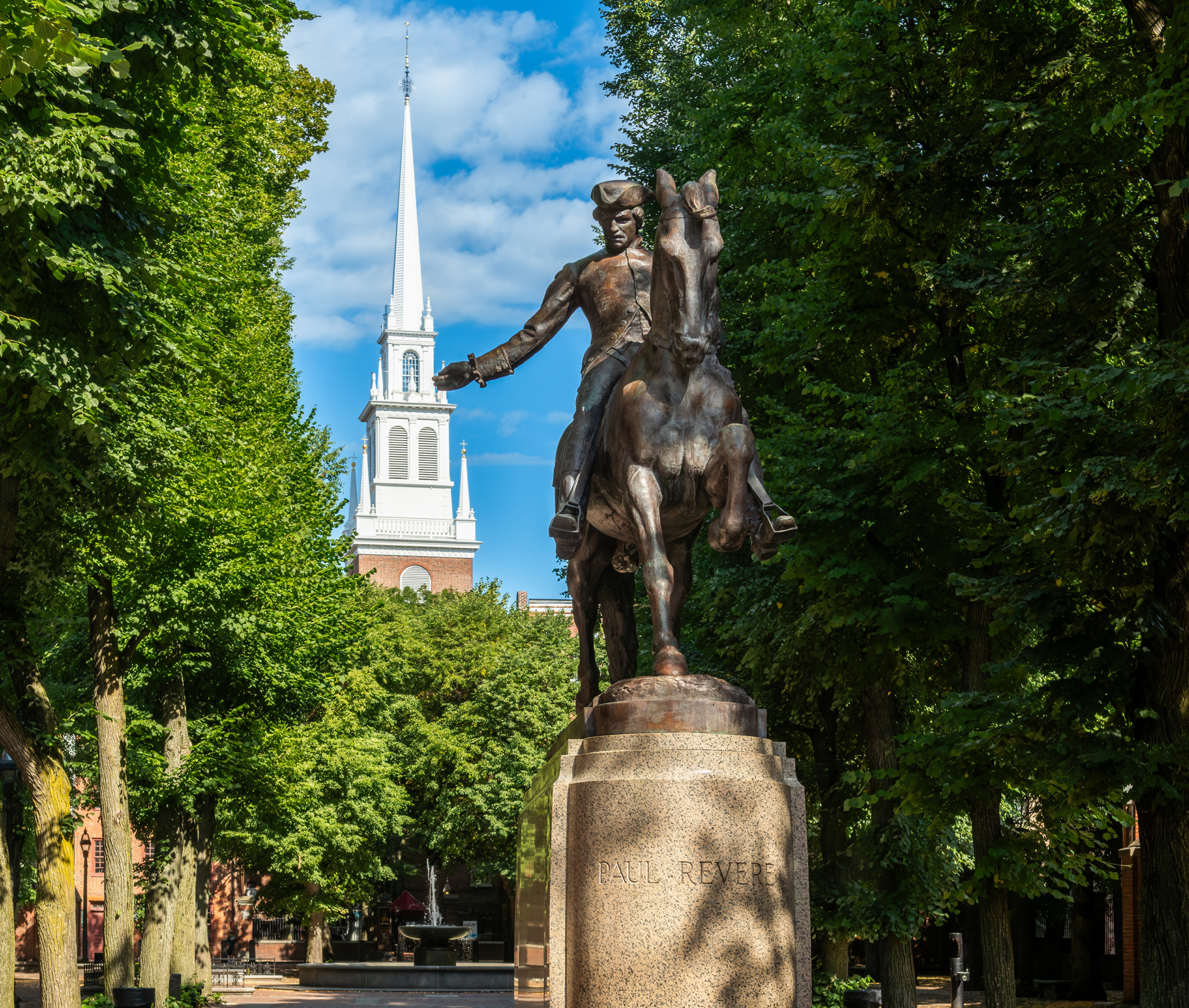
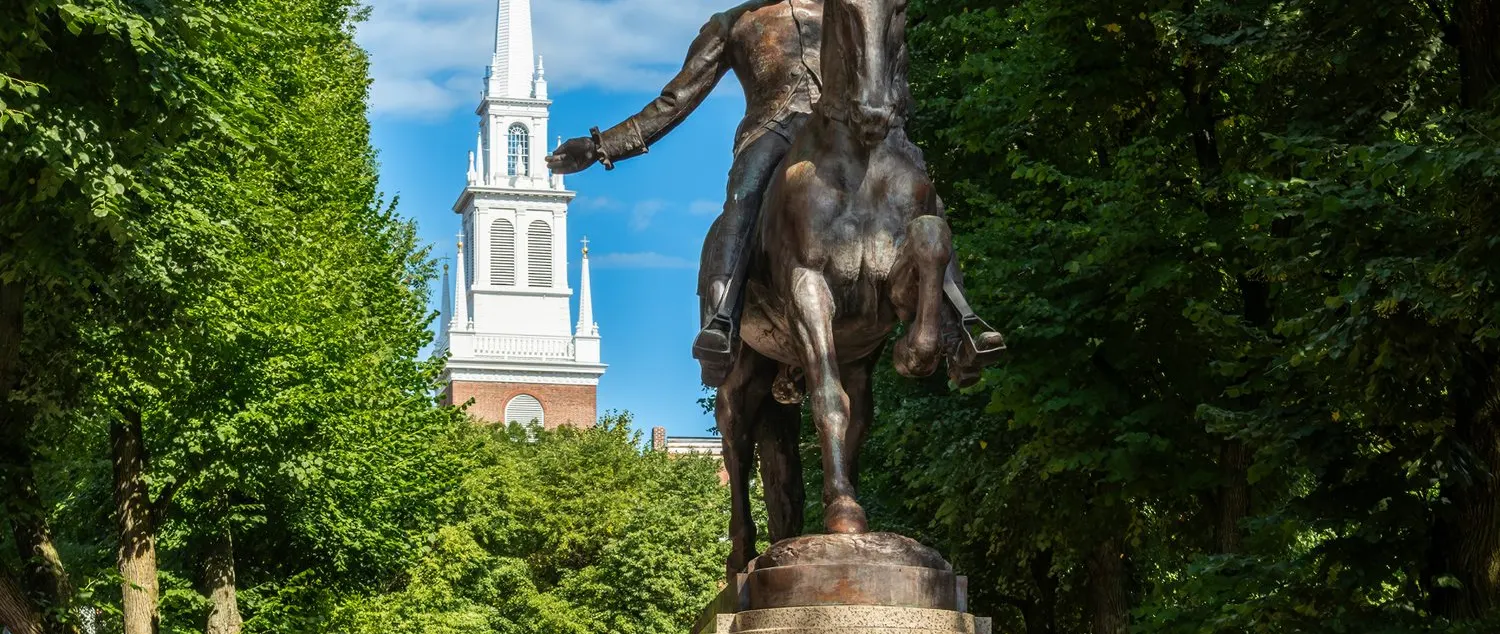
The North End contains the Paul Revere House and a well-known statue, making it an obvious part of a historical walk. Yet the neighbourhood is also a living place with residents and businesses whose daily routines should be respected. Visitors can observe the scale of streets and buildings, but should avoid treating the entire district as a reconstructed eighteenth-century stage. Much has changed since Revere's lifetime. A knowledgeable guide can identify what is original, what has been restored and which features belong to later periods. Such distinctions help a visitor appreciate the neighbourhood's continuing life as well as its historical importance.
The journey into the countryside matters
The tour continues beyond Boston into Massachusetts countryside associated with the events of 1775. That change of landscape gives participants a better sense of the distances involved and the difficulties of communication before modern transport and telecommunications. A route that seems brief on a map may have had a very different meaning at night in a politically tense environment. The hotel's description includes a stop for lunch at the Colonial Inn in Concord, bringing a hospitality element into the day. Travellers should confirm the precise schedule and meal inclusions rather than assume every possible interpretation of a historic route is part of one fixed package.
Minute Man National Historical Park provides context
The final planned destination is Minute Man National Historical Park, where visitors can explore the events that followed the warnings and the military encounters of the period. The park is valuable because it allows history to be considered in relation to actual places, roads and landscapes rather than as a sequence of names in a textbook. Guests should follow park rules and respect any restricted or sensitive areas. A private tour may simplify organisation but does not confer unlimited access to public historical sites. Its strength should be a knowledgeable interpretation of the material available, with enough time to consider the questions it raises.
Revere's capture changes the familiar ending
The hotel's release highlights Revere's capture before reaching Concord, a detail that complicates the popular conclusion to the midnight ride. The larger warning network involved multiple people, so one person's interruption did not simply stop the exchange of information. A good historian can show how coordination, contingency and local knowledge shaped the events. This is one reason the tour's central idea has merit: the iconic name becomes a starting point for learning about a wider community. Visitors who arrive with an established story may leave with a deeper understanding of how historical change occurs through relationships rather than through isolated heroic acts.
Private guiding can encourage better questions
A small group of up to five can give participants more opportunities to ask questions and explore a particular interest. One guest may care about military events, another about political ideas, and another about artistic objects or the history of the city. A guide can potentially adapt the pace and discussion, though the exact arrangements should be confirmed with the hotel. The benefit is not merely avoiding a crowd. It is having space for interpretation and conversation, particularly when the subject includes commonly repeated myths. Luxury historical travel is most rewarding when it allows curiosity rather than replacing learning with a carefully staged photograph.
Family groups may approach the material differently
The experience could appeal to multigenerational visitors, but a full-day itinerary is demanding for some children and older adults. Families should consider walking distances, time in museums and the interests of their group before booking. A young visitor may respond to physical objects and a story about a nighttime journey, while an adult may want more discussion of political context. It is sensible to ask whether the guide can adapt explanations without distorting the facts. A day designed for engaged travellers should feel welcoming to different levels of prior knowledge rather than requiring everyone to be an expert in American revolutionary history.
The 250th anniversary invites both celebration and scrutiny
Commemorations can create opportunities to revisit established historical narratives, but they should not become an excuse to avoid complexity. The American Revolution involved people with different experiences and interests, and Revere's story is part of a much larger history. A responsible cultural itinerary should situate the events within their political and social context while making clear when a familiar account is incomplete. The hotel's feature identifies the anniversary as a reason for developing the tour. Its educational value will depend on the accuracy and balance of the guiding rather than the prestige of the celebration or the convenience of private transport.
A hotel base beside the Public Garden
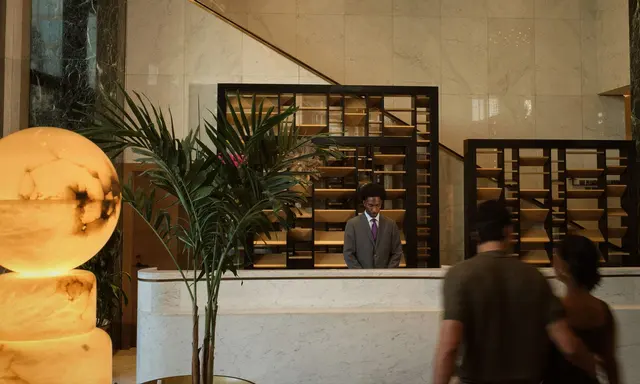
Four Seasons Hotel Boston is positioned near the Boston Public Garden and other central landmarks, providing a convenient base for cultural exploration. Such a location can make it easier to combine the full-day history journey with quieter walks or independent museum visits. But a tour leaving the city requires transport planning and may not leave much time for additional appointments. Travellers should avoid an overloaded schedule that turns a substantial educational experience into one hurried stop among many. A well-paced city break gives guests time to absorb what they have learned and perhaps revisit a particular site on another day.
History-led luxury does not require spectacle
Private cultural experiences can sometimes rely too heavily on privileged access or expensive staging. Chasing Paul Revere is more interesting when considered through the quality of its interpretation and the relevance of the places visited. Seeing a genuine historical object and understanding why it matters can be more valuable than attending a lavish themed dinner with little connection to the past. The collaboration with local historical guides is therefore an important feature. Guests should ask about credentials, itinerary flexibility and the nature of museum access. The aim should be an engaging, evidence-aware journey that treats history as something to understand rather than consume as entertainment alone.
What is established by the announcement
The official hotel release confirms the Chasing Paul Revere concept, its privately guided format, limit of five guests, named museum and historic stops, and use of expert guides and transport. It does not establish unlimited access to every institution, a guaranteed price for every date or an independent assessment of how visitors will respond. The first-party press photograph illustrates the itinerary or hotel context and should be credited accordingly. Current availability, accessibility and inclusion details must be obtained directly. The tour is a credible cultural offering because it connects documented places and objects with a familiar historical narrative while encouraging guests to examine its complexities.
A more thoughtful way to visit Boston
The best result of a history-led city break is not simply having visited the famous places, but understanding why they mattered and how their stories have been told. Boston's architecture, museums and neighbourhoods offer many opportunities for that kind of learning. For luxury travellers who appreciate curated experiences, Chasing Paul Revere provides an organised route through one important subject, while leaving room for independent curiosity. Its enduring attraction is the possibility of returning from a day in Massachusetts with a less simplified account of the Revolution and a stronger appreciation of the people, objects and decisions that shaped it.
Sources and image credits
Reporting based on Reimagining the Midnight Ride: Four Seasons Hotel Boston Debuts “Chasing Paul Revere”.
Lead photograph: Boston's Chasing Paul Revere Experience Interprets Urban History — official Four Seasons first-party press photograph. © Four Seasons Hotels and Resorts, original property press photograph Original official image source.