The Aeolian island with a useful harbour choice
Lipari is the largest of the Aeolian Islands, and a yacht arrival is best understood as the beginning of a volcanic island visit rather than merely another berth on a Mediterranean itinerary. Streets rise from working waterfronts toward a historic citadel, while the surrounding sea opens routes toward other islands whose geological characters differ dramatically. The challenge for a 12–24-metre skipper is to choose a suitable place to leave the yacht before thinking about beaches, cafés and viewpoints. Lipari has more than one berthing area, and the differences are operational, not merely cosmetic.
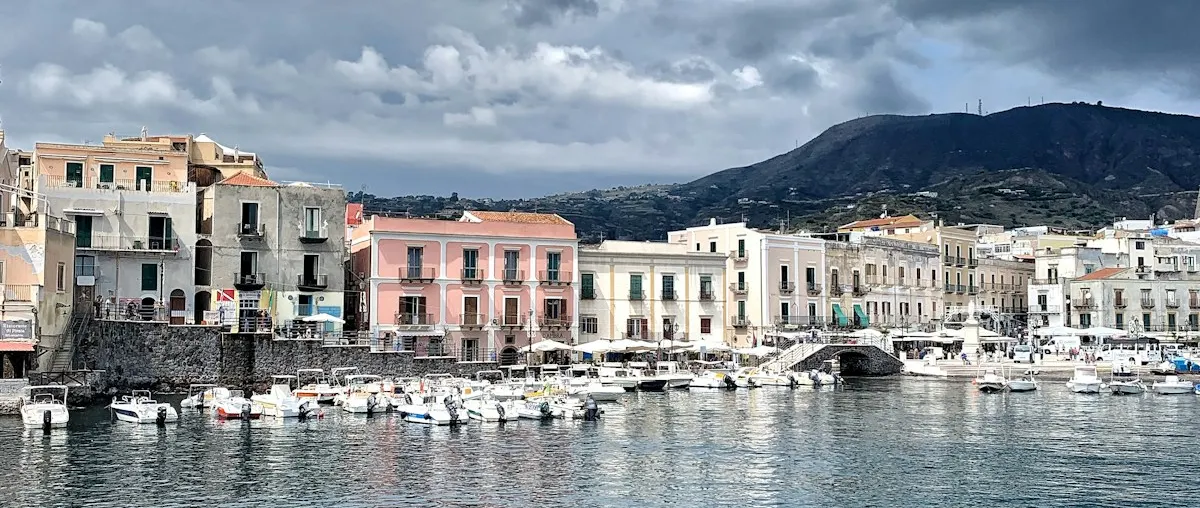
The official Sicily tourism authority distinguishes Marina Corta, Marina Lunga and Pignataro in describing the island. Marina Corta is associated with small craft and a picturesque square; Marina Lunga also serves ships and hydrofoils; Pignataro provides facilities for pleasure craft. For a yacht of substantial length, these terms should not be collapsed into one generic 'Lipari Marina'. Start with a specific operator and a confirmed berth, then build the visit around that actual location. The accompanying photograph shows Lipari waterfront scenery and does not purport to depict an assigned berth.
Pignataro: a sheltered working option
Eolmare Marina Resort says its facility is located in Porto Pignataro on Lipari's eastern side, inside an inlet protected by artificial moles. The operator's own berth-plan page lists 120 places, a stated maximum yacht length of 30 metres, depths of approximately 3–5 metres alongside and VHF channel 09. Those details give a 12–24-metre owner a credible starting point for an enquiry. They do not prove that every berth has 5 metres under the keel, or that a yacht of the maximum advertised length is assured space on a given day.
The operator also describes shore electricity, freshwater supply, showers, Wi-Fi and assistance with berthing. Such services may be especially welcome after a day between islands, but the advertised electrical connection must be assessed against the yacht's real load. Ask for amperage, cable format and whether the arrangement is suitable for air-conditioning and other substantial demands. Equally, ask about shore access, security arrangements and the space available to manoeuvre near ferry or police-vessel movements. A prudent captain distinguishes a marketing list from the operational details that decide whether a berth works.
Marina Lunga and the town-centre alternative
Yacht Harbour Lipari, a separate operator in the Marina Lunga bay, publishes a different proposition. It lists 50 moorings, a stated maximum vessel length of 60 metres and VHF channels 72 and 16, with the dock within walking distance of the town centre. The published maximum accommodates vessels well above Luxury Yacht Guide's intended segment, but it does not mean that this particular article concerns larger yachts. For an owner of an 18-metre motor yacht, the interest is in walking to restaurants and the archaeological quarter without arranging a transfer.
The technical details shown by Yacht Harbour Lipari include a wide depth range and describe exposure from easterly sectors, making local berth assignment and weather particularly important. A slip in one part of the waterfront should not be assumed to have the same protection or depth as another. The operator advertises line assistance, electricity, water and security, yet those services still require direct confirmation. Compare the actual terms with Pignataro before choosing. The right berth is the one that safely fits the yacht and the intended programme, not necessarily the one closest to the best-known photograph.
The arrival is a navigation operation
The Aeolian Islands are beautiful precisely because their coastlines and volcanic forms are irregular. A skipper should avoid translating that visual appeal into casual arrival procedures. Review current charts, weather forecasts, pilot guidance, notices and instructions from the selected harbour operator. In an area with ferries, hydrofoils and busy seasonal pleasure-boat movements, the bridge team must allow time to identify the correct entrance and maintain an appropriate lookout. The fact that an operator publishes VHF numbers is helpful but never a substitute for making a prior reservation.
Before arrival, communicate the yacht's full length, beam and draft, not a rounded model designation. Ask whether the berth uses lazy lines, what fender arrangement is advisable and whether the operator expects the yacht at a specified time. In a 12–24-metre vessel, the consequences of a last-minute berth change can be awkward for crew and guests alike. If the agreed position becomes unsuitable, a professional decision to wait or divert is worth more than keeping to a dinner reservation. The island's best experiences become possible only after the yacht is secure.
Lipari town: archaeology before aperitivo
The historic core gives Lipari much of its depth. Sicily's official tourism authority highlights the Castle of Lipari, the Bernabò Brea archaeological museum, the cathedral and associated heritage sites. These are not peripheral attractions added to a marine resort; they are evidence of the island's long human history and of its position amid Mediterranean movements of people and goods. An afternoon on foot can place a sailor's present-day arrival in that older context, from ancient finds to the buildings above the harbour.
A sensible shore itinerary moves slowly through the older streets, allows time for the museum and finishes with a meal rather than treating the whole town as an obstacle course. Marina Corta's small-scale waterfront is particularly suited to watching local activity and enjoying the atmosphere. A good guide should not imply that boats of all lengths can simply berth in its most picturesque corner. It is a place to visit on foot after leaving a yacht safely in a suitable facility elsewhere. That distinction preserves both the pleasure and the accuracy of the advice.
The volcanic landscape and UNESCO significance
The Aeolian Islands were inscribed on UNESCO's World Heritage List in 2000 for their exceptional volcanic features and scientific importance. UNESCO emphasises the study of island formation and continuing volcanic processes, including the eruption types associated with Vulcano and Stromboli. This is one of the rare island groups where a leisurely voyage can also become a clear lesson in geology. But its World Heritage status is not a promise of open access to every crater, coast or landing point. Restrictions can change with volcanic activity and local conservation needs.
For guests, a visit to Lipari can combine cultural heritage with a broader appreciation of the archipelago. An island excursion by land may reveal pumice and obsidian features or viewpoints over the other islands; boat excursions may show contrasts in coastlines and volcanic materials. The responsible approach is to select licensed local guides where needed, follow access restrictions and never market an active volcanic area as a predictable private adventure. Nature is a reason to visit, and also a reason to plan with humility.
Small passages, big decisions
Distances between some Aeolian islands may appear short on a chart, yet the practical cruising question is not simply how many nautical miles separate two attractive anchorages. Seasonal wind patterns, traffic, swell, local restrictions, anchoring regulations and exposed landing places influence each day's choice. A 15-metre yacht with family guests may rightly remain berthed while the party joins a local excursion; a differently equipped and crewed yacht may be more comfortable shifting position. Neither decision is inherently less adventurous.
Set a realistic daily plan that starts with weather and berth or anchorage suitability, then gives guests enough time ashore to understand where they are. Avoid promising swimming at every cove; local conditions and conservation rules matter. If a captain cannot verify an anchorage's holding, depth or permitted use from authoritative current sources, do not describe it as recommended. Lipari's appeal does not require inventing secluded stops. The extraordinary presence of volcanic islands on the horizon is already sufficient to distinguish the voyage.
Eating, walking and a slower rhythm
Sicily's official guide suggests Lipari's historic lanes, waterside cafés and local delicacies as part of the visit. Fresh granita, regional pastries and a long evening meal are natural ways to experience the town, but the most successful yacht day is not necessarily the most extravagant. Guests can explore the archaeological area in the morning, cool down over lunch and enjoy the waterfront as the lights come on. Crew may use the same quiet interval for essential provisioning and checks, provided their rest periods are respected.
For owners, the value of a town-based berth is the freedom to choose. A guest may return to the yacht early; another might continue through the shops or climb toward a viewpoint. There is no fixed shuttle timetable tying everyone together. That flexibility is harder to reproduce if the chosen berth turns out to be far from town or accessible only by tender in deteriorating conditions. It is another reason to verify where the yacht will actually lie, not just the name of the island in a booking confirmation.
A three-night Lipari itinerary
After arrival, give the first evening to a waterfront walk and an easy dinner. Day two can centre on the Castle, the Bernabò Brea museum and Marina Corta, with enough room for a genuine pause. Day three may suit a guided island landscape excursion or a carefully planned short cruise when conditions and regulations permit. If the forecast is unsettled, remaining in the harbour for another day is a sensible possibility; the town offers enough depth to reward that decision. No itinerary should require a captain to force a departure just to meet an editorial fantasy.
Before sailing on, reconfirm the next harbour or anchorage, the current sea state, charter or passenger rules if relevant and the requirements for leaving the selected berth. Lipari is memorable because it joins a real nautical base to a living town and an exceptional volcanic archipelago. For a yacht within the 12–24-metre band, the experience can feel intimate, cultured and adventurous without relying on superyacht-scale amenities. The essential purchase is time: time to berth properly, look around, and let the island reveal more than its coastline.
Image credit: Waterfront at Lipari in the Aeolian Islands — Razvan Horhat / Unsplash. Original photograph, used under the Unsplash License. The lead photograph is illustrative and does not depict an unverified product or berth.