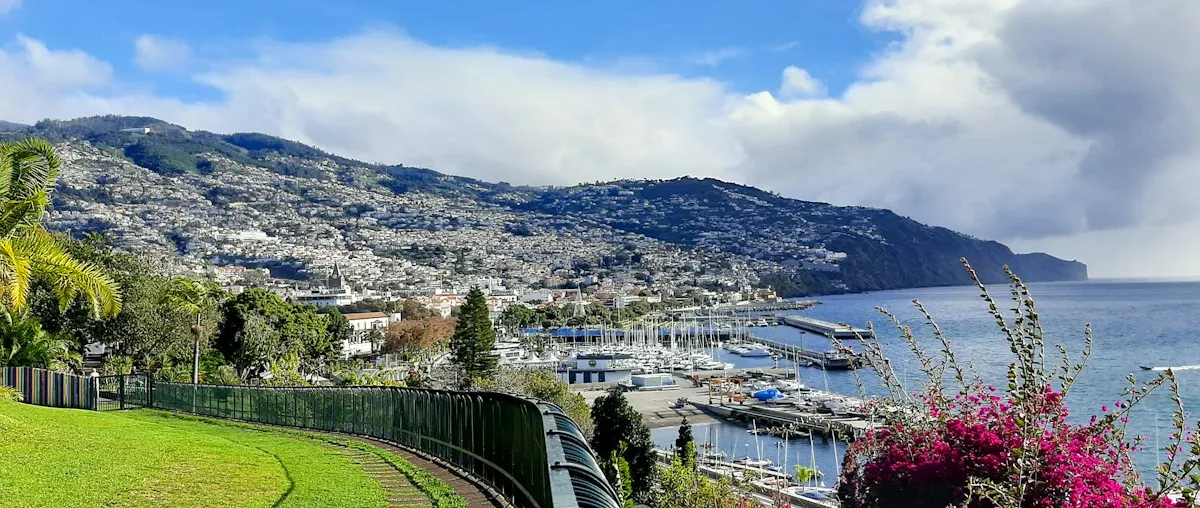
Why Funchal works as a yacht stop
The first view of Funchal from the water is of a city climbing the hillside above a working Atlantic port. That setting immediately distinguishes Madeira's capital from a resort marina built around one basin. For a 12–24-metre cruising yacht, the appeal is practical and cultural at once: an established city waterfront, places to provision, galleries and gardens, a wine tradition, and a dramatic landscape within easy reach of a berth. It is also a useful place to pause rather than keep sailing for the sake of a schedule. A crew can complete the necessary maintenance and still find a satisfying afternoon ashore within a relatively small radius.
Madeira's geographical position means that a skipper should resist treating this as an ordinary Mediterranean coastal hop. The island is in the Atlantic, where swell, weather systems and exposed approaches deserve serious attention. The city's marina is inside the main harbour, but sheltered berthing does not make the outward or inward passage conditions irrelevant. Check the forecast for the actual route and timing, ascertain current harbour rules and distinguish the yacht marina from the commercial and cruise operations sharing the wider port.
What the marina actually offers
Madeira's official tourism authority describes Funchal Marina as a 210-berth facility within a sheltered part of the main harbour. It names water and electricity connections, fuel, sanitary facilities, nautical businesses and eating places among the services. The site is managed by Clube Naval do Funchal and Centro de Treino Mar within infrastructure belonging to the regional port authority. These are useful starting facts, not confirmation that a specific 22-metre yacht can arrive unannounced to find a berth, sufficient shore power or a suitable turning area.
The national Visit Portugal marina listing gives a maximum berth length of 20 metres, a published depth figure of 3.5 metres and slightly different counts for permanent moorings. There is therefore a genuine source discrepancy, not an editorial detail to smooth over. A yacht in the upper part of the 12–24-metre band must obtain direct written confirmation that its actual length, beam and draft can be accepted. Even a yacht below 20 metres should confirm current restrictions, seasonality and services. The marina's own contact page identifies VHF channels 16 and 9, an obvious first point of operational reference.
Arriving without assuming a berth
A sound arrival plan begins with an accurate specification sheet: length overall including projecting fittings, beam, draft, air draft if relevant, power requirements, arrival date and intended duration. Ask the marina for a named or clearly identified berth and how to reach it inside the wider harbour. The skipper should independently review up-to-date charts, harbour notices and local traffic arrangements. It would be unsafe to substitute a travel article or an old marina listing for navigational instructions, particularly where large commercial vessels may be moving nearby.
Guests often see a yacht arriving alongside as a simple matter of dropping lines over bollards. The operational reality is more exacting. A fresh Atlantic breeze can turn a high-sided 18-metre yacht into a substantial sail; fenders, the direction of approach, line handlers and thruster use should all be considered in advance. If conditions or berth dimensions are marginal, waiting or accepting an alternative arrangement is professional seamanship. Funchal's charm is best enjoyed after the vessel is settled, not while the crew is improvising in a busy port.
The waterfront and the compact city day
The marina's position close to the city makes Funchal unusually convenient for guests who want to explore without complex transfers. Madeira's tourism authority encourages walking the public promenades, gardens, museums and civic spaces. A modest shore itinerary can follow the seafront, turn into the older streets and return to the yacht after lunch. There is no need to claim that the best food or most authentic culture is hidden in one unverified restaurant. The pleasure comes from observing a functioning city: local shops, streets lined with distinctive architecture and a working harbour in constant view.
This is also a destination where separating crew time from guest sightseeing can improve the whole visit. Provisioning, laundry and maintenance may be handled during the morning while guests explore nearby museums. Later, a shared walk or meal brings everybody back together. That arrangement respects the labour involved in operating a private yacht and avoids making shore time a sequence of hurried appointments. For an owner travelling with family rather than a large professional crew, the compactness of the city is a meaningful form of luxury.
Mercado dos Lavradores and Madeiran flavours
The Mercado dos Lavradores is a strong first stop for visitors who want a clearer sense of Madeira than a postcard provides. According to the official tourism board, the market opened in November 1940 and remains an important central-city place for regional produce. Its tiled architecture, bustle, flowers, fruit and fish counters offer both a cultural experience and an opportunity to understand the ingredients that shape local cooking. This is a public market rather than a private yacht service. Guests should check the current opening times, browse respectfully and ask prices before ordering items.
A yacht can turn that visit into something memorable without elaborate arrangements: choose produce for the next day's breakfast, discuss local ingredients with the galley, and make time for a café stop in town. Madeira wine is another natural subject, but tasting should be chosen with care around the skipper's responsibilities. The tourism authority identifies established wine producers and visitor locations, including houses in Funchal. A tasting while safely berthed is different from encouraging alcohol consumption before a passage. Thoughtful planning lets the island's hospitality enrich the itinerary without compromising the next day's navigation.
The climb to Monte
One of Funchal's defining excursions rises almost directly from the old-town area. The Madeira Cable Car connects central Funchal with Monte, gaining around 560 metres of height over a route of approximately 3.2 kilometres, according to the official tourism authority. The ride offers a distinctive reading of the island's topography: the port and seafront fall away while the city's terraces and green slopes emerge. The service is an attraction in its own right and a convenient way to reach gardens and heritage locations at the top.
Do not plan that trip on the assumption that published operating hours will be unchanged on the day. The tourism authority's pages list schedules that may be revised, and conditions can affect services. Confirm the day's operation and allow enough time to explore rather than turn the cable car into a rushed return ticket. Guests who are less mobile or travelling with children may prefer to focus on viewpoints and gardens with appropriate access arrangements. The goal is a satisfying day, not to collect as many attractions as possible in the space between marina chores.
Gardens, views and a slower afternoon
A Funchal stay can easily become too busy: shops, terraces, museums, markets, cable car, wine and long lunches all compete for time. On a yacht, there is a case for deliberately omitting something. The steep green setting makes a garden visit or a quiet viewpoint more evocative than another scheduled activity. Madeira's tourism guidance highlights the city's parks and botanical spaces, and these fit naturally into a second day. Use reliable local transport where gradients or distance make walking impractical, especially after a warm day.
The quality of a yacht visit depends partly on the time guests spend aboard without obligation. The marina is a useful base for this type of rhythm. A party can be active ashore in the morning, then return for an afternoon on the aft deck, looking back at the city from the water. That is the distinctive advantage of visiting Funchal privately by yacht: the town remains immediately present, but the vessel offers a familiar retreat. A good itinerary leaves room for unplanned conversations and a change of weather.
How it differs from other Madeira marinas
Madeira has other marinas, including Calheta farther along the island, but Funchal is not simply interchangeable with them. Calheta may suit a different coastal itinerary; Funchal is the obvious choice when the capital's restaurants, museums, market and Monte are the main attractions. This distinction matters to the 12–24-metre owner because choosing a marina by island name alone can lead to unnecessary transfers and missed opportunities. Confirm what each facility can actually accept, then choose the harbour that serves the intended shore programme.
For larger yachts within this publication's segment, current berth limitations are especially important. A listing that says there are 210 berths may leave unanswered whether any of them accommodate a particular beam or 22-metre length. A forecast that promises settled weather may also fail to describe swell at the entrance. Contacting the marina, keeping a viable alternative and allowing some timetable flexibility are far more reassuring than a falsely precise guide claiming that arrival will be straightforward.
A sensible two-night plan and departure
On the first day, approach with adequate time for harbour formalities and securing the yacht. Once alongside, walk the waterfront and find an easy evening meal. On day two, visit Mercado dos Lavradores, explore the old streets and consider the cable car to Monte if it is operating and the party has the appetite for it. A third morning can be devoted to provisioning, a final garden or museum visit and a relaxed return aboard. Such a sequence is workable because it does not depend on impossibly tight transfers or invented private experiences.
Before leaving, confirm the next passage forecast, relevant port arrangements, fuel and water levels and the position of lines and fenders. A crew that has crossed open Atlantic water should not become casual because a city harbour feels comfortable. Funchal delivers an unusually successful combination: the conveniences of a European capital, the sensory character of a volcanic Atlantic island and a marina situated close enough to make spontaneous exploration possible. For a suitable 12–24-metre yacht with its berth properly confirmed, that is a persuasive reason to call.
Image credit: Funchal waterfront and sea in Madeira — Sofia Vila Flor / Unsplash. Original photograph, used under the Unsplash License. The lead photograph is illustrative and does not depict an unverified product or berth.