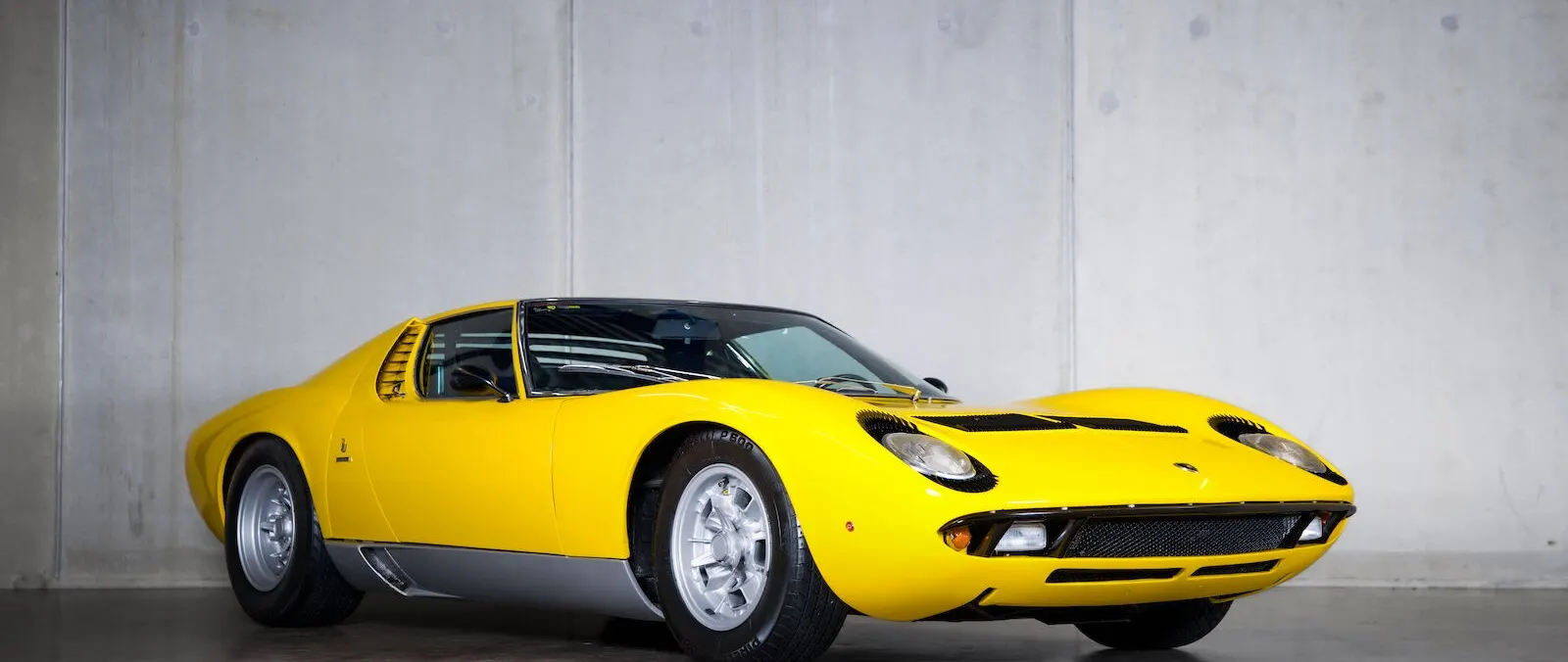
A seven-figure result on the Belgian coast
A Lamborghini Miura P400S has made a high-profile appearance in the Belgian collector-car market, with its Zoute sale drawing attention to the model’s enduring desirability. This development is relevant to owners and guests who pursue luxury motoring, hospitality, private travel or collectible objects alongside their yachting interests.
Bonhams identified this particular example as one of only 114 late P400S cars equipped with ventilated brake discs. It was delivered new in Switzerland and had remained with its most recent owner for more than a decade, factors which help distinguish the lot from otherwise similar surviving Miuras.
Why the P400S occupies an important place
When Lamborghini unveiled the Miura during the 1960s, the positioning of its V12 engine behind the passenger compartment challenged the prevailing approach to prestigious road-going sports cars. The layout had obvious racing antecedents, but its use in such an accomplished production grand tourer made the Miura a defining step toward the modern supercar.
The P400S followed the original P400 and refined aspects of its mechanical specification and interior appointments. Later examples with ventilated brake discs are a distinct subset of that production history, so an auction catalogue should be read carefully rather than treating every car wearing an S badge as mechanically identical.
The model’s appeal extends beyond acceleration or headline power figures. Its low stance and dramatic proportions became part of the visual vocabulary of the supercar, while its compact transverse powertrain and packaging continue to interest engineers and enthusiasts who study the origins of high-performance road vehicles.
Matching numbers and the individual car
For chassis 4578, Bonhams listed engine number 30534 and body number 633, reporting matching-number components. Such details are important to collectors because they can help support the identity of a surviving car and its relationship to factory production records, rather than relying solely on outward appearance.
The auction information also records the Swiss delivery and long period of recent ownership. These points contribute to a provenance narrative, but a buyer conducting a technical assessment would still seek the full paper trail, service documentation, inspection reports and details of any past restoration work.
Even a well-documented Miura demands specialist knowledge. Fuel systems, cooling, brakes, corrosion and the condition of the drivetrain can each make a substantial difference to the cost of using or maintaining the car, and surviving examples may vary considerably in how frequently they are exercised.
Interpreting the price and the next chapter
The €1.725 million figure is a completed auction result including the relevant premium, not an advance estimate or proof that every P400S has the same value. Individual prices can reflect originality, colour, condition, mechanical history and the specific group of bidders present when a lot crosses the block.
For owners who collect sports cars alongside yachts, art and other substantial assets, proper storage and insurance are central parts of ownership. A rare Italian classic may need controlled indoor conditions, planned exercise and specialist access before it can be enjoyed with confidence on European roads.
The Zoute sale confirms that this particular late Miura found a buyer at a significant figure. Beyond the sale itself, the result is a reminder that the model’s place in the history of the mid-engined supercar remains integral to its collecting appeal more than half a century after its introduction.
For readers combining cruising with international travel or collecting, the announcement provides a useful reference point when planning a private itinerary or acquisition. Individual costs, access and conditions should be verified with the company concerned before making a commitment.