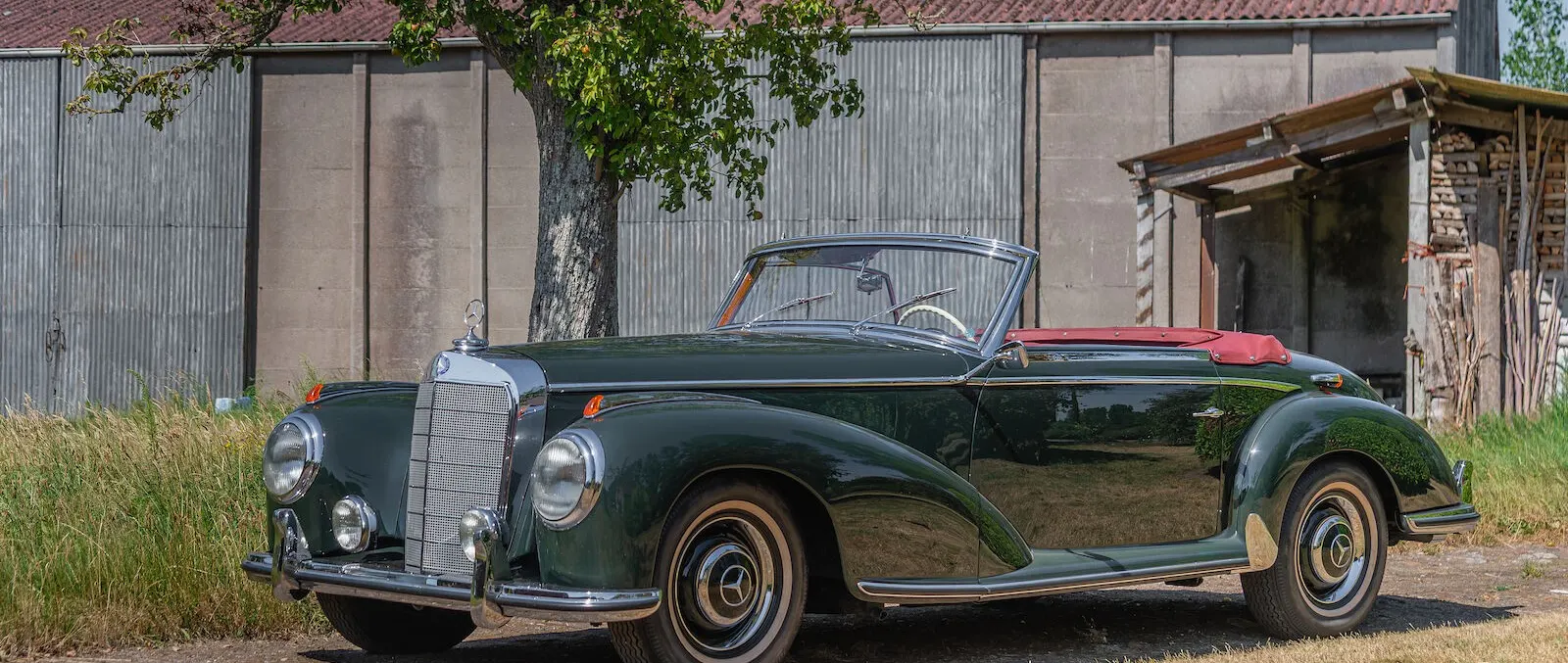
A rare post-war Mercedes finds a new owner
The Mercedes-Benz 300 S Roadster represents an era when luxury craftsmanship and open-air grand touring were central to the automobile ownership experience. This development is relevant to owners and guests who pursue luxury motoring, hospitality, private travel or collectible objects alongside their yachting interests.
The auctioneer describes the 300 S Roadster as one of only 141 built, with this example delivered new to California. The catalogue identifies chassis 188012 00071/53 and engine 188920 00073/53, alongside an assertion that the original engine remains with the car.
A flagship conceived for a different kind of luxury
Mercedes-Benz introduced the 300 range in 1951 as part of its return to high-end automobile production after the war. It represented an emphasis on comfort, technical quality and restrained authority, an alternative to the lighter, overtly sporting cars which would later define some of the marque’s best-known collector vehicles.
The 300 S occupied an especially prestigious position, offering carefully crafted bodywork and richly detailed appointments for buyers willing to pay considerably more than the cost of a conventional large saloon. The open roadster was a particularly exclusive way of experiencing that approach.
It is important not to confuse the 300 S Roadster with the much better-known 300 SL. They belong to different branches of Mercedes-Benz history, and the 300 S is primarily a substantial luxury vehicle with an emphasis on refinement, traditional craftsmanship and graceful touring.
Restoration and a long-lived identity
Bonhams described this car as exceptionally restored and recorded ownership by its most recent custodian since 2017. Such a statement should guide a prospective buyer toward the restoration file rather than substitute for a full evaluation of the work, including any body, engine, electrical and interior refurbishment.
The Californian delivery history and matching-number engine claim provide identifiable provenance details. These should be reconciled with factory documents and surviving paperwork, since the history of a seventy-year-old automobile can include lengthy gaps, changes in registration or work performed by numerous specialists.
Collectors wishing to drive a 300 S face practical decisions about maintenance and preservation. Parts availability, period chassis construction, sealing and brake condition can require specialist attention, while the original cabin materials may need particular care in warm or humid storage conditions.
The collector’s perspective on the result
The €345,000 figure is the completed price including premium as recorded by Bonhams. It should not be used as an automatic valuation for another Mercedes-Benz 300 S because body style, restoration quality, provenance and mechanical originality can produce considerable differences in desirability.
A collector’s budget should include appropriate insurance, expert storage and scheduled work, rather than treating the auction price as the total lifetime cost of ownership. Even rarely driven cars need preventive maintenance to remain safe and usable over time.
The Zoute transaction draws attention to a model that deserves consideration alongside more familiar 1950s sports-car icons. Its rarity and dignified character offer a different expression of European luxury, and its historic significance extends well beyond the figure achieved in the saleroom.
For readers combining cruising with international travel or collecting, the announcement provides a useful reference point when planning a private itinerary or acquisition. Individual costs, access and conditions should be verified with the company concerned before making a commitment.