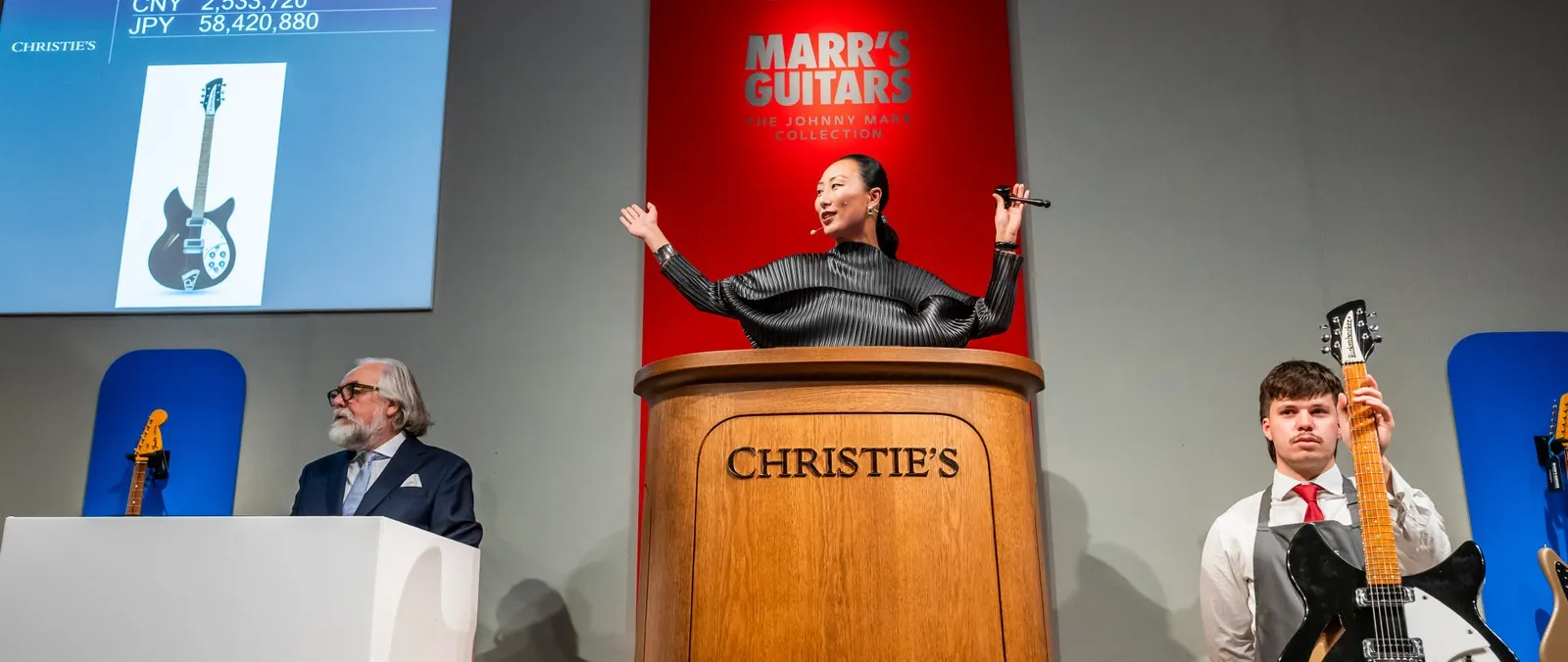
Johnny Marr’s private collection has realised more than £3.6 million at Christie’s, more than three times the pre-sale estimate and a strong result for a category where music history, design and celebrity provenance overlap. Registrants came from 34 countries, showing the global reach of a collection built around one of Britain’s most influential guitarists.
The sale included guitars, instruments and personal objects associated with Marr’s career, giving buyers access to pieces tied directly to The Smiths, later collaborations and his solo work. Rather than functioning as a general memorabilia auction, the collection was anchored by tools Marr actually used to create and perform music.
The 1982 Rickenbacker 330 Jetglo led the collection
The top lot was Marr’s 1982 Rickenbacker 330 Jetglo, a model closely associated with his distinctive sound and visual identity. For collectors, an instrument of this kind carries several layers of value at once: it is a functional guitar, a design object and a documented piece of modern music history.
That combination can produce bidding far beyond the value of an equivalent instrument without provenance. Ownership history matters because buyers are acquiring direct physical connection to recordings, performances and an artist whose style influenced generations of guitar players.
Music memorabilia is becoming a serious collecting category
Major auction houses increasingly treat instruments, stage-worn clothing, handwritten material and studio objects with the same research and presentation given to traditional fine art. The strongest lots can attract collectors who may not otherwise buy paintings or sculpture but who understand cultural importance through music.
This creates a market where emotional memory is unusually powerful. A guitar associated with a formative song can carry personal meaning for thousands of potential bidders, and that shared cultural recognition can translate into intense competition when a truly important object reaches the market.
Global bidding shows Marr’s influence beyond the UK
Registrations from 34 countries demonstrate that the audience for the collection was not confined to British fans. The Smiths and Marr’s later work have long had international followings, and the auction translated that cultural reach into a global collector base.
Online bidding also makes this type of sale more accessible than traditional saleroom participation. A collector in another continent can study condition reports, provenance and images, then compete live without travelling to London, broadening demand for highly personal objects.
Charity gave part of the sale a wider purpose
Hammer proceeds from 31 lots were designated to benefit The Guide Dogs for the Blind Association and The National Autistic Society. That element adds a philanthropic dimension to the dispersal of personal material and connects Marr’s decision to sell with causes beyond the market itself.
For buyers, charitable benefit can create additional motivation without replacing the importance of the object. The strongest results still depend on provenance, rarity and emotional connection, but knowing that part of the sale supports a defined cause can deepen the significance of participation.
The auction preserves provenance even as objects disperse
When an artist’s private collection is broken up, one concern is that objects lose the context they had while kept together. Detailed cataloguing helps preserve that history by documenting where instruments were used, when they were acquired and how they relate to Marr’s career.
The £3.6 million total confirms that collectors responded strongly to that documentation. As music memorabilia matures as a market, provenance is likely to become even more important because the difference between an ordinary vintage instrument and a culturally significant one rests largely on the story that can be proved.