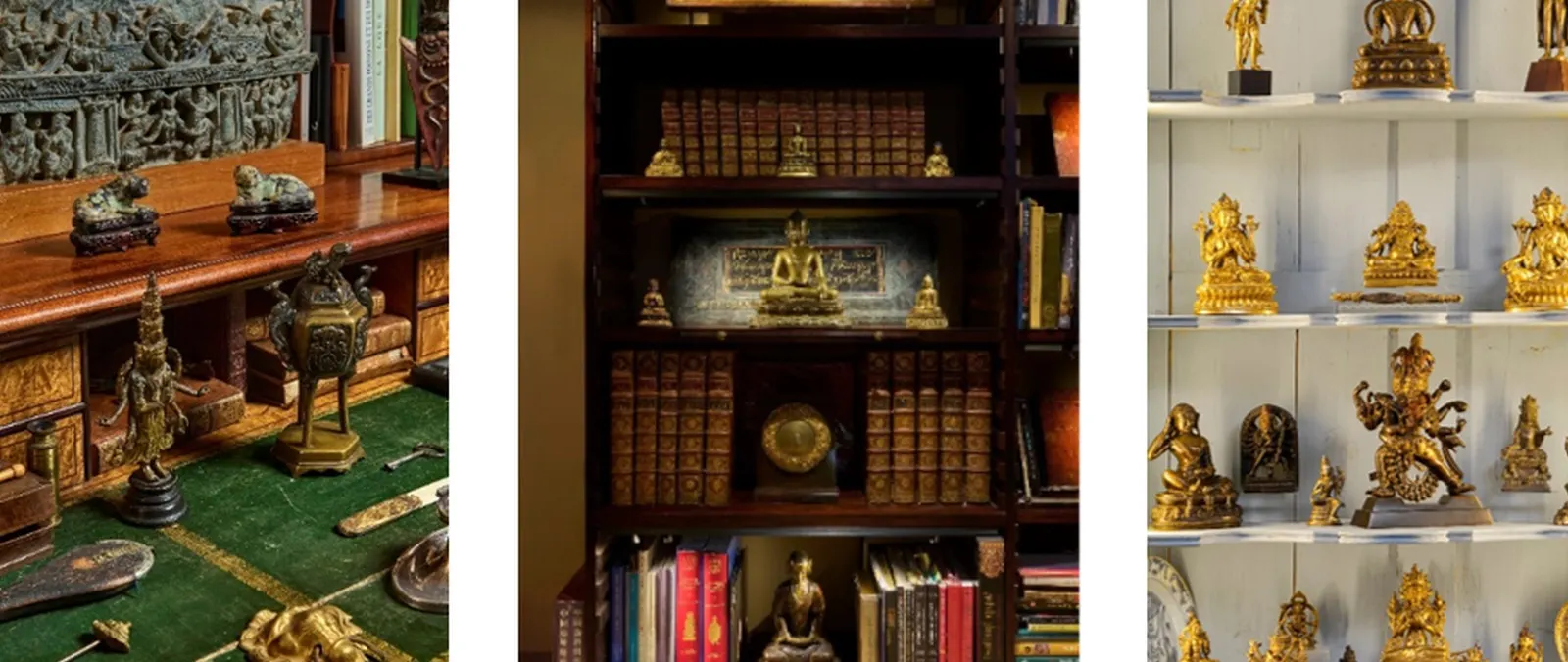
Christie’s will offer the JPHY Collection in Paris in December, presenting one of the most important groups of Indian, Himalayan and Southeast Asian Buddhist art to reach the international market in more than a decade. The collection will be divided between a live auction titled Masterpieces of Buddhist Art: Peaceful and Wrathful and an online sale running alongside it.
The works were assembled over more than half a century, with acquisitions made through galleries in Brussels, Amsterdam and Paris as well as major Asian-art auctions in New York and London. That long formation gives the collection the character of sustained scholarship rather than a recent aggregation of market-ready objects.
The collection moves across regions and centuries
Buddhist art developed across an enormous geographic area, and the JPHY Collection reflects that breadth through works connected with India, the Himalayas and Southeast Asia. Different sculptural traditions, materials and iconographies show how shared religious ideas were translated into local artistic languages.
For collectors, that regional range creates an opportunity to compare how form and symbolism evolved as Buddhism moved between cultures. A single collection can therefore function almost like a private survey, linking objects that might otherwise appear in separate specialist auctions.
Live and online sales divide masterpieces from broader depth
The December 10 live auction will focus on the most important works, while the online sale from November 30 to December 11 provides additional depth. This two-part structure allows Christie’s to create a museum-like focus around headline pieces while still offering a broader range of material to collectors at different levels.
Online access is particularly important in a specialist field because serious buyers may be spread across Asia, Europe and North America. Digital bidding allows those collectors to participate even if they cannot travel to Paris, while the physical exhibitions provide opportunities for close inspection before the sale.
The collection will travel before reaching Paris
Selected works are being shown in Beijing, Chengdu, Taipei, Hong Kong and Brussels before the full collection is exhibited in Paris. This travelling preview gives Christie’s access to several of the most important regional centres for Asian-art collecting and allows specialists to see the material in person.
Such tours are especially valuable for sculpture and ritual objects because surface, scale, casting quality and condition can be difficult to judge from photographs alone. A collector may understand iconography from a catalogue, but physical examination often determines confidence at the highest price levels.
Provenance and connoisseurship are central to the field
Older Buddhist sculpture can involve complex histories of movement between temples, dealers and private collections. Buyers therefore place heavy emphasis on documented provenance, publication history, condition and specialist opinion before committing to important works.
The JPHY Collection benefits from decades of careful acquisition and a coherent ownership history. That does not remove the need for individual due diligence, but it gives the group a level of continuity that can be difficult to find when works enter the market one by one from unrelated sources.
Paris strengthens its position as a centre for Asian art
The sale adds to Paris’s long history as a market for Asian art, supported by museums, galleries, scholars and private collectors. Bringing such a significant collection to the city creates an event that extends beyond the auction itself, particularly during the full public exhibition in early December.
For collectors, the appeal lies in the chance to see a major private collection assembled over decades before it disperses. Once the works move into new hands, the collection will never exist in quite the same form again, making the preview as important culturally as the sale is commercially.