The Slovenian coast through the history of a former island
Izola occupies a small but culturally distinctive section of the northern Adriatic. The Slovenian Tourist Board describes a town that once occupied an island and whose identity developed around fishing, boatbuilding, fish processing, olive growing and viticulture. Its old inner harbour, known locally as the mandrač, sits within the historic settlement, while the modern marina serves a different set of requirements. For owners of twelve-to-twenty-four-metre yachts, that contrast is worth exploring. Izola is not simply another sheltered stop on a Mediterranean itinerary; its waterfront, former industrial activity and inland agricultural traditions can form a coherent shore programme. The captain should agree the appropriate berth with the marina operator in advance, particularly when the yacht has a greater beam, draft or electrical demand than the facility's typical visiting boats. With the operating arrangements settled, guests can spend two or three days exploring the town and surrounding landscape without needing a new berth every evening.
Izolana and the lives behind the fishing fleet
The town's interactive museum, Izolana — House of the Sea, offers an unusually direct introduction to the maritime community. Its collections include scale vessel models and a restored full-size pasara, a traditional local boat. The Slovenian Tourist Board describes an interactive reconstruction following the development of the town from its early history to the present, as well as a simulation of a bicycle journey along the former Parenzana railway. A guest familiar with contemporary composite motor yachts or performance sailing boats can use the models to consider a different design tradition. A small local fishing craft is shaped by its intended waters, load and working methods; its proportions need not resemble those of a recreational vessel designed for long passages or private hospitality. Look at how the museum explains the relationship between work and construction rather than assess the historic boat exclusively through modern standards. Confirm the actual opening hours and available exhibitions, particularly for a visit outside the Adriatic summer season.
Roman infrastructure at Simonov zaliv
The archaeological park at Simonov zaliv preserves remains associated with a Roman maritime villa and harbour approximately two thousand years old. This offers a different perspective on waterfront property from that available during a tour of a modern marina. A coastal residence in antiquity had a particular relationship with its harbour, gardens and surrounding agricultural land, and archaeological remains allow investigators to consider that relationship through surviving structures. Not every feature will be visible to a casual visitor, and interpretive reconstructions should be distinguished from objects or walls known to survive from the period. Families interested in architectural history can arrange an independent visit to the park and consult its current interpretation programme. The value of the site is in seeing how earlier inhabitants organised their activities near the sea. It is not necessary to approach the site directly by yacht, and the existence of an ancient harbour provides no information about safe modern access for a vessel. Use approved visitor access from land.
A viewpoint from St Maurus and Besenghi degli Ughi Palace
The church of St Maurus stands on the higher ground of the former island. According to the tourist board, the adjacent viewing tower provides a panorama of the town and coast. A climb offers the chance to see the compact old settlement as a whole and understand how the lower streets connect with the waterfront. The board also identifies the palace of Besenghi degli Ughi as a significant example of late Baroque architecture, remarkable in the context of Slovenian Istria. These two buildings represent different aspects of the town's historical life, and a walk through the old streets provides a useful connection between them. A visit should allow for gradients, steps and the current accessibility of particular buildings. Interior access cannot be inferred from the inclusion of a property in a general tourism guide. An owner planning an outing with older family members can keep the programme flexible, with separate options for those interested in ascending the tower and those who would prefer a slower walk at street level.
A culinary tradition extending from the sea to the hillside
The tourist board places brodet, a fish stew served with polenta, at the centre of Izola's culinary inheritance. Its account also describes preparations using baccala and Istrian truffles. These dishes give an owner accustomed to entertaining aboard an opportunity to examine how local cooking makes use of the produce of both the coast and the inland region. A traditional stew has many possible variations, depending on the selection of fish, the chef's methods and the ingredients actually available. Do not expect identical preparations on every menu. The board also highlights the regions associated with Refosco and Malvasia wines and olive oil. An independently arranged visit to a producer can place those ingredients in context. Confirm the details of any tasting or tour with the producer, and organise transport so that participating guests are not responsible for driving or operating the boat while impaired. Owners whose yachts have a professional chef may prefer to discuss the local ingredients with that person rather than try to reproduce an entire restaurant menu aboard.
Parenzana and the landscape beyond the marina
The former narrow-gauge railway linking Trieste with Poreč is now represented by the Parenzana walking and cycling route. The tourist board identifies sections around Izola marked D6 and D8, with various opportunities to explore the countryside. A bicycle excursion gives a family a way of experiencing places that cannot be reached conveniently from the yacht. It is also an opportunity to appreciate the earlier transport geography of the region. Part of the interest of a former railway is the way the alignment reflects the need to negotiate terrain and link settlements. The route should be selected according to the distance, surface and gradients appropriate to the actual cyclists. A suitable bicycle, helmet, repair arrangements and a realistic means of returning are more important than completing the greatest possible distance. If guests have different abilities, organise separate activities rather than require an entire party to keep the pace of the most experienced cyclist. Consult current route information, as conditions on individual sections may change.
Strunjan's cliff, saltpans and protected waters
The nearby Strunjan Landscape Park includes a prominent cliff approximately eighty metres high. Its protected landscape incorporates the surrounding land, saltpans and a coastal marine belt. This creates an opportunity to consider the relationship among the rock, vegetation, coastal waters and human activities that have shaped the area. A yacht visitor should distinguish the landscape's visual attractiveness from the navigational and environmental rules governing the use of the water. Current restrictions on anchoring, landing and other activities must be established independently, and the skipper must assess the approach using authoritative navigation information. The setting can equally be enjoyed by walking ashore or arranging an appropriate excursion with a local operator. Access to a viewpoint does not confer permission to go into adjacent restricted areas. Guests interested in photography can concentrate on changing light, textures and the overall composition of the landscape while maintaining respect for the park's requirements. Check the conditions of paths and the weather before undertaking longer walks.
An inland experience at Korte and Kaštelir
The tourist board describes the village of Korte and its nearby archaeological park as another opportunity to examine Istrian history. Kaštelir preserves evidence of prehistoric fortification and later activity from the Roman period. The published visitor experience also includes traditional village architecture and an old communal washing place. Such details help establish why the town's coastal economy should not be considered in isolation from its agricultural surroundings. For guests interested in everyday history rather than formal monuments alone, the village can provide a different kind of outing from the maritime museum. Arrange a suitable guide and transportation if desired; check the actual arrangements rather than infer specific availability from the general listing. A longer yacht stay gives families the time to discover the contrast between the marina, the old harbour and the rural landscape. A focused excursion can be more informative than a succession of brief roadside stops.
A visit built around a settled yacht base
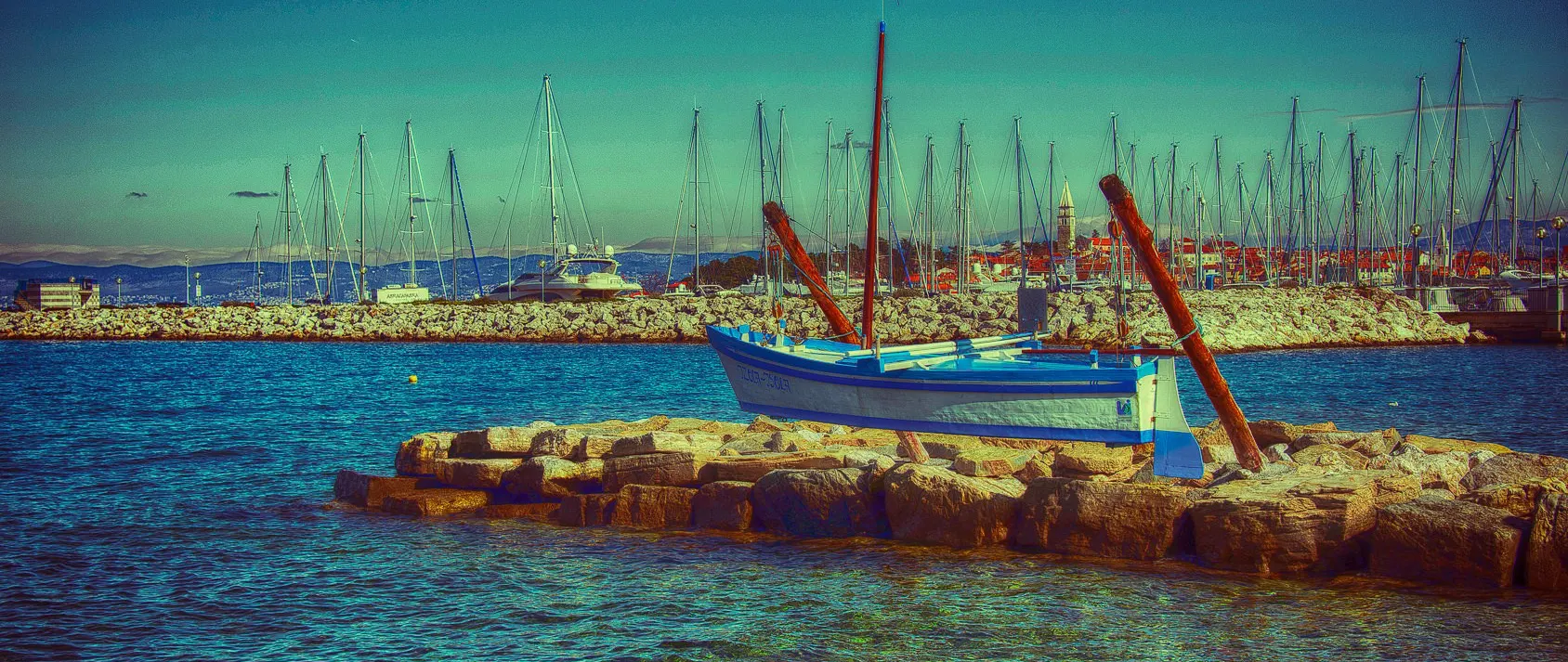
An enjoyable Izola stay could begin with the old harbour and Izolana, continue with an archaeological or architectural outing and reserve another day for the hinterland or Strunjan. The chosen activities can be adapted to the interests of the people travelling and the prevailing weather. Before committing to the marine element, confirm the actual yacht dimensions, accepted berth and shore services with the responsible operator, and consult current nautical information. The accompanying photograph illustrates Izola's coastal setting and is not a statement of current berth capacity. The town's particular value for yacht owners is the opportunity to connect the contemporary experience of private cruising with the fishing, agricultural and architectural histories that give Slovenian Istria its own character.
Sources and photograph
Source documentation: https://www.slovenia.info/en/places-to-go/regions/mediterranean-karst-slovenia/izola. Photograph: Izola — Andraz Muljavec fotomorgana / Wikimedia Commons, CC BY-SA 4.0. Resized for web display under CC BY-SA 4.0.