Slovenia's maritime city extends well beyond the quays
Koper is the largest urban centre on the Slovenian coast and an important commercial port. The Slovenian Tourist Board identifies its medieval Venetian architecture, churches, town squares and Istrian hinterland as the principal elements of its visitor appeal. For a private yacht of twelve to twenty-four metres, the city's maritime role is relevant to the preparation of its approach, but the attractions of its historic centre do not depend on the yacht being berthed beside the most prominent buildings. An owner should establish the appropriate visitor facility and its accepted dimensions before scheduling the voyage. If the arrangement in Koper is unsuitable, an independent excursion from another properly confirmed coastal base can give the guests the same opportunity to explore the city. The contrast between the commercial waterfront and the older streets is an important part of Koper's character. It distinguishes the destination from coastal developments where nearly all the waterfront has been planned specifically for contemporary visitors.
Tito Square and the vertical perspective of the bell tower
The tourist board identifies Tito Square as the centre of Koper's architectural heritage. Among the buildings surrounding it is the 54-metre bell tower, whose history reaches back to the twelfth century. The tower's position gives an elevated perspective on the arrangement of the old city. From the yacht, a tall building may first be noticed as an element of the town's skyline. From within the streets, its relationship with the public square and adjoining buildings is quite different. An architectural outing could begin by observing the composition of the square before exploring the details of individual façades. Visitors who wish to ascend the tower should check its current opening conditions, the nature of the stairs and whether the visit is appropriate to the physical abilities of the group. Travellers who prefer not to climb can still appreciate the surrounding historic buildings from public areas. The interest of the square arises from the relationship among the buildings, not simply from the height of the tower.
The Praetorian Palace and the display of civic authority
The Praetorian Palace is one of Koper's most recognisable Venetian-associated buildings. The national tourist board describes its current ceremonial function. The exterior demonstrates the importance that earlier civic authorities placed on the visual character of the buildings representing them. Decorations, openings and the overall scale of a façade can express the significance of the institution for which a building was constructed. In a historic city, successive alterations may also preserve evidence of changing administrative arrangements and artistic tastes. Owners who commission contemporary yacht interiors or residential architecture can find inspiration in observing how a building's formal appearance is connected with its function. It would be simplistic, however, to regard a historic public palace as a pattern to reproduce aboard a modern vessel. A more useful approach is to study proportions, material relationships and the way an entrance establishes the character of the spaces beyond it. Confirm whether tours or particular interior visits are currently available before making them central to the guest programme.
Carpaccio and the experience of art in a church
The Cathedral of Mary's Assumption contains a significant work by Vittore Carpaccio, according to the Slovenian Tourist Board. Seeing a painting within a religious building is a different experience from viewing a work in a commercial gallery or a museum. Its placement, the available light, the height of the surrounding space and the purpose of the interior are part of the context in which it can be understood. Yacht owners who collect art may appreciate this relationship between a work and its setting. An acquisition intended for a private interior should be considered in terms of conservation, access and the conditions under which it will actually be seen. The cathedral visit is not an opportunity to acquire the work, but an occasion to observe how an artistic object can develop significance in relation to a place. Respect worship and any restrictions on photography or public access, and confirm current visiting arrangements. A thoughtful visit can also encourage guests to investigate other works associated with the artistic traditions of the northern Adriatic.
Muda Gate and the city's dependence on water
The sixteenth-century Muda Gate is the only surviving city gate identified in the tourist board's account. It leads towards the Da Ponte Fountain, a water source mentioned in historical records from the fifteenth century. The importance of reliable water supply creates an interesting connection between this element of civic history and the practical concerns of life afloat. A city and a yacht have profoundly different systems for supplying water, but in both environments the availability and management of a basic resource can shape the organisation of daily life. Owners should not assume that a decorative or historical fountain is a source intended for filling yacht tanks. The importance of visiting it is to understand its former role within the city. A contemporary vessel should use an appropriate potable-water supply obtained through confirmed arrangements with the relevant facility. The route around the gate and fountain can be combined with a walk through older streets, allowing visitors to appreciate how public infrastructure relates to the architecture around it.
Hrastovlje and the Dance of Death
The Church of the Holy Trinity at Hrastovlje provides a rewarding reason to venture inland. Its celebrated medieval Dance of Death fresco is identified by the national tourist board among the most significant preserved examples of its kind. A visit allows guests to consider the relationship between visual storytelling, religious belief and the historical audience for which such a work was created. The imagery is particularly interesting when compared with the more formal Venetian artistic traditions encountered in Koper's centre. The two visits can provide different perspectives on the cultural inheritance of Istria without pretending that they are examples of precisely the same style. Arrange appropriate transport to the village and check the church's current visiting conditions. If the group is interested in the interpretation of the paintings, a qualified local guide may add substantially to the experience. The visit is best planned as a separate excursion, rather than imposed on a crowded day involving several unrelated inland attractions.
Olive oil, truffles and the territory behind the city
The tourist board highlights Istrian olive oil, local wine production and truffle-related experiences. It identifies Vinakoper as a significant regional producer and also describes the protected designation of origin associated with olive oil from Slovenian Istria. For guests interested in food, the inland landscape gives a different context to the dishes served in the coastal city. A visit to a producer can be an opportunity to understand cultivation, harvest decisions, methods of processing and the characteristics the producer seeks in the finished product. Ask about the specific experience available and its actual timing rather than assume a visit will coincide with harvesting or manufacture. A guided truffle outing requires confirmation of the provider's arrangements and applicable access permissions. An owner wishing to purchase food for the yacht should consider appropriate storage and transport. Where wine tasting is involved, arrange safe onward transport and ensure nobody responsible for driving or vessel operation is impaired.
The Škocjan Inlet nature reserve
The Škocjan Zatok Nature Reserve lies close to the urban environment. The national tourism body's description highlights birdlife and educational routes. Its location provides a distinctive contrast with the city's streets and port infrastructure. For yacht guests interested in landscape observation, the chance to see how a reserve exists alongside a busy coastal city is especially interesting. The protected habitat should be approached through the routes and facilities made available by its managers, rather than by attempting to enter from the water. Check the reserve's current visitor requirements and the actual accessibility of the intended path. Appropriate observation practices matter more than obtaining close photographs of wildlife. A morning at the reserve can give the family a different pace from an architectural tour, while leaving time for a return to the yacht or accommodation before dinner.
Organising an Istrian city stay
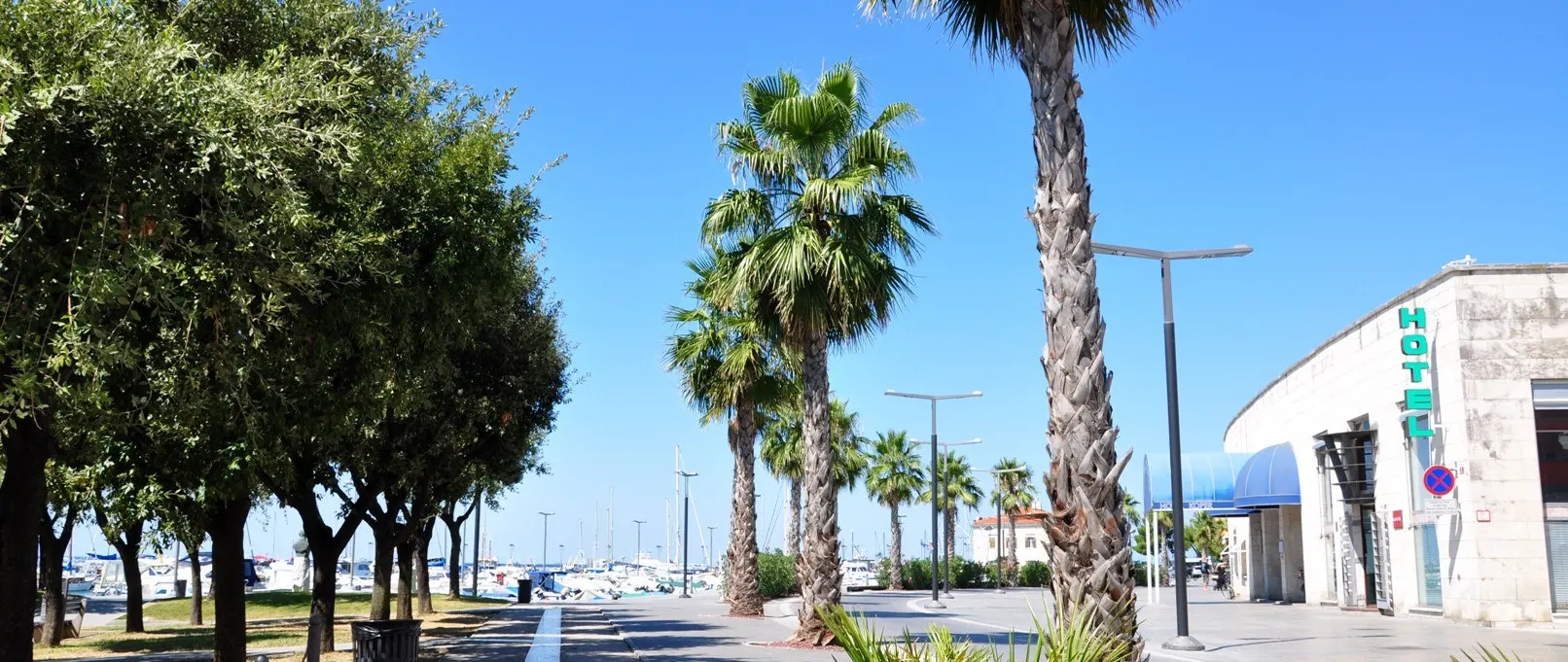
Koper rewards a programme that separates architectural sightseeing, a countryside excursion and a quieter nature visit. The yacht's captain should independently establish the suitability of facilities and use current official navigational information when preparing the passage. The accompanying licensed photograph records a view of Koper and is not evidence of today’s harbour capacity. Guests can enjoy the city's civic architecture, painting, local food and the landscapes beyond the coast even if the vessel itself is based elsewhere in the region. Rather than make the visit dependent on an immediate departure for the next destination, allow enough time for the historical and contemporary character of the city to emerge through its different spaces.
Sources and photograph
Source documentation: https://www.slovenia.info/en/places-to-go/regions/mediterranean-karst-slovenia/koper. Photograph: Koper — János Korom Dr. / Wikimedia Commons, CC BY-SA 2.0. Resized for web display under CC BY-SA 2.0.