A mechanical solution to a familiar problem
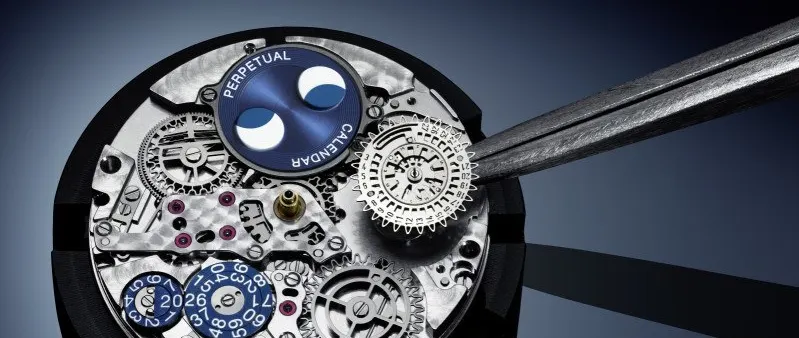
IWC Schaffhausen unveiled its ProSet perpetual-calendar system at Watches and Wonders Geneva in April 2026. The mechanism uses interconnected gears to coordinate the calendar indications while providing greater freedom over their adjustment. Its most relevant feature for an owner is the possibility of correcting the date forwards or backwards, something that has traditionally needed particular care in many complicated watches.
A perpetual calendar is built to recognise differences between months and leap years, but the setting process can still be frustrating when the watch has stopped. That practical difficulty is often overlooked in a discussion dominated by prestige and the number of visible indications. The ProSet approach shifts attention back toward everyday usability.
Why reversing a calendar is significant
Mechanical calendar mechanisms depend on the timed relationship between multiple indications. If a wearer moves some displays independently, the sequence can be disturbed or risk damaging delicate components. IWC says the new interconnected system keeps the displays coordinated while the correction is made, reducing the complexity of an operation that would otherwise demand careful instructions.
The engineering matters most to owners who rotate several watches and may leave one unworn for days or weeks. A practical setting system encourages a complicated watch to be enjoyed rather than avoided. As always, owners should follow the instructions supplied for the exact calibre, since a general description cannot replace the maker's service guidance.
A link to Kurt Klaus's work
IWC's modern reputation for calendar design is closely associated with Kurt Klaus, whose Da Vinci Perpetual Calendar Chronograph arrived in 1985. Its crown-based setting concept helped make a complex mechanism more approachable. ProSet builds on that history while exploring a different mechanical arrangement and a broader range of permitted corrections.
The connection is important because watchmaking innovation is not simply the addition of more parts. Simplifying the way a wearer operates an existing complication can be as meaningful as increasing its technical complexity. The decades between the Da Vinci and the new Big Pilot models illustrate how long manufacturers may continue refining a single design problem.
A notably precise moon-phase indication
IWC describes a moon-phase display whose gearing deviates by only one day after 1,040 years. That claim concerns the predicted alignment of the lunar indication, not the daily timekeeping accuracy of the movement. This distinction helps readers understand what an astronomical complication measures and why its accuracy is discussed differently from that of a balance wheel.
In use, a moon-phase display may be appreciated primarily for its appearance, yet its underlying mechanism can represent substantial design effort. Long theoretical correction intervals are compelling for collectors, although the watch will still need ordinary servicing and care. Precision in one display does not make any mechanical instrument exempt from maintenance.
Three initial Big Pilot interpretations
The launch included three Big Pilot's Watch versions using white ceramic, stainless steel and gold. A Le Petit Prince edition pairs ceramic with a deep blue gradient dial, while other variants express the new system through different materials and finishing. The range allows a collector to choose a style rather than treating the mechanism as inseparable from one particular colour.
Material selection affects weight, appearance and the kind of care a case may need. An attractive dial can draw attention first, but the mechanical innovation remains the main point of the release. Prospective buyers should compare current specifications and availability instead of assuming that the three launch examples have identical cases or prices.
A more usable kind of complication
The announcement dates from April 2026, so its significance in October is not that a new release occurred today. Rather, ProSet offers an instructive example of a manufacturer investing in what happens after a watch has been purchased. A complication that is easier to live with may give an owner more reasons to wear and enjoy it.
The verified facts concern the synchronised gear system, bidirectional adjustment, moon-phase gearing and the three initial models. Future servicing experience and long-term owner feedback will be useful measures of success. For collectors, the concept is a reminder that genuine technical refinement often lies in solving awkward practical problems.