An Ingenieur with a visible complication
IWC Schaffhausen presented the Ingenieur Tourbillon 41 at Watches and Wonders Geneva in April 2026. The model incorporates a flying minute tourbillon into a watch family associated with integrated bracelets and Gérald Genta's design legacy. It is a striking combination because the original Ingenieur's appeal lies in its robust sporting architecture rather than the overt display of complications.
The new reference does not abandon that identity. Its tourbillon opening occupies the six-o'clock position within a recognisable dial and case composition. The resulting contrast is likely to appeal to collectors who enjoy both mechanical movement and industrial design, while those preferring a quieter watch may favour the simpler Ingenieur models.
One hundred watches and a substantial gold case
Reference IW345901 is limited to one hundred pieces. The case measures 41.6 millimetres and is made from 18-carat 5N gold, with an integrated bracelet in precious metal. Five functional screws fasten the bezel, using the manufacturer's Armor Gold alloy. These details give the model considerable physical presence without replacing the established design language.
A heavy precious-metal sports watch offers a very different wearing experience from its stainless-steel counterpart. Prospective owners should consider the feel of the bracelet and whether the case dimensions suit their wrist. A production limit provides information about supply, but it does not by itself determine the value of the watch in a secondary market.
How a flying tourbillon works
The tourbillon contains elements of the regulating system inside a rotating cage, completing a revolution once each minute. Its historical purpose relates to positional effects on mechanical timekeeping, though modern wristwatches operate in conditions unlike those of stationary pocket watches. In a contemporary collector's watch, the visible mechanism also offers a direct view of elaborate movement construction.
A flying tourbillon is supported differently from some traditional arrangements, allowing a clearer view of its moving components from the dial side. Such a mechanism demands specialist manufacturing and careful assembly. Readers should distinguish the artistry of the complication from claims that it will necessarily outperform every well-adjusted conventional mechanical watch.
An olive-green grid against polished metal
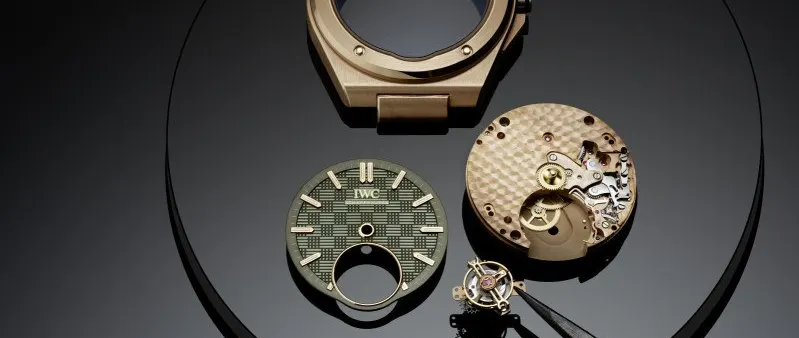
The watch combines an olive-green Grid dial with gold markers, polished facets and satin-brushed surfaces. The textured pattern reinforces a connection with the Ingenieur collection, while the opening for the tourbillon changes the visual balance. The interplay of green and gold gives the watch an individual identity even before its mechanism is considered.
Material contrast is particularly important on a watch worn close to the eye. Changes in light can bring polished edges forward or make the dial appear darker, so the object may look different from a catalogue photograph. These details are part of its attraction for collectors interested in how industrial design and finishing work together.
Movement technology behind the display
IWC uses its 82905 calibre with a Pellaton winding system incorporating ceramic elements. The movement can be viewed through a sapphire case back, adding a second perspective on its construction. For enthusiasts, the arrangement invites an appreciation of mechanical function as well as the deliberately conspicuous complication on the front.
Specialist movement servicing is an important ownership consideration. A tourbillon and an integrated precious-metal bracelet may require more planning than a standard time-only watch. Customers should confirm the maker's advice on handling, water resistance and maintenance for the exact reference they purchase.
A new chapter for a classic outline
The Ingenieur SL introduced in 1976 helped establish the visual vocabulary of this integrated-bracelet family. The 2026 gold tourbillon is a modern interpretation rather than an exact remake of the Genta-era watch. Its limited release illustrates the manufacturer's ability to expand a familiar design into a more elaborate category.
The verified facts are the limited production, materials, model reference, dial treatment and calibre. A buyer's interest should rest on those tangible features and the enjoyment of the mechanism. The continuing appeal of the Ingenieur lies in its recognisable design, even when its mechanical ambitions become more elaborate.