A watch with two very different appearances
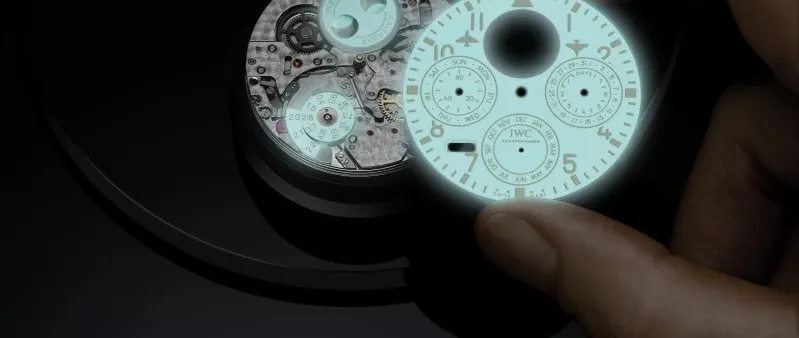
IWC Schaffhausen introduced the Big Pilot's Watch Perpetual Calendar Ceralume in April 2026, using proprietary luminous material across the case, dial and strap. By day the watch appears predominantly white, while stored light can produce a blue-toned glow after dark. The contrast makes the model a study in materials as well as a mechanical watch.
The result is more dramatic than a conventional application of luminous paint to hands and markers. IWC has used the case itself as part of the visual effect, challenging expectations of what ceramic should look like. Owners may enjoy the changing appearance, although actual brightness depends on exposure to light and the conditions in which it is viewed.
The engineering behind luminous ceramic
The company developed Ceralume with its experimental XPL team, combining expertise in technical ceramics with pigments that absorb and later release light. IWC compares the process with storing energy in a battery, though the material has no electrical power source. It is a carefully selected physical property of the ceramic mixture.
Ceramics are valued in watchmaking for surface hardness and the ability to produce distinct finishes, but specialised compounds can create new manufacturing challenges. A finished case must meet dimensional and aesthetic requirements while retaining its material characteristics. Such work illustrates why a watch's case can be as interesting technically as its movement.
A blue glow is not a permanent lamp
After exposure to sunlight or artificial illumination, the luminous material releases energy gradually as visible light. IWC states that a strong effect can persist for more than twenty-four hours under specified conditions. That claim should be understood in context, since ambient light, charging conditions and the observer's eyes influence how bright the watch appears.
Collectors should avoid treating luminous watch materials as maintenance-free or indestructible. The case and strap still face ordinary wear, and the manufacturer remains the correct source of guidance on cleaning and replacement. The glow is the appeal of the watch, but durability and service arrangements are equally relevant to ownership.
A full perpetual calendar inside
The reference IW505801 also incorporates a perpetual calendar within a substantial 46.5-millimetre Big Pilot case. A calendar of this kind accounts mechanically for the differing lengths of months and leap years when kept correctly set and running. Its indications add a traditional complicated-watch dimension to an otherwise futuristic surface treatment.
This pairing of conventional mechanism and unusual material makes the watch distinctive. It asks the wearer to appreciate a slowly changing astronomical display and an immediate visual transformation from light to darkness. Both features can be fascinating, but both should be understood through the maker's instructions rather than marketing shorthand.
Only 250 pieces in the edition
IWC has stated a limit of 250 examples, giving the model a defined production run. That may appeal to dedicated collectors, but an edition number does not determine future financial performance. The condition of the ceramic, completeness of the package and clear documentation are more useful starting points when evaluating an individual piece.
The large case and strong visual presence also make fit a practical consideration. Buyers should try on the model where possible and compare its proportions with other Big Pilot references. A striking catalogue image cannot reliably show how a watch sits beneath a sleeve or feels during a long day.
Why Ceralume matters beyond its glow
The April announcement is part of IWC's ongoing experimentation with ceramic materials, not a new October launch. Its significance lies in showing how colour and surface behaviour can be engineered into a recognisable watch design without giving up a complex mechanical movement.
The confirmed story is the luminous case, dial and strap, perpetual calendar and 250-piece edition. The effect is visually unusual, but the lasting interest will depend on how well the material and complication perform during ownership. It illustrates the meeting of materials science and traditional mechanical watchmaking.