An exhibition centred on the mystery of light
A single lamp illuminating a group of people in a darkened room is among the most powerful situations imagined by the British painter Joseph Wright of Derby. This November, Los Angeles visitors will have an opportunity to study a particularly revealing group of his paintings together. The Getty Center's A Light in the Dark exhibition, opening on 24 November 2026 and continuing until 14 March 2027, examines Wright's development as a painter of artificially illuminated interiors. It brings together pictures that are usually separated by geography and ownership, prompted by the emergence of a work long thought lost and acquired by the Getty in 2020. For a yacht owner with an interest in art, collecting or the design of intimate interiors, the subject has particular appeal. Wright demonstrates how much visual drama can emerge from an apparently simple arrangement: people, a small number of objects and carefully directed illumination. The exhibition provides an opportunity to look at the original material evidence behind that effect rather than admire it only through reproductions.
A provincial artist in metropolitan exhibition rooms
Wright was born in Derby in 1734 and died there in 1797. His distinctive designation, Wright of Derby, distinguishes him geographically and also reflects a career associated with a town whose intellectual and industrial life formed an important backdrop to British painting. He learned his profession through portraiture, a discipline that demanded attention to character, expression, fabric and the representation of a human presence on canvas. During the 1760s, he began applying those skills to dark interiors dominated by a concentrated source of light. These are not simply portraits placed in a dim room. His subjects increasingly concerned what people were doing together: examining a sculpture, looking at a model of the solar system or investigating an everyday object. The annual exhibitions at which they appeared in London offered a competitive environment for a painter who wanted his works to attract attention. A picture with startling contrasts of brightness and darkness offered a different experience from the evenly illuminated portraits surrounding it. The Getty's research considers how Wright developed that visual language.
The Orrery: a painting of shared curiosity
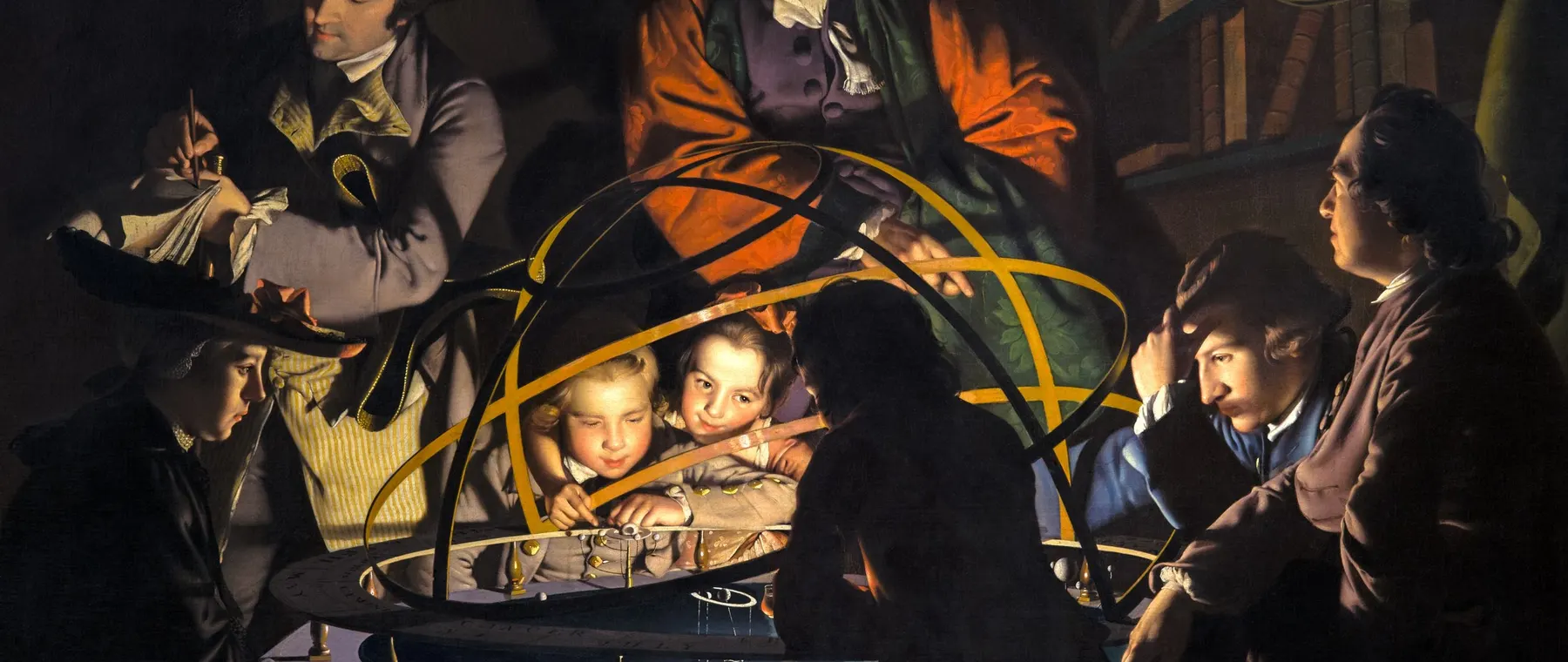
One of the most important loans is the large 1766 painting from Derby Museums generally known as The Orrery. At its centre is a mechanical representation of the solar system, with a lamp occupying the position of the sun. Wright has arranged a group of people around the device, their faces receiving different amounts of its light. The result is a composition about understanding as well as seeing. Instead of making the astronomical mechanism the sole subject, the artist directs attention to the relationship between the people and the demonstration. The varying positions of their hands, faces and bodies invite the viewer to consider how each participant experiences the moment. Scientific instruction becomes an occasion for contemplation, collective interest and emotional response. In its original scale, approximately two metres wide, the work offers a very different encounter from the small images familiar from books or screens. The public-domain reproduction accompanying this article illustrates the composition; it cannot convey every quality of the actual painted surface.
The difference between depicting a lamp and creating its effect
A painter has no actual flame within the finished picture. The appearance of light depends on the interaction of pigments, ground layers, contrasts and other material choices, together with the way the painting is illuminated when viewed. Wright's achievement lies partly in the precision with which he persuades the eye that the represented objects are receiving light from a particular source. A face positioned close to that source can become the most legible element, while somebody further from it is visible in more restricted passages of colour and form. This gives the composition a kind of visual hierarchy independent of the social rank of the sitters. Details emerge gradually as attention moves into the shadows. The experience provides a useful comparison with architectural lighting. An interior can become more interesting when its brightest areas are chosen deliberately, rather than when every surface is illuminated equally. That is an aesthetic observation, not an argument that eighteenth-century pictures should be displayed under actual candles or that subdued lighting is appropriate to every space aboard a yacht.
A rediscovered painting changes the chronology
The Getty's acquisition of Two Boys with a Bladder in 2020 provided the starting point for this exhibition. In the painting, children investigate an inflated animal bladder in the glow of a concealed flame. The subject is less grand than the astronomical demonstration, but its concentration on the behaviour of light passing through a material is similarly compelling. The institution's exhibition research connects the painting with the works Wright displayed in London in 1767, alongside Two Girls Dressing a Kitten by Candlelight, now at Kenwood. Seeing the two compositions together promises to give visitors an unusual opportunity to compare their scale, arrangements and approach to illuminated objects. It also exemplifies how a rediscovered picture can become more significant than the addition of one name to a museum collection. It can alter the interpretation of a period of an artist's career and create new questions about relationships between works. Collectors benefit from such research because a picture's significance is often understood through documentary and material evidence extending far beyond its appearance.
Silver leaf beneath the painted surface
Perhaps the most fascinating technical development in the exhibition concerns Wright's use of silver. Getty researchers report that he introduced silver leaf into some of his candlelight compositions from 1767 onwards, placing it in areas intended to appear illuminated through materials such as cloth, paper or an expanded bladder. Modern investigation allows conservators to examine the distribution of that metal within the paintings. X-ray fluorescence mapping is one of the methods used by Getty's research team to determine where silver is present. The results provide a basis for reconsidering the relationship between a surface effect and the layers producing it. This is a particularly good example of scientific analysis informing art history. Rather than simply decide that a luminous passage appears unusual, researchers can compare the material composition of different works. The museum describes the silver-leaf approach as distinctive among known British paintings of the period. It should not be understood as evidence that every Wright candlelight uses the same combination of materials, or as a simple application recipe that explains his entire style.
The collector's interest in material history
The exhibition offers an instructive perspective for the owner of an older painting or someone considering a collection. A reputable assessment of an artwork involves more than recognising an artist's characteristic subject or identifying attractive colours. The construction of the support, condition of the surface, materials, history of conservation and documented ownership can all be important. Some changes in appearance are the consequence of the ageing of original materials; others follow later restoration or the conditions in which a picture has been displayed. A painting's conservation history therefore deserves attention even when its appearance is especially appealing. Scientific evidence can clarify aspects of technique, although it is not necessarily sufficient to authenticate a work in isolation. Documentary research and specialist judgment remain important. The Getty exhibition illustrates the benefits of bringing these forms of investigation together. It is also an invitation to approach a gallery as a place of discovery rather than a catalogue of prestigious objects. The knowledge gained may enrich the enjoyment of collections aboard and ashore.
Prints and the circulation of Wright's images
The exhibition also includes historic prints made after some of Wright's compositions, among them a mezzotint of an air-pump experiment by Valentine Green. Mezzotint is particularly well suited to exploring the gradations between darkness and brightness that make Wright’s pictures so distinctive. A print is a separate work with its own material structure and history, not merely the inferior version of an oil painting. Such reproductions helped his imagery reach people who could not view or acquire the original canvases. In the context of eighteenth-century culture, that circulation encouraged familiarity with subjects and compositions far beyond the exhibition rooms where the paintings first appeared. For a modern visitor, comparing print and painting can illuminate what survives the translation from colour into tonal variation and what is transformed in the process. For someone interested in building a collection, historic prints may provide a different field of study from major oil paintings. Individual impressions still require specialist evaluation of their origin, condition and quality.
And the light aboard a contemporary yacht
The central artistic questions of this exhibition resonate with the character of a well-designed yacht interior. Windows, reflective surfaces, upholstery and joinery can all appear profoundly different when exposed to coastal daylight, artificial lighting at anchor or changing weather. Wright's paintings remind the viewer that illumination is not just a matter of adequate visibility: it also determines where attention gathers and how surfaces relate to one another. Owners commissioning or refurbishing an interior may find inspiration in the use of contrast, carefully placed pools of light and materials whose texture changes according to angle and intensity. Real yacht lighting nevertheless has practical obligations that a painted interior does not. Safe passage through accommodation, clear controls, emergency illumination and appropriate working light must be preserved. Fine art displayed aboard requires professional advice on vibration, movement, humidity and exposure to sunlight. The aesthetic principle to take from Wright is the expressive potential of thoughtful illumination, not a prescription for dark machinery spaces or vulnerable museum objects at sea.
Planning a visit to the Getty Center
The Getty's official exhibition listing places A Light in the Dark in the West Pavilion at plaza level. Admission is included with the museum's free timed-entry reservation, with parking charged separately. The exhibition runs from 24 November through 14 March, so a California itinerary over the winter offers several opportunities to see it. The Getty also lists a curator discussion on 6 December and a further event about conservation research on 12 March 2027; consult the individual event pages for local times and booking arrangements. The accompanying 144-page catalogue, edited by Julia Siemon, is priced at $30 in the institution's announcement. It provides a way to extend the experience after leaving the gallery, particularly for someone interested in the paintings' technical and documentary background. The exhibition checklist may be requested from paintings@getty.edu, as published on Getty's exhibition page. No marina arrangements or visitor reservations have been made. For a yacht owner planning a Los Angeles stay, the appeal is an intelligently curated shore excursion with a reason to return to the pictures and their remarkable light.
Sources and photograph
Source documentation: https://www.getty.edu/news/getty-exhibition-joseph-wright-of-derby/, https://www.getty.edu/exhibitions/wright-of-derby/, https://www.getty.edu/news/new-getty-book-offers-timely-reexamination-of-joseph-wright-via-his-distinctive-candlelight-paintings/. Photograph: Joseph Wright of Derby, A Philosopher Lecturing on the Orrery, 1766 — Joseph Wright of Derby / Derby Museums, via Wikimedia Commons — public domain reproduction. Resized for web display under Public Domain Mark 1.0.