A new design prize reaches Miami
FENDI is preparing to present *VIA*, a furniture collection by Gustav Craft, at Design Miami in December 2026. The project won the inaugural FENDI Design Prize, announced during Milan Design Week in April, and the Miami presentation is a public opportunity to examine how the designer has translated the language of Roman streets into contemporary furniture. Rather than starting with a decorative motif borrowed from a handbag, *VIA* takes its point of departure from the sanpietrino, the dark basalt paving blocks that form part of the everyday fabric of Rome. The work connects the city's physical heritage with materials and techniques associated with the fashion house, including polished metal and hand-woven saddle leather. The designer describes it as a five-piece furniture collection. For collectors interested in luxury interiors, the appeal is not that the pieces are automatically rare investment objects, but that they propose a coherent relationship between place, making and use. The announcement should be described as a forthcoming Design Miami presentation, not an exhibition that has already opened on 26 November.
The prize and its first winner
FENDI launched the annual Design Prize to identify and support emerging creative talent while maintaining a connection with the house's interest in workmanship and materials. Gustav Craft was named the first winner on 19 April 2026, selected from six finalists, and the project has since been developed for presentation in Miami. FENDI identifies the possibility of further collaboration with FENDI Casa in 2027, but that possibility is not a guarantee of mass production or an announced retail catalogue. A design prize has a different purpose from a commercial furniture launch. It allows a designer to develop and demonstrate an idea with resources and attention that might not otherwise be available. The final work can generate discussion even when its future production arrangements are uncertain. A prospective collector should understand whether a piece is an exhibition prototype, a commissioned edition or a product available for order. The status of each item matters when evaluating provenance, service and long-term ownership.
Starting with the stones beneath one's feet
The central concept of *VIA* is unusually grounded. Gustav Craft describes looking down at Rome's sampietrini, the small basalt blocks that pave streets and plazas, rather than looking only at the monuments that attract visitors' attention. The observation changes the scale of design. A familiar piece of urban infrastructure becomes the origin of furniture intended for an intimate interior. The stone paving is arranged in repeated units, with joints and the wear of use contributing to its appearance. The collection translates aspects of that practical language into contemporary forms rather than reproducing a miniature road inside a room. Such a process can give a new object a meaningful connection to its source without requiring a literal historical replica. The idea may appeal to travellers who value a city's lesser-known details: the way a material feels, the rhythm of a street or the evidence of generations of craft. A luxury object can carry those associations without making exaggerated claims about its age.
Basaltina from Viterbo
The designer identifies Basaltina, a volcanic stone from the area around Viterbo, as one of the collection's materials. In *VIA*, the mirror is described as standing on a single block of the stone. That detail establishes a link between the project's Roman inspiration and the material used in its construction. Stone can provide visual weight and a sense of permanence, but it also requires careful consideration of mass and support. A free-standing object with a substantial stone element must be designed for stability, floor loading and safe handling. A yacht owner considering comparable stone furniture aboard would have additional questions about weight distribution, securing systems and the response of the object to movement at sea. The designer has not announced that *VIA* was engineered for marine use, and it should not be presented as ready to install on a yacht without technical assessment. The relevant inspiration is the disciplined use of a distinctive material, not an assumption that every luxury object suits every environment.
Visible welds as a design decision
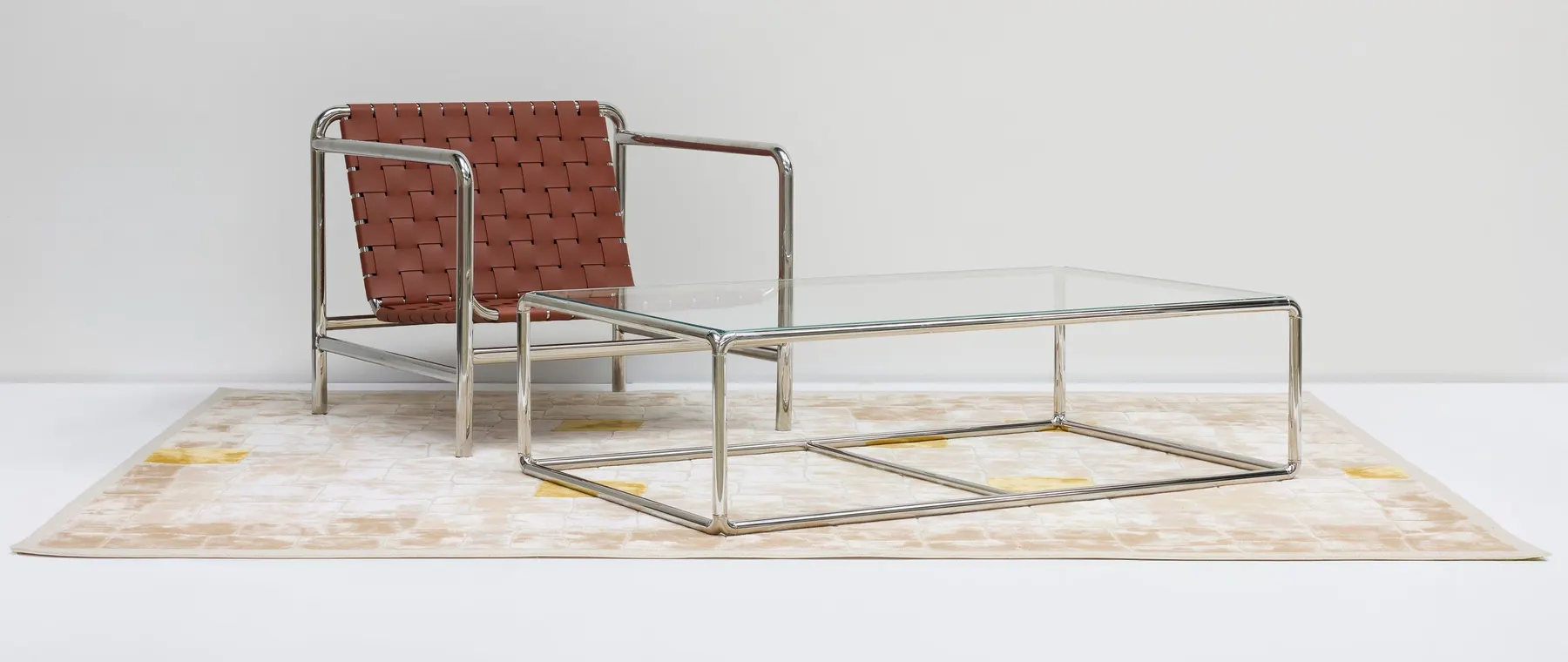
Gustav Craft's own description identifies polished stainless steel tubing and TIG welds that are deliberately left visible rather than ground away. That is an interesting departure from a common luxury expectation that the processes of making should be completely concealed. A visible weld can reveal the logic of how an object is assembled, although it must still be executed cleanly and safely. The decision creates a relationship between construction and decoration: the joint is not hidden behind a cover but becomes part of the appearance. Collectors may appreciate this directness because it invites attention to technique, not simply surface finish. Yet a visible weld is not automatically a sign of superior engineering. Structural performance depends on correct material selection, design and fabrication. The value in this case lies in the way the maker chooses to communicate process. The object acknowledges its manufacture rather than pretending to be an effortless single form.
Hand-woven saddle leather
The collection incorporates hand-woven saddle leather associated with FENDI's Selleria tradition. This introduces a softer, tactile element alongside the harder steel and stone. The combination invites a person to notice how different materials behave in proximity. Leather can develop character with use, while polished steel reflects light and requires cleaning to preserve its finish. The designer has to establish a convincing relationship between them rather than use contrast as a purely decorative device. Handwork is relevant because each repeated movement can give a surface a distinctive character, although the exact durability depends on material quality and construction. Anyone considering such furniture should ask about cleaning, exposure to strong sunlight and the possibility of repair. Leather used in a frequently occupied interior faces different demands from leather displayed in a gallery. The presence of a luxury label does not remove the need for practical information. Good design should remain understandable when the object leaves the exhibition setting.
Five pieces, one coherent language
Gustav Craft describes *VIA* as a five-piece furniture collection. The point of a collection is not simply to place several unrelated objects under a shared name; it is to explore an idea through distinct functional forms. The designer's published project material identifies stone, stainless steel, saddle leather, glass and wool among the materials. Each brings different handling and maintenance considerations. A mirror, for example, has a particular relationship with light and movement, while seating requires attention to ergonomics. Without final retail specifications, it would be inappropriate to claim that each piece has already entered commercial production or quote dimensions that the designer has not confirmed. Collectors can nevertheless evaluate the consistency of the design language. Do repeated construction details feel purposeful? Are the materials selected for reasons that follow from the original concept? The strength of a furniture collection often depends on whether its pieces remain convincing individually while also belonging together.
FENDI Casa and the boundary between fashion and furniture
The project illustrates how a fashion house can engage with furniture in a way that goes beyond transferring a logo onto a familiar object. FENDI's involvement gives the designer access to a tradition of leatherwork and a wider conversation about contemporary interiors. The arrangement also asks whether materials commonly associated with accessories can be translated into furniture without losing their purpose. Saddle leather may become structural or tactile rather than simply a signifier of brand identity. A successful collaboration should offer a reason for the design to exist beyond publicity. This can be particularly important in a crowded collectible-design market where many objects compete for attention. A buyer may recognise a brand immediately, but the object will need its own formal and material appeal to remain interesting years later. The FENDI Design Prize offers a framework for developing that appeal through a named designer's independent concept.
What makes collectible furniture different?
Collectible design occupies a space between ordinary retail furniture and autonomous art objects. A piece may be intended for use yet also attract attention because of its authorship, production method or limited availability. Collectors need to know what they are purchasing: a unique commission, a numbered edition, an open edition or a production object that may remain on sale. The *VIA* announcement establishes an award-winning project and exhibition, not a complete price list or resale history. Any financial claim should therefore be treated cautiously. Documentation about materials, creator, fabrication date and repair methods can be valuable, particularly when unfamiliar components are used. A collector also needs to consider whether the object will remain functional in an ordinary home. A sculptural chair can be beautiful without being comfortable for prolonged use, and a dramatic mirror may require more space than first appears. Ownership decisions deserve the same scrutiny as any significant design acquisition.
The December 2026 exhibition context
Design Miami is scheduled for 1–6 December 2026, during the wider period of Miami's art and design programming. The organiser's 2026 partner programme identifies FENDI's presentation specifically as *VIA* by Gustav Craft, a winner of the first Design Prize. This is separate from the fair's general gallery displays and from earlier FENDI collaborations at previous editions. Visitors should verify the final visitor schedule, ticket conditions and the location of the partner installation rather than assume that all programmes have identical access arrangements. The fair is still in the future as of 26 November. Publicity images show the intended design work or preparatory presentation, not proof that the final stand has been installed and inspected. An informed visitor can use the current announcement to decide which collections to study more closely once the doors open. The most useful evaluation will take place in person, where materials, scale and detail can be understood beyond the limits of photography.
How to view the work intelligently
Visitors interested in design should begin by looking closely at connections: where metal meets leather, where stone carries the mirror and where individual elements are intentionally left visible. These details can reveal whether a work's underlying concept is expressed consistently. Photography may exaggerate a particular silhouette while concealing how an object is assembled. If the exhibition permits inspection at close range, visitors may see qualities that are difficult to communicate in a flat image. Questions about the number of pieces made, the fabrication partners and the development process may also help establish the project's significance. Collectors should not assume that every element on a fair stand is available to purchase or that the object can be altered without affecting its provenance. A careful enquiry through the appropriate representative can establish the work's actual status. The aim is to understand why the piece is distinctive, not merely to identify its brand.
A lesson for yacht and residential interiors
An owner considering bespoke furniture for a yacht may find *VIA* inspiring because it shows how one strong idea can guide a family of objects. The important lesson is not to install heavy basalt blocks aboard a vessel without engineering checks. It is to choose a meaningful source and translate it through appropriate materials and craftsmanship. A yacht interior might draw on a port's history or a particular landscape while retaining the practical requirements of weight, movement and moisture exposure. Steel and leather can be used in marine interiors, but material grades, surface treatments, supports and maintenance must suit the environment. The FENDI project does not establish those specifications for yacht use. Instead it offers a way of thinking about design: visible making can be part of the experience, and materials can tell a story without becoming literal themed decoration. That approach can create interiors with lasting personal significance.
The value of emerging creative voices
The introduction of an annual Design Prize is significant because it provides a new platform for early-career designers to develop work with an established luxury house. An exhibition at a well-known international fair can bring a project into contact with collectors, galleries and design professionals. Yet an award alone does not ensure a successful career or sustained production. The designer still needs to balance creative ambitions with the demands of fabrication, pricing and customers. The importance of the prize will be better established through the work it helps realise over several years. Gustav Craft's first-winning project makes a specific proposition: rather than chasing novelty through unfamiliar materials, it re-examines ordinary urban fabric and skilled construction. That proposition may prove more durable than a design conceived only to surprise visitors for a few minutes. The test will be whether the objects reward repeated viewing and use.
A preview, not a review of a completed fair
The confirmed facts are the inaugural FENDI Design Prize, Gustav Craft's *VIA* as the winning project, the collection's five-piece composition and its use of polished steel, hand-woven saddle leather and Basaltina stone. The Design Miami presentation is scheduled for December 2026, and the designer identifies a possible connection with future FENDI Casa work. As of 26 November there is no basis to claim that the fair has opened or that the installation has won an additional award in Miami. The most meaningful aspect of the announcement is how its Roman street-paving inspiration has been developed into a collection with a strong material identity. For Luxury Yacht Guide's readers who follow collectible design, this is a reason to watch a new designer and a contemporary luxury house working at the boundary between furniture, craft and cultural storytelling. It remains a creative project whose long-term significance will become clearer after the presentation.
Original sources and manufacturer-supplied image
The project's materials, five-piece composition and sanpietrino concept come from Gustav Craft's official *VIA* project page. Its FENDI Design Prize status is confirmed by FENDI's official prize information, and the scheduled Miami presentation appears on the Design Miami 2026 partner programme. The lead visual is the original FENDI partner publicity photograph published by Design Miami for this announced installation. Credit: FENDI / Design Miami; photographer and all additional rights remain with their original holder. The image is used only as attributed editorial illustration of *VIA* and does not establish final sale availability.