An Atlantic race inspires a pair of watches
The Route du Rhum – Destination Guadeloupe has inspired a new pair of Alpina watches that bring the visual language of offshore sailing into everyday watchmaking. The Swiss brand is the official timekeeper of the race's thirteenth edition and has introduced limited versions of its Seastrong Diver Extreme Automatic and Alpiner Extreme Solarmetre. Both employ turquoise details recalling Caribbean waters, with the race route engraved on the caseback. Their appeal lies in a shared maritime identity but quite different ways of keeping time.
The collection was announced ahead of the race, which began from Saint-Malo on 1 November 2026, bound for Pointe-à-Pitre in Guadeloupe. This is not a newly announced release on 7 November; it is a timely look at the watches while the transatlantic event is under way. Alpina also supports French skipper Éric Péron. Its connection with the race is therefore more substantial than a casual nautical colourway, even though the watches remain luxury personal accessories rather than required equipment for competitors.
Two mechanical ideas, two styles of ownership
The fundamental distinction is in the movement. The Seastrong is an automatic mechanical dive-style watch, powered by the movements of its wearer when worn regularly. The Alpiner is a solar-powered watch that converts light into stored electrical energy. These designs speak to different ideas of endurance: one celebrates the mechanisms and tradition of Swiss mechanical watchmaking; the other aims to keep running with little routine attention as long as it receives sufficient light.
Neither technology is inherently superior for every yacht owner. An automatic watch offers a particular tactile and emotional appeal and needs to be kept wound or reset when left unused. A light-powered watch is a practical alternative for someone who rotates among timepieces and likes a long reserve when the watch is stored. The choice also depends on case dimensions, appearance, strap comfort and the kind of use a buyer expects, not simply on whether a brochure includes an ocean-going photograph.
Seastrong Diver Extreme Automatic: the physical details
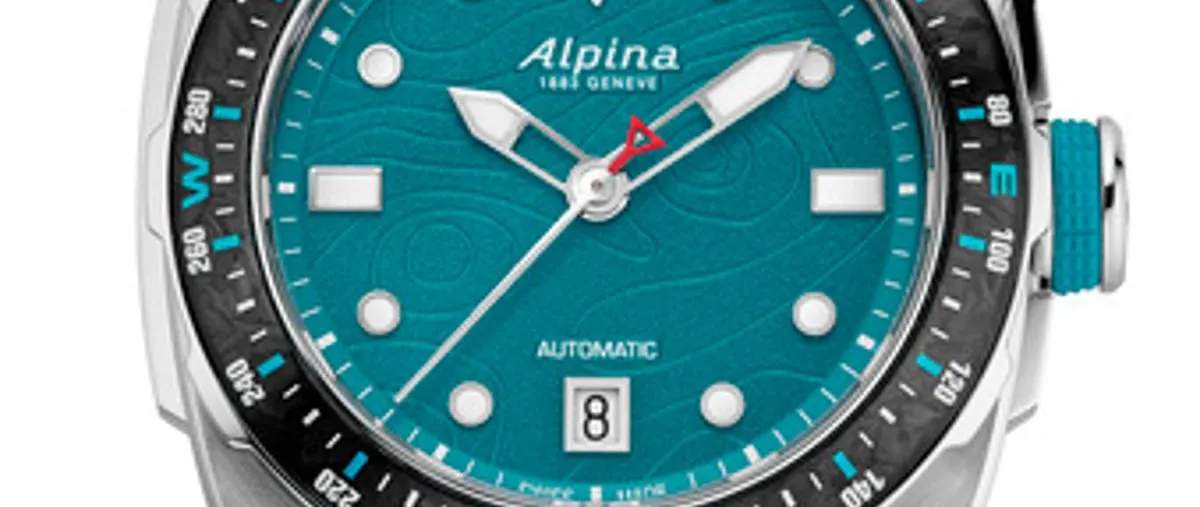
The Seastrong Diver Extreme Automatic Route du Rhum edition is limited to 313 individually numbered pieces, a reference to the race's thirteenth running. Alpina describes a steel case measuring approximately 39 by 40.5 millimetres, with a turquoise dial whose design evokes Atlantic currents. A carbon-insert bezel has compass-style cardinal points and degree markings, while the date display includes a small red number thirteen. The distinctive palette continues onto a textured rubber strap.
The stated water-resistance rating is 300 metres, supported by a screw-down crown with a rubber grip. It is a robust specification for a sports watch, though a water-resistance rating should never be interpreted as a promise that all forms of diving or impact are safe without checking the manufacturer's operating guidance. More importantly, the compass markings are a design and orientation reference, not a substitute for calibrated navigation equipment. A yacht's helm still needs the instruments, charts and competent decisions appropriate to the voyage.
The subtle distinction between an emblem and a tool
It is tempting to turn any nautical watch into a romantic story of personal survival at sea. The Seastrong's design does refer to ocean currents, a compass and a transatlantic route, but none of those features makes it the equivalent of a yacht's navigation system. An engraved route records the edition's inspiration; it does not guide the wearer across the Atlantic. Similarly, the water-resistance specification indicates a tested aspect of case construction, not a comprehensive statement about the watch's fitness for a particular crew role.
That distinction actually strengthens the design. A watch can be appreciated as an expression of taste and craftsmanship without pretending to perform functions it was not built to provide. For a luxury-yachting audience, the Seastrong is best viewed as a marine-inflected personal timepiece with a genuine link to a recognised race. It belongs to the culture surrounding sailing as much as to the practical experience of standing watch.
Alpiner Extreme Solarmetre: autonomy through light
The Alpiner Extreme Solarmetre is the more technically contrasting member of the pair. It uses a 37.5-millimetre cushion-shaped steel case and a translucent dial through which light reaches the solar energy system. Alpina says that one minute of suitable light can supply approximately a day's operation, while a fully charged watch can run for up to ten months in total darkness. These are the brand's stated performance figures, not independent laboratory results assessed by Luxury Yacht Guide.
The limited run comprises 513 numbered watches, again drawing on the thirteenth edition of the race. Its design shares turquoise elements, a carbon accent and a rubber strap with the Seastrong, with the route engraved on the back. The smaller case may appeal to owners who prefer a less assertive wrist presence. The Solarmetre's ten-atmosphere water-resistance specification is also different from the Seastrong's 300-metre claim, and the two should not be treated as interchangeable in demanding water activities.
What solar power means on a yacht
Solar charging is easy to misunderstand because a watch is not a solar panel for the boat. It collects a very small amount of energy to operate its own movement. It does not power other devices, and the movement still depends on an internal rechargeable energy store. The benefit is reduced attention to periodic winding and battery maintenance, provided the watch receives suitable light over time.
For owners moving between long sailing passages and periods ashore, that may be appealing. Watches are often left in cabins, travel bags or drawers for days. Alpina's lengthy claimed dark reserve seeks to reduce the inconvenience of discovering that a rarely worn watch has stopped. Yet storage conditions, light exposure and long-term servicing remain practical considerations. The correct starting point is the instruction manual supplied with the watch, particularly when placing a watch under strong sunlight or near heat.
Why Route du Rhum is an appropriate partner
The Route du Rhum is a single-handed transatlantic race whose course takes competitors from the French Atlantic coast to the Caribbean. Unlike a short inshore regatta, it draws attention to fatigue, weather windows, self-reliance and the challenge of maintaining concentration for an extended period. That imagery naturally resonates with a watch brand seeking to communicate durability and independence.
Alpina's official timekeeping role and its support for Éric Péron create a specific connection to this edition. The caseback engraving provides a tangible reminder of the passage, while the edition counts add a collector-oriented detail. For an owner familiar with the race through spectator interest rather than direct competition, the watches offer a way to commemorate an event without presenting the product as a replica of specialist sailing electronics.
The turquoise decision and the rest of the design
Colour is often the quickest way for a watchmaker to signal a nautical collection, and it can also be the least convincing. Here Alpina has placed turquoise into a more complete design story: ocean-current patterning on the Seastrong dial, a race-route engraving and references to compass instrumentation. The vibrant colour stands out against the darker technical elements and steel cases. The visual effect may suit casual coastal dress more readily than formal tailoring, although personal style decides the outcome.
Limited editions also carry an obvious risk for design enthusiasts. When an event reference is applied too heavily, a watch can become a souvenir rather than an enduring object. The Seastrong and Alpiner retain the recognisable shapes of their parent collections, which helps explain the approach. Owners are not being asked to wear a miniature racing poster on the wrist; they are being offered variants of existing watches with an identifiable link to an Atlantic event.
Collectibility, supply and sensible expectations
Alpina's own material identifies the two runs as 313 and 513 pieces. Limited numbers can attract collectors, but they do not establish future resale value, rarity in any wider market or a financial return. Watches should be assessed primarily for their desirability, condition, serviceability and fit. Availability and regional pricing can change, and the manufacturer's website should be consulted for the current offer rather than relying on an old advertised figure.
An owner considering either model may also want to compare the specifications that are easy to miss in a headline. The mechanical Seastrong and solar Alpiner differ in water-resistance rating, case dimensions and movement type. The rubber straps fit an active, informal setting, but long-term comfort depends on the individual wrist. Limited editions are most satisfying when the buyer enjoys the watch itself and sees the event connection as an added pleasure.
A watch is not a safety system
There is a useful editorial point whenever sports watches appear alongside offshore racing. A watch is not a replacement for a suitable chartplotter, a dependable time source at the navigation station, a working VHF radio, or the personal safety devices and procedures demanded by conditions. Digital race tracking, safety communications and emergency arrangements should be treated separately from jewellery and wristwear, regardless of marketing language about extreme environments.
Conversely, personal equipment can have a legitimate place in life aboard. A comfortable, legible watch is convenient during an ordinary day's sailing, and an owner may prefer something resilient enough for damp decks and informal shore excursions. The Alpina pieces sit within this latter category: sports watches designed with marine themes, one mechanical and one solar. Their enjoyment need not depend on a claim that they could replace the dedicated systems of a properly prepared yacht.
A well-timed maritime collection
As the 2026 Route du Rhum unfolds, Alpina's pair of limited editions illustrates how watchmakers can connect established products with authentic sporting partnerships. The Seastrong Diver Extreme Automatic offers an emphatic dive-watch profile and a mechanical movement; the Alpiner Extreme Solarmetre offers a smaller solar-powered alternative with unusually long claimed autonomy in darkness. Both tie their appearance to the Saint-Malo–Guadeloupe course.
For Luxury Yacht Guide readers, the most interesting question is not whether a turquoise watch makes someone a better sailor. It is whether the design, technology and relationship to a race with genuine offshore character form a watch worth wearing long after the finish. Alpina has supplied two contrasting answers, and the choice between them is as personal as the way an owner uses a yacht.
Official Alpina press photograph of the Route du Rhum limited-edition Seastrong Diver Extreme Automatic, distributed in the manufacturer's press media gallery via Lulop.
Sources: Alpina, Route du Rhum limited editions; Route du Rhum official partner announcement; Alpina press release and official photography media gallery.