Nine watches and a chapter of American watchmaking
Jaeger-LeCoultre has opened the eighth edition of its Collectibles programme in New York with nine restored vintage watches made for the American market between 1933 and 1981. The pieces are presented at the house's flagship boutique on Madison Avenue from 6 to 20 November 2026 and are being offered for purchase to collectors worldwide. This is not a conventional launch of nine newly manufactured watches. The story is about the return to the market of historical objects, their restoration by the manufacturer's own specialists and a period when an American LeCoultre signature appeared on watches assembled for that market.
The selection coincides with the 250th anniversary year of the United States' Declaration of Independence. Jaeger-LeCoultre says it has used its archives to examine a relationship with American customers extending back to the 1930s. The result is a capsule that combines comparatively familiar design families, such as the Reverso and Memovox, with less usual expressions including a rectangular Triple Calendar and a watch concealed inside a gold coin. Their common feature is not identical styling but an American story: the way regulation, taste and technical experimentation shaped what the brand supplied across the Atlantic.
Why LeCoultre appeared on American dials
A collector encountering an old LeCoultre watch might wonder how it relates to the contemporary Jaeger-LeCoultre manufacture. The company's account explains that its American presence developed under different trading arrangements from those in Europe. Jaeger Inc. was established in New York in 1926, while LeCoultre S.H. of America opened an office in 1936. The LeCoultre name subsequently became a characteristic signature on US-market watch dials. This historical naming practice matters in authentication because a dial bearing LeCoultre alone is not automatically evidence of an unrelated manufacturer.
The business environment also influenced the watches themselves. The United States applied import duties whose cost could depend on the value and specification of a complete watch. The brand's solution, according to its archives, was to export Swiss movements with dials and hands for American assembly, while cases could be produced locally. Some US-market movements carried 17 jewels and the VXN customs code. Such details are significant because they help explain why an apparently familiar calibre might sit within a case whose proportions and materials differ from a corresponding European version.
Jaeger-LeCoultre notes that gold-filled cases and 14-karat gold designs became part of this language. Distinctive lugs, warmer dial colours and unusual case shapes followed. The resulting watches were not simply European references with another retail address; in some instances, they developed an identity of their own. For collectors who examine original case construction, dial printing, movement markings and period-correct parts, the American LeCoultre chapter is therefore a substantial field of study. Aesthetic appeal is one consideration, but provenance and coherence of the components are equally important.
The earliest Reverso in the capsule
One highlight is a 1933 Reverso with a rare chocolate-brown dial. The manufacture identifies its movement as Calibre 410, developed specifically for the Reverso and incorporating small seconds at six o'clock. The rich dial colour was reportedly available only on special request. A steel case and brown leather strap complete the presentation. The Reverso's rotating rectangular case has become widely recognisable, but a historic example such as this cannot be judged by contemporary dimensions or finishes. Its interest lies in the convergence of a formative design, an early in-house movement and an unusual original dial choice.
The announcement also features two expressions of the Triple Calendar. A 1947 example combines steel, a pink-gold bezel and a copper-coloured dial around Calibre 494, with calendar displays and an integrated moon phase. The manufacture draws particular attention to a circa-1952 Reference 2726, an exceptionally rare rectangular Triple Calendar rather than the more typical round format. It has an 18-karat yellow-gold case and Calibre 484. The model was introduced as a tribute to Jacques-David LeCoultre, an important figure in the manufacture's development and American expansion.
Powermatic and the appeal of mechanical ingenuity
Two Powermatic watches help to tell the story of the self-winding wristwatch. The Powermatic family, introduced in 1949, made the display of remaining power a visible part of daily use. Its Calibre 481 placed a power-reserve indicator on the dial, a useful reassurance when an automatic watch had not been worn continuously. For a contemporary buyer accustomed to digital battery percentages, the complication has an appealing mechanical directness: it communicates the energy available in the spring without electronic assistance.
The circa-1950 Powermatic Nautilus in the New York selection is distinguished by extended lugs crossing the upper part of its gold-filled case. Jaeger-LeCoultre points out that the Nautilus name was used for these LeCoultre cases in the 1950s, long before it became familiar in a different context elsewhere in Swiss watchmaking. A separate 1952 Powermatic uses the dramatic so-called beetle-lug form, a black dial and a red reserve indicator within a 14-karat yellow-gold case. These are not interchangeable examples of one generic vintage dress watch; they show how boldly case design could respond to American tastes.
Diving watches bring a marine connection
Three watches in the selection have an especially natural connection to the maritime and yachting world. Jaeger-LeCoultre links their development to the 1950s and 1960s expansion of recreational scuba diving. As diving became more accessible outside military and professional work, watchmakers explored legible dials, rotating timing scales and more robust case designs. A mechanical diver's watch from that era is now primarily a collectible object, but its original design priorities came from practical underwater use. These pieces illuminate the crossover between specialised equipment and personal luxury.
The Master Mariner Deep Sea Barracuda from 1968 has a tonneau-shaped Super Compressor case, a crown-operated internal rotating bezel and a date display driven by Calibre 883. The company's account distinguishes this model from non-diving Master Mariner variants. That distinction is more than a name on the dial. Inner-bezel construction, correct case architecture and movement type are among the details an informed collector would want to verify before making any comparison with another reference in the family.
The circa-1970 Shark Deep Sea introduces a different proposition: a chronograph using the Valjoux Calibre 72, combined with a timing scale. Jaeger-LeCoultre says the model was historically associated with three interchangeable bezels for diving, telemeter and world-time uses. The watch in the current capsule is offered with one bezel, the diving version; the announcement does not suggest that all three original accessories accompany this particular item. The 40-millimetre steel case was large for its period, and the manufacturer cites an original water-resistance specification of 120 metres. No vintage watch should be used for diving today without a specialist's assessment of its current condition and pressure integrity.
A 1972 Memovox Polaris II adds a vibrant blue-gradient dial, blue rotating bezel and the audible alarm complication. The model brought Calibre 916, a higher-frequency automatic movement running at 28,800 vibrations per hour. The manufacture describes the original case as water-resistant to 100 metres when introduced. Again, these are historical design and specification facts, not a contemporary certification for a restored example. For yacht enthusiasts, the appeal may be the way diving, timing and sound are expressed through mechanical engineering rather than through a modern instrument screen.
The improbable coin watch
The final piece reaches into the early 1980s. Jaeger-LeCoultre describes a secret watch built inside a hollowed-out 18-karat-gold United States ten-dollar coin, with an exceptionally slim Calibre 839 concealed beneath a hinged cover. The case is listed as only 4.3 millimetres thick. A pusher releases the cover to expose the dial for time-setting and winding. The design is playful, but it also demonstrates how small movement dimensions enabled watchmakers to pursue unconventional cases. The object sits somewhere between timekeeper, jewellery and conversation piece.
Restoration, documents and what a buyer receives
The firm's Collectibles programme is supported by a dedicated restoration workshop staffed, according to the announcement, by ten master watchmakers. They undertake movement servicing, remanufacture components when needed and draw on the manufacture's historical parts stock, with the stated aim of preserving the character and patina of each watch. The company says every watch is accompanied by an extract from its archives and a complimentary Collectibles reference book. A new handmade strap is generally supplied where appropriate, while original boxes, papers and accessories are included only when available.
This last distinction is essential. 'Restored' does not mean untouched, and 'museum-grade' is the manufacturer's description of its programme, not a substitute for a buyer's individual review of the case, dial, movement, replaced components and condition report. Values in the vintage-watch market depend heavily on originality, documentation and scarcity. The release does not publish a full independent valuation table or guarantee of future price appreciation. Anyone considering an acquisition should request the documentation for the exact watch and understand the manufacturer's approach to conservation before judging the price.
The nine-piece capsule is on display at Jaeger-LeCoultre's New York flagship, 701 Madison Avenue, from 6 to 20 November 2026, with the house indicating boutique hours of 10am to 6pm during the presentation. The watches are also offered through its worldwide website from 6 November. Inventory is necessarily limited to the available historical pieces, so the presentation should not be treated as an open-ended product line. The timely news is the New York opening; the lasting story is how the watchmaker's American history appears in metal, movement design, dial signatures and restoration choices.
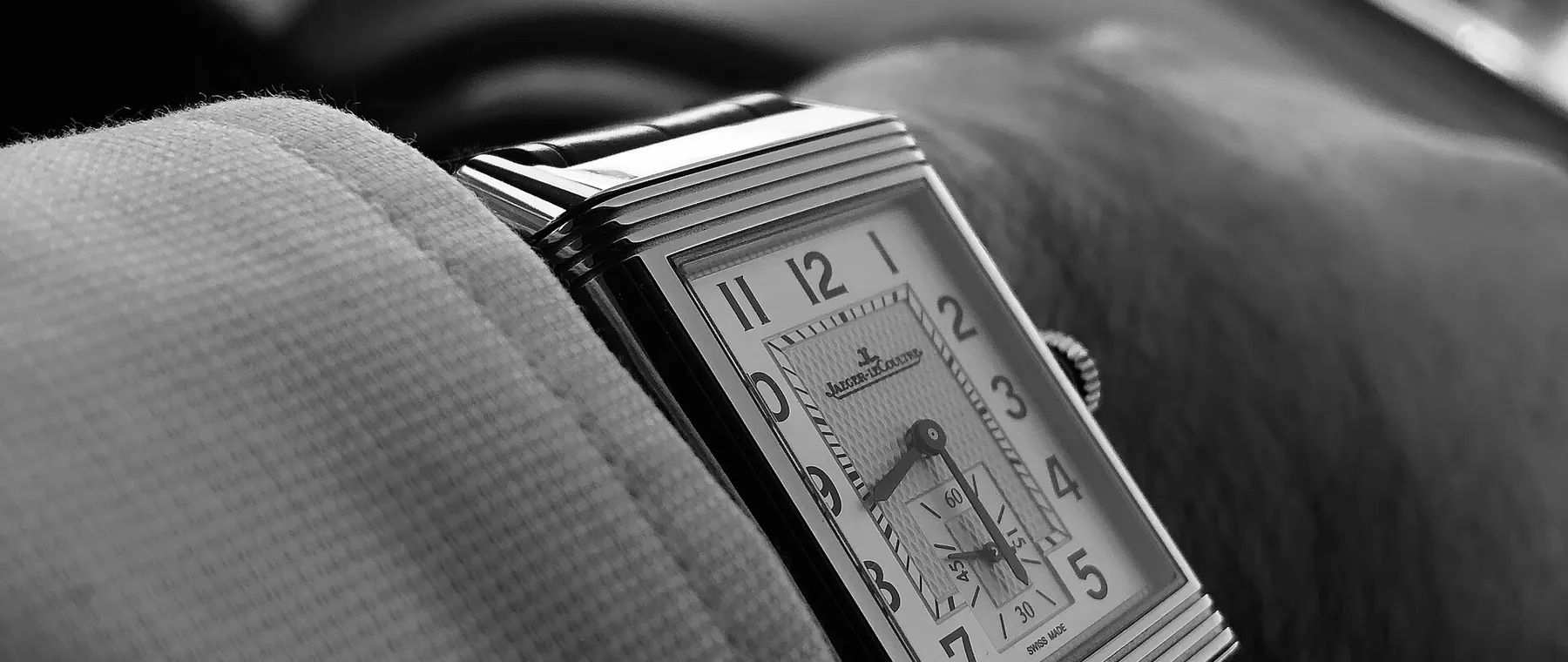
Source and photo disclosure: Official Jaeger-LeCoultre press release, The Collectibles VIII 'LeCoultre', 6 November 2026. The accompanying photograph shows a Jaeger-LeCoultre Reverso photographed by Tiberido and made available on Wikimedia Commons under CC BY-SA 4.0. It is a contextual image of the watch family and does not depict the specific 1933 chocolate-dial example offered in the New York capsule.