A new expression of the Tambour
Louis Vuitton has introduced the Tambour Convergence Mirror Steel, bringing a hardened stainless-steel case to a watch collection previously associated with precious metals and elaborate decorative finishes. Announced by Louis Vuitton Japan on 4 November 2026, the new reference W9ST11 retains the Convergence family's compact, handless display but makes its polished case the centre of attention. The launch is a product development in the maison's fine-watchmaking range, not an entirely new movement or a different collection.
The Convergence first appeared in 2025 as a distinctive reinterpretation of a traditional window-display wristwatch. Its two moving discs show the time beneath a small aperture, replacing the familiar configuration of central hands. For the Mirror Steel edition, Louis Vuitton has deliberately chosen a material associated with everyday watches while applying specialist case-making and finishing techniques. That contrast between conventional material and highly involved execution is the defining story of this release.
A case designed around reflection
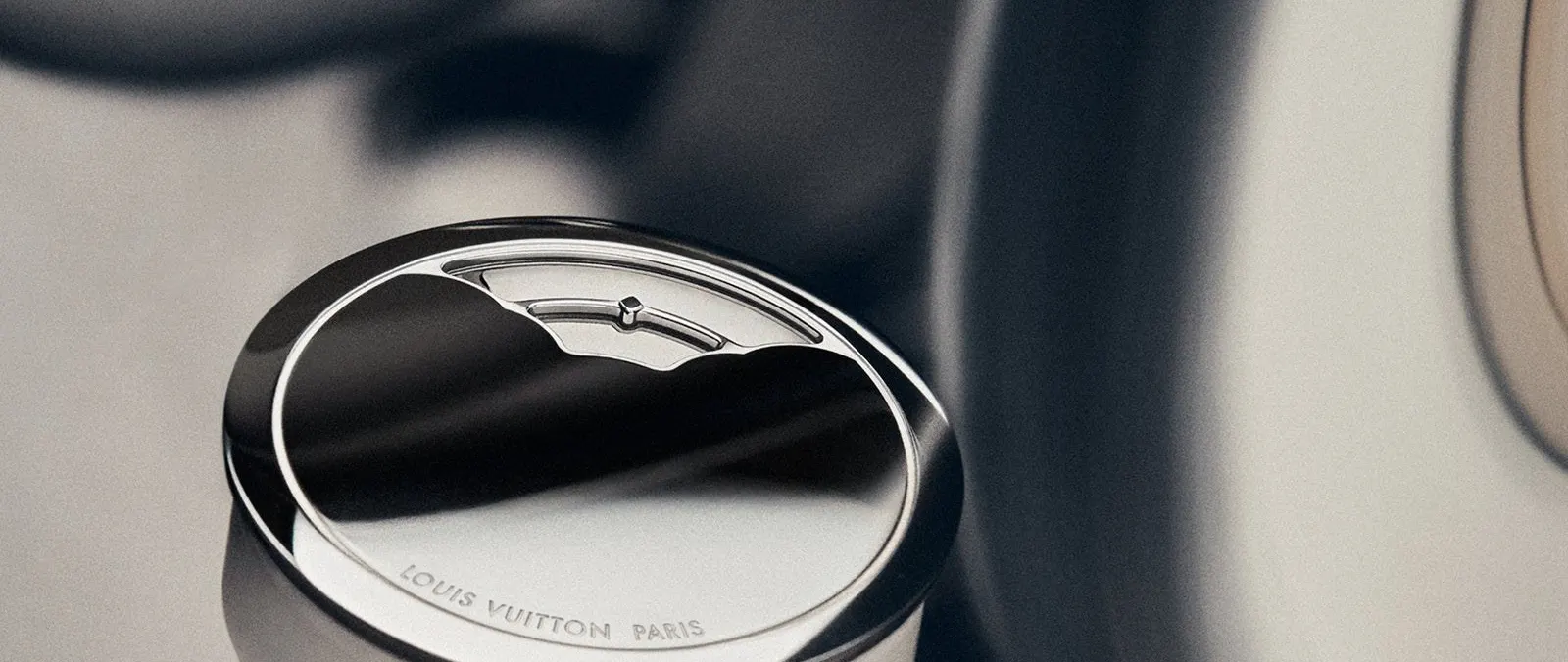
The new case measures 37 millimetres across and 8 millimetres thick, according to Louis Vuitton's official product specification. Its broad, gently curved surface is mirror-polished, including the crown and the outside surfaces of the lugs. Inside the hollowed lugs, sandblasted detailing supplies a quieter contrast. Viewed from above, the highly reflective surface leaves only a small opening for the actual time display, creating an unusually restrained face for a contemporary luxury wristwatch.
The impression is architectural as much as horological. Where many watches use a complex dial to emphasise craftsmanship, the Mirror Steel design directs attention toward the curvature, uninterrupted planes and transitions of the surrounding metal. Polishing therefore becomes an essential part of the design rather than an invisible final step. The visual effect is striking in photographs, although a mirror-polished object will naturally change appearance with its environment and can reflect the surroundings more than a satin-finished equivalent.
Hardness is an important technical claim
Louis Vuitton says the case receives a patented treatment that raises the steel's surface hardness to nearly six times its untreated level. Its Japanese press announcement specifies a hardness of 1,130 Vickers, a figure intended to help explain the material choice and resilience of the finish. The company also says this treatment and the steel's purity enable an unusually refined polish. Those performance claims are the manufacturer's descriptions; they should not be mistaken for independently tested lifetime durability results.
Surface hardness is not the same thing as complete resistance to damage. A watch can still be affected by impact, abrasion, careless handling or unsuitable exposure even when its finish is engineered for greater resilience. That distinction matters in a luxury product whose aesthetic relies heavily on a reflective surface. The technical achievement Louis Vuitton is emphasising is the combination of hardening and hand finishing, rather than a promise that the case could never show marks during ordinary wear.
The distinctive window display
The hours and minutes are read through an opening placed toward the upper part of the case. Two rotating discs carry the numerals, providing what the company calls a dragging-hours-and-minutes display. Unlike a conventional jumping-hour arrangement, in which the numeral changes suddenly, this mechanism displays the passage of time continuously. The method gives the watch a particularly calm visual character: movement takes place within the aperture, while most of the case remains a polished expanse of metal.
The framing of that opening carries historical references too. Its scalloped and arched form recalls elements of the interior decoration at the Louis Vuitton family home in Asnières, according to the brand's release. The watch also references the older tradition of the montre à guichet, the French description for a timepiece read through small windows. These design decisions connect the house's travel-goods history with an independent visual language for its contemporary watches, without relying on traditional monogram decoration.
The movement remains in-house
Behind the steel exterior sits the automatic LFT MA01.01 calibre, made by La Fabrique du Temps Louis Vuitton. It is a time-only movement with the paired display discs, rather than a conventional three-hand layout. The brand lists a 45-hour power reserve and a frequency of 28,800 vibrations per hour, or four hertz. Its technical specification gives a movement diameter of 23 millimetres, thickness of 5.4 millimetres and 26 jewels.
The movement can be seen through an open caseback protected by sapphire crystal, offering a counterpoint to the comparatively closed front of the watch. Louis Vuitton specifies a rose-gold oscillating weight, introducing a discreet precious-metal component even though the visible case is steel. For collectors interested in how the maison is developing its watchmaking capabilities, the movement is at least as significant as the external finish. It keeps the latest edition connected mechanically to the original Convergence design.
Daily use and the fit of the watch
The compact dimensions give the Mirror Steel a different proposition from a larger sports watch. Louis Vuitton pairs the case with an Arroyo Grey saffiano calf-leather strap and a hardened-steel pin buckle engraved with its signature. The brand describes the strap as hand-stitched, with a beige lining referenced in its Japanese announcement. Together, these choices reinforce the idea of a formally elegant watch that could also be worn outside special occasions, rather than a model designed primarily for sporting activity.
The product listing states water resistance of 30 metres, but that number should be understood within the maker's care instructions rather than as an invitation to take the watch diving. For yacht owners and travellers, a leather-strapped, mirror-polished dress watch is better judged on comfort, legibility and the suitability of its materials for a particular itinerary. Anyone considering frequent contact with salt water or water sports should check the manufacturer's recommended use and maintenance guidance before wearing it in those conditions.
How it compares with earlier models
Louis Vuitton launched the Convergence with precious-metal versions and later developed further decorative interpretations. Its November announcement points to earlier rose-gold, diamond-set platinum and guilloché-treated versions as examples of how the same case architecture can support very different finishes. Mirror Steel deliberately changes the emphasis. Rather than layering jewellery or decorative engraving onto the case, it uses a highly reflective treatment to demonstrate the finish that can be achieved on a comparatively familiar base material.
That does not necessarily make the manufacture process simpler. Louis Vuitton says that working with the hardened steel can require up to three times as much finishing time per case as the rose-gold version. The figure is a manufacturer statement, and it illustrates why material cost alone is a poor guide to labour intensity in specialist watchmaking. The commercial story is equally interesting: the brand is positioning stainless steel as a surface for demanding high-end craft rather than as an inexpensive substitute for gold.
Price, availability and the wider view
Louis Vuitton's Netherlands product page lists the Tambour Convergence Mirror Steel at €26,000, while its Japanese announcement gives a domestic price of ¥4,411,000 including tax. These are market-specific published prices at the time of reporting, not a currency conversion or a guarantee of the amount charged in every country. The watch is identified as reference W9ST11, and prospective purchasers should confirm local price, availability and delivery arrangements directly with the maison.
The attraction of this release lies in its refusal to equate a luxury watch with a crowded dial or conspicuous gemstones. Its signature remains legible in the shape of the time window, the movement architecture and the extraordinary demands placed on the steel surface. Whether an owner favours the original precious-metal Convergence or this new version will ultimately be a matter of taste. The launch nevertheless makes an informed statement about the value Louis Vuitton now places on specialist case construction within its watchmaking identity.