Louis Moinet revisits a miniature universe
Swiss independent watchmaker Louis Moinet has placed its Moon Meteor timepiece back in the spotlight in a 5 November 2026 atelier update, drawing attention to a watch whose dial contains material from several worlds. The piece is not a newly announced mass-market collection: the manufacturer already presented it earlier in 2026, and the current update explains the artistic and astronomical design. What makes the story distinctive is the combination of a moving moon display, hand-painted luminous scenery and physical meteorite fragments within a compact mechanical instrument. Only twelve examples form the edition, a number confirmed on the maker's own product page.
The reference is LM-113.20.20, identified as a grade 5 titanium watch in the company's Cosmic Art family. Its case measures 40.7 millimetres across and carries a domed sapphire crystal intended to give the dial depth. The spectacle is not merely a printed picture of space. Different stones, painted surfaces, mechanical indications and applied figures have to coexist without preventing the wearer from reading the time. Louis Moinet's official technical description is the starting point for these details; the claims about rarity and astronomical accuracy are the manufacturer's, not independent laboratory findings by this publication.
A dial designed for daylight and darkness
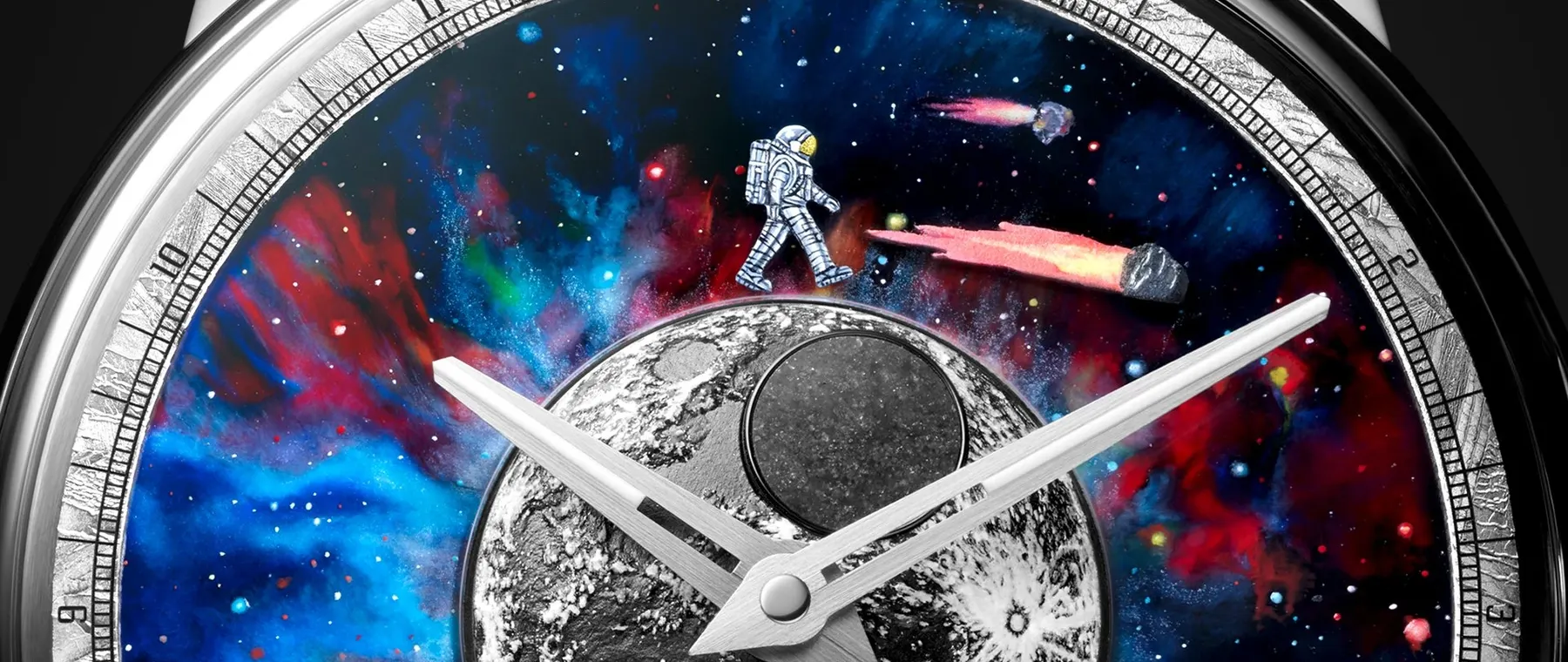
The dial shows a brightly coloured nebula rendered by miniature painting. According to the atelier, the artist works under a binocular microscope with a brush carrying only a few hairs, building the scene through repeated applications of lacquer and varnish. Luminescent paint is then introduced to make the composition appear different after the lights fade. That sequence gives the watch two visual identities: a detailed daytime artwork and a more vivid nocturnal display. It also explains why photographs taken in normal studio light cannot capture the whole effect of the piece.
Painting with luminous pigments is a demanding process because the material is thicker than ordinary colour and must be distributed carefully across small shapes. The maker says that each stage is assessed in darkness as well as in light. For a potential collector, this is a reminder that the dial should be inspected under both conditions, including the transition between them. It is tempting to treat photoluminescence as a decorative feature, but the quality of the finishing and the legibility of the hands are equally important in a watch that must remain functional.
The astronaut and the astronomical moon
At the centre sits a domed disc modelled on the lunar surface, with engraved craters, painted relief and luminous material. A small, individually painted astronaut serves as the fixed reference point while the lunar display moves beneath it. Rather than relying solely on conventional symbols for the phases, Louis Moinet uses two actual lunar meteorite fragments to signify the extremes of the cycle. The maker names Gadamis 005, a pale and marbled stone, for the full moon and the darker Dhofar 457 for the new moon. Their different appearance makes the indication part of the artwork.
The company describes a gear train incorporating a 135-tooth wheel and claims that its astronomical moon display deviates by only one day in 122 years. That specification concerns the theoretical rate of the mechanism, rather than a promise that a watch never needs setting or servicing. An owner still has to maintain the movement and follow the maker's instructions for adjusting the lunar indication. The appeal is the way an unusually precise long-cycle complication has been given a legible visual story, with a figure standing above the changing moon.
Meteorites from the Moon, Mars and asteroids
The celestial display extends beyond its two lunar stones. In the dial's upper area, the company identifies Jbilet Winselwan at approximately two o'clock, a meteorite found in Morocco. Sahara 97093, an enstatite specimen, appears near four o'clock, while the NWA 13925 Martian meteorite occupies the area around eight. These fragments represent distinct sources and compositions, though a dial alone cannot communicate the complex geological history of each rock. Their identification comes from Louis Moinet's published materials, which also distinguish the origins and locations of the fragments.
Another meteorite, Muonionalusta, forms the chapter ring around the dial. The atelier describes laser-engraved hour markers on that surface, giving the unusual material a practical role in time reading. The resulting arrangement brings several different textures into a single watch: mineral grains, polished titanium, painted colour and finely defined graduations. For enthusiasts who value provenance, the precise names of the stones matter more than the generic label 'space rock'. The manufacturer offers those names, although buyers seeking detailed individual specimen certificates should ask for the documents accompanying their particular watch.
Mechanical specifications behind the spectacle
Moon Meteor is powered by the self-winding calibre LM113, specified by the manufacturer with a 48-hour power reserve, 29 jewels and a frequency of 28,800 vibrations per hour, equivalent to four hertz. The stated functions include hours, minutes and the lunar cycle. These figures describe a conventional mechanical foundation supporting an unconventional display. The movement's automatic winding means it draws energy from motion on the wrist; it does not make the watch independent of wear or remove the need for occasional winding when it has been left unused.
The maker quotes water resistance of 30 metres, which should not be interpreted as an invitation to dive to that depth. For a highly decorated, limited-edition watch, exposure to water, impact and direct heat still deserves sensible caution and attention to the manufacturer's care instructions. The case is described as polished and satin-finished grade 5 titanium, paired with an alligator strap and folding clasp. These choices put the emphasis on wearability and finishing while preserving a comparatively light structural material for the substantial, three-dimensional dial construction.
Where craft meets credible rarity
Twelve pieces is a very small edition, but the number alone does not establish future auction values or investment performance. Its interest must be judged through the execution of the miniature painting, the composition of the meteorite display, the mechanical engineering and the documented originality of each example. Louis Moinet presents the limited run as part of a deliberately artistic approach to watchmaking. The site offers a purchase-enquiry route rather than a universal checkout price, so availability and a current quotation should be obtained directly from an authorised source.
Collectors comparing Moon Meteor with other scarce watches have a useful checklist. They can inspect the dial in daylight and darkness, review the stated reference and movement details, request information about servicing and confirm which accessories or provenance documents accompany the piece. The fact that meteorites have distinctive histories does not remove the importance of those ordinary ownership considerations. A beautiful material is most persuasive when the object containing it is comprehensively described and supportable over many years of use, especially at the upper end of independent watchmaking.
An astronomical connection stretching back centuries
The atelier links its interest in astronomy to the historical watchmaker Louis Moinet and his use of precision timing for celestial observation. Nathanaël Schaller, identified as creative director, also describes a family fascination with the cosmos and meteorite collecting as a personal influence on the design. That background gives context to the decision to make the moon indication the emotional focus instead of treating it as a small supplementary window. It is a contemporary expression of the link between measuring time and observing movements in the sky.
The design belongs to a wider group of Louis Moinet cosmic watches rather than standing outside the company's established identity. The maker's catalogue includes other lunar-themed pieces and watches incorporating extraterrestrial material. Moon Meteor's particular contribution is the dialogue among several meteorites, an astronaut reference and a luminous painted nebula. Readers should distinguish the historical narrative used by the atelier from the verified specifications of the present model. Both help explain the watch, but only the latter establish what the buyer is actually being offered.
What the November atelier update means
The November update is best understood as a renewed presentation of an existing 2026 watch, not the first public unveiling of Moon Meteor. That distinction matters for accurate luxury reporting: a new company post can draw attention to an object that has already been exhibited or discussed. In this case the update provides a useful moment to revisit the technical description and the unusual construction of the dial. It does not announce a new edition size, a revised calibre or a fresh allocation of watches, so none should be inferred.
For collectors who enjoy mechanical watches as miniature works of art, Moon Meteor offers an unusually literal meeting of astronomy and horology. The official reference, twelve-piece limitation, titanium case, LM113 movement and named meteorite fragments are all documented by the manufacturer. Whether the blend of celestial imagery and intense luminescence suits a particular collection is a matter of taste. The strongest reason to examine it closely is straightforward: its details were conceived to reward a viewer who looks twice, once in daylight and once after dark.