A 1962 form receives an autumn palette
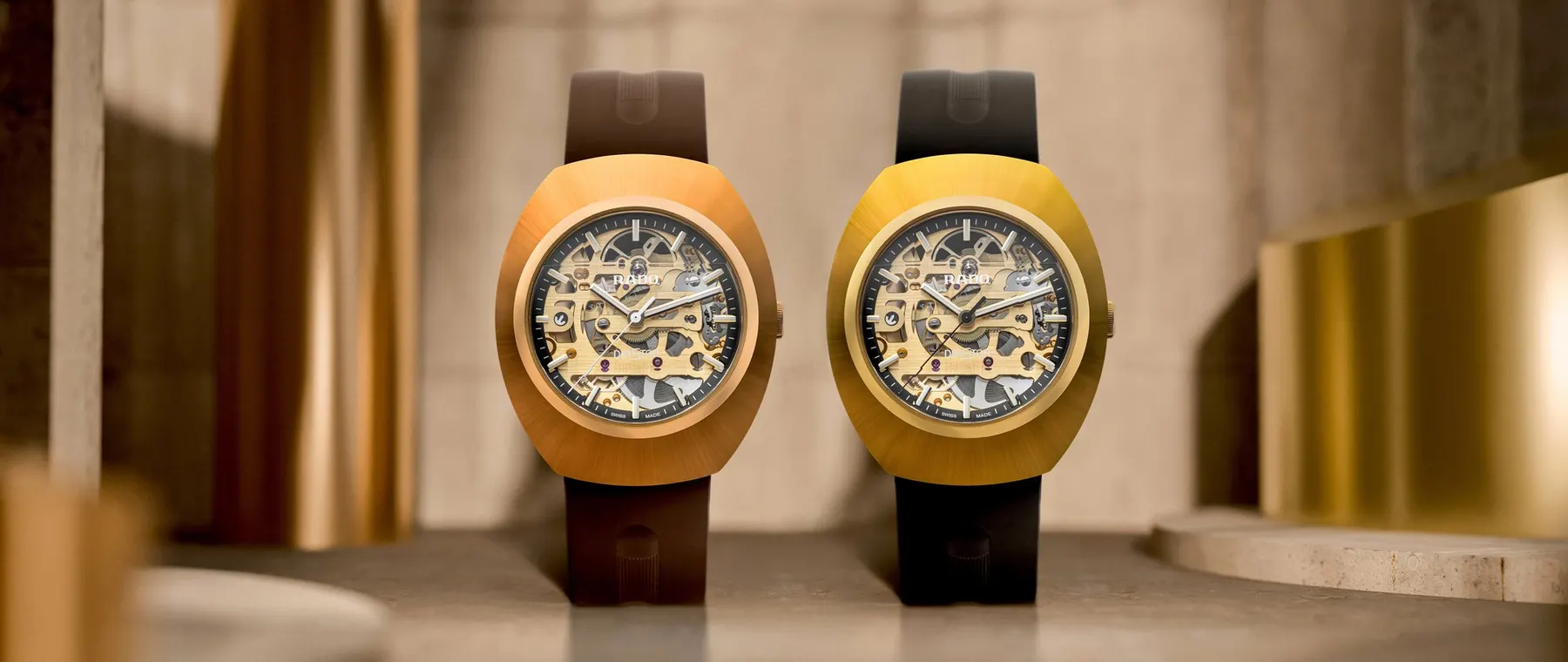
Rado has introduced two new DiaStar Original Skeleton models, refreshing a design family that traces its identity to 1962. The latest versions adopt metallic gold and rose-gold tones on their distinctive bezels, paired with matching rubber straps and visible mechanical movements. Rather than replacing the longstanding shape, the changes emphasise its sculptural profile and offer a more contemporary, relaxed way of wearing the collection.
That distinction is important for a design with more than six decades of history. Collectors may recognise the silhouette immediately, but younger owners need an object that functions naturally in present-day wardrobes. A coloured bezel and sportier strap can change the character of a watch without erasing its origins. Rado’s approach puts the familiar design under a warmer visual light rather than treating its history as a reason to leave it untouched.
Ceramos gives the bezel a metallic ceramic character
The DiaStar’s pronounced bezel is crafted in Ceramos, Rado’s material combining high-tech ceramic properties with a metallic appearance. The brand describes a radially brushed finish, adding directional texture to the form. One version uses a yellow-gold-coloured PVD coating, while another introduces a rose-gold-coloured PVD treatment to the DiaStar Original Skeleton line for the first time.
A coated Ceramos component is not the same as a solid precious-metal case, and the distinction should be clear. Its appeal lies in a combination of surface appearance, durability and lighter wearing qualities rather than intrinsic bullion value. The two colours create different effects against the dial and movement. Prospective owners should inspect the surface in changing light, because radial brushing and warm coatings can look markedly different from studio photographs.
Visible mechanics provide the central spectacle
Both new watches house Rado’s automatic calibre R808, presented in a yellow-gold colour with an extensively openworked architecture. The dial arrangement allows the bridges and moving parts to become part of the visible design. A square, faceted sapphire crystal frames the view, creating an unusual contrast between the traditional movement’s circular patterns and the distinctive outer case shape.
Openworking is not merely a matter of removing metal for visual effect. The architecture must retain strength and permit reliable operation while giving the eye a useful path through the components. Rado has chosen to make the mechanical interior central to the experience of wearing the watch. For someone who enjoys observing the balance and gear train, the display offers an ongoing attraction beyond reading the time.
An eighty-hour reserve supports practical wear
The R808 is specified with an 80-hour power reserve, providing several days of operation when fully wound and left unworn. Rado also says the movement is regulated in five positions, an approach intended to support consistent accuracy when the watch changes orientation during daily use. These details matter because an attractive skeletonised dial is ultimately of limited value if the watch does not perform reliably.
An eighty-hour reserve should be understood as a manufacturer specification rather than an absolute promise under every set of conditions. Wearing habits, service condition and winding state all influence actual results. Nevertheless, the stated capacity provides practical flexibility for an owner who alternates between watches. A piece taken off before a weekend may still be running when it returns to the wrist.
The rotating anchor becomes part of the dial
A familiar Rado symbol, the rotating anchor, appears to float above the movement against a darker background. It is more than a small logo applied to a static surface; the arrangement gives the dial a sense of depth. Rado has also incorporated luminous treatment into the hands, indexes and anchor, so the watch reveals different visual priorities when ambient light falls.
Legibility can be a challenge for skeleton watches. The eye must separate the hands from the mechanical architecture beneath them, especially when metals and decorative finishing occupy similar colour ranges. By using luminous details and a clear outer structure, Rado attempts to keep the time display accessible. Anyone planning to wear the model frequently should assess the dial at arm’s length, not only through enlarged photographs.
Coordinated rubber straps add another personality
The two watches use rubber straps in colours selected to harmonise with their annular dials. Rado describes the result as a more sporting interpretation of the DiaStar, and the practical material supports that direction. The EasyClip system allows the straps to be changed without making the entire watch feel permanently committed to one form of dress or one colour pairing.
Rubber can be particularly useful in warm climates and during casual travel, although owners should still respect the maker’s water-resistance instructions. Its visual softness provides a counterpoint to the faceted crystal and metal-like bezel. The choice also makes the skeletonised movement feel less formal, opening the possibility of wearing a complicated-looking mechanical watch with everyday clothes rather than reserving it for a dress occasion.
Two finishes tell separate design stories
The yellow-gold-toned version echoes the colour of the skeletonised movement, producing a more unified, luminous impression. The rose-gold-toned option offers a softer and somewhat more contemporary contrast. Both are connected by the DiaStar silhouette and the R808, but the choice of bezel treatment changes how the watch relates to skin tone, jewellery and clothing.
Rado has not represented the pair as entirely different technical platforms. The variation is principally aesthetic, supported by the rubber and dial combinations. That makes an in-person comparison especially valuable. Someone who prefers the movement as the visual focus may favour a quieter overall palette, whereas another buyer may enjoy a stronger metallic frame. Neither response can be captured adequately by the specification sheet alone.
A heritage model designed to be used
The 2026 DiaStar Original Skeleton demonstrates how a brand can preserve the identity of a long-running design while revisiting its wearing experience. It keeps the distinctive bezel and visible mechanics, then adds modern materials, coordinated straps and a reserve long enough for an active collection. The result is recognisably Rado without relying on nostalgia as its only selling point.
For collectors and frequent travellers, the essential questions are comfortable fit, ease of reading, maintenance and the interaction of the finishes with everyday life. The official information supports the movement specification, two bezel tones and strap system, but precise availability and servicing arrangements should be confirmed with an authorised retailer. Its real distinction is the meeting of visible mechanics and a highly individual case design.