A watch designed around the start line
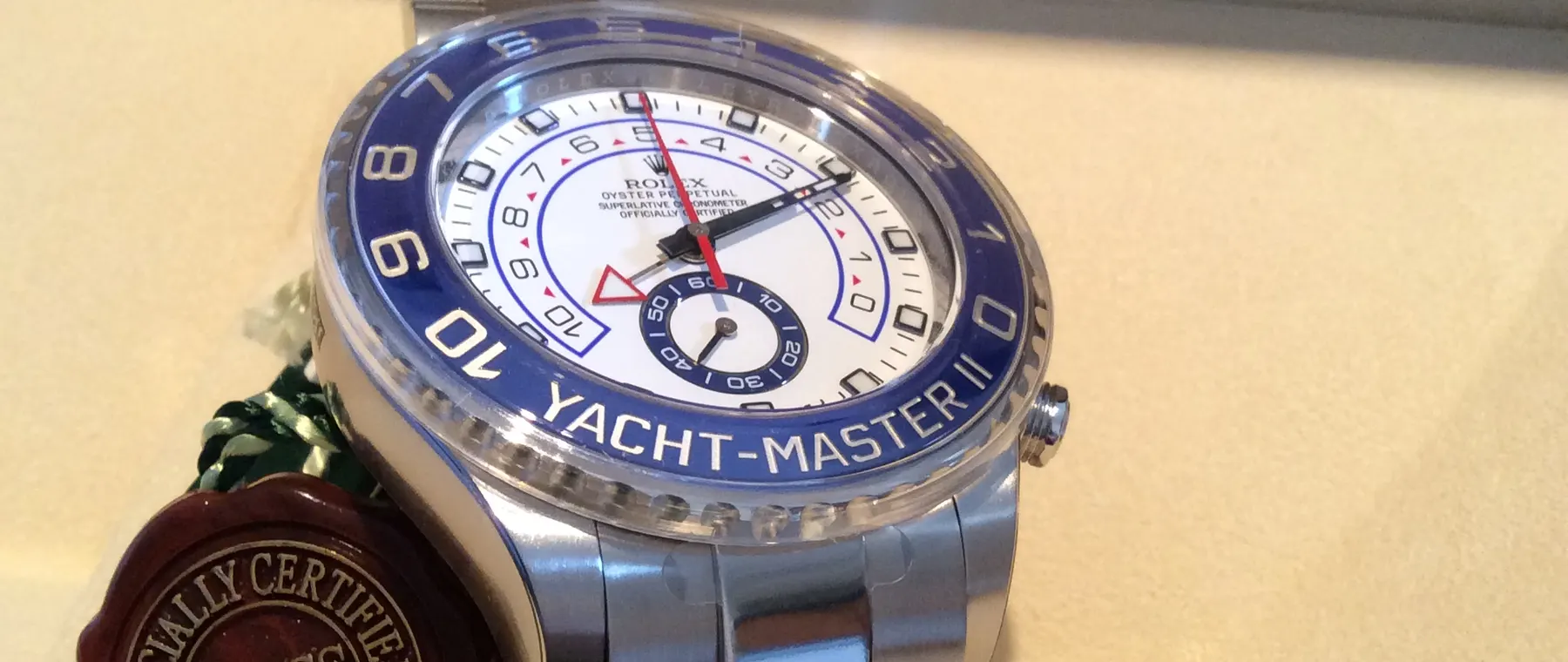
Among the luxury watches associated with yachting, few have a purpose as specific as the Rolex Oyster Perpetual Yacht-Master II. The model was created for the minutes before a sailboat crosses a starting line, when a crew must coordinate boat speed, position, wind conditions and the official countdown. Rolex’s new-generation version, unveiled in 2026, changes the way that function is operated and read. Its significance is not simply a revised appearance. The Swiss watchmaker has reworked the mechanism and display to address the problem that made this model distinctive from its beginning: how to make a mechanical wristwatch useful during a competitive sailing start.
The original concept and its return
The Yacht-Master II first appeared in 2007, bringing an unusual programmable countdown with mechanical memory. That was a different proposition from a conventional chronograph, which generally records elapsed time. A racing skipper may need to know precisely how long remains until the start, and may need to reset or synchronise the watch when the race committee changes the sequence. Rolex's official account confirms that the 2026 model revisits both movement and interface. The previous version had left the brand's catalogue in 2024; the return therefore marks a deliberate renewal of a specialist design rather than a routine dial variation. It has been presented in Oystersteel and 18-carat yellow gold.
Why countdown functions matter at sea
For a yacht approaching the start of a race, time is a tactical resource. Arriving at the line early can force a manoeuvre or create a rules problem; arriving too late sacrifices momentum and clear air. On many club and offshore events, the starting procedure uses a sequence of signals whose timing must be interpreted correctly by the crew. A dedicated countdown helps the wearer maintain awareness of that sequence, but it is only one element of a successful start. Instruments, visual signals, the helm and the trimmers all have to agree. The value of a mechanical regatta watch lies in providing an immediate, independent time reference on the wrist. It cannot substitute for watching the committee boat or understanding the sailing instructions.
A more direct interface
The most conspicuous functional update is the relationship between the two side pushers and the countdown. Rolex says the new system has been redesigned to simplify operation, with the countdown set exclusively through the lower pusher and with the two side pushers managing its use. The scale has moved to a flange, creating a fresh arrangement for reading the information. The minute and seconds countdown hands turn counterclockwise to make the remaining interval clearer. It is a change that may sound modest until one considers the circumstances: a sailor wearing gloves, moving around a cockpit and glancing at the dial for a fraction of a second needs an unambiguous indication more than a decorative complication.
Calibre 4162 at the centre
The new movement is Rolex calibre 4162, developed and manufactured in-house for the 2026 Yacht-Master II. It succeeds the earlier calibre 4161 and retains an approach to chronograph control built around a column wheel and vertical clutch. Rolex also describes a reengineered countdown function, a Chronergy escapement and a blue Parachrom hairspring. These are not visible to the wearer during a start, yet they help define the watch's operating characteristics. According to the manufacture, the power reserve is approximately 72 hours. That is useful for an owner who alternates between weekend sailing, ordinary daily wear and time ashore, although it remains prudent to confirm the watch's state before a race rather than assuming it has been running continuously.
Steel or gold, with the same purpose
Rolex offers the new Yacht-Master II in Oystersteel and in 18-carat yellow gold. Both use a 44 mm Oyster case and a blue ceramic Cerachrom bezel insert, according to the manufacturer's model information. The principal function does not change with the precious-metal choice. The distinction is chiefly the material, the visual character and the experience of wearing the watch. A substantial gold sports watch makes an unmistakable statement on a marina terrace. The steel version will speak more readily to buyers who prefer a professional instrument aesthetic. Neither choice changes the practical responsibility of its owner to keep the watch safe, serviced and appropriate for the circumstances in which it is worn.
How robust is a luxury regatta watch?
The official technical brochure states a water-resistance rating of 100 metres and specifies the Oyster case construction, screw-down crown and sapphire crystal. This rating concerns a properly maintained watch under standard test conditions; it is not a reason to neglect seals or operating guidance. Salt, spray, sunscreen, knocks and frequent changes between hot decks and cooler cabins are ordinary features of life afloat. Regular maintenance and rinsing where the manufacturer recommends it remain relevant. The Yacht-Master II uses an Oyster bracelet with an Oysterlock safety clasp and an Easylink extension of approximately five millimetres, a small comfort adjustment that can matter when wrist size changes in warm weather.
What the redesigned dial communicates
In high-end watchmaking, complexity is often shown through a crowded face. The 2026 Yacht-Master II takes a different route by moving key information and simplifying the sequence of interactions. A countdown needs to answer a simple question immediately: how much time remains? The scale, the direction of movement and the distinction between the ordinary time display and the event timer are therefore central design questions. Rolex has retained an assertive nautical identity while adjusting the information hierarchy. Whether an individual sailor finds the revised layout intuitive will depend partly on practice. No watch should be first learned in the last minute of a crowded start line.
Mechanical memory and synchronisation
The Yacht-Master II's identity still rests on a programmable countdown with a mechanical memory and the ability to synchronise during a running sequence. That combination is more specialised than a conventional elapsed-time chronograph. In practice, a skipper may set a countdown to the specified interval before leaving the dock, then use the synchronisation facility if an official signal requires alignment. The details of the controls should always be learned from the manufacturer's guide for this precise reference. Enthusiasts sometimes assume a complicated watch is easier to use because it is expensive. At sea, competent operation comes from a few deliberate repetitions in calm conditions, followed by a consistent routine before the racing begins.
Precision and reliability claims
Rolex applies its Superlative Chronometer certification to the model, with stringent testing after the movement is cased. The company states a precision tolerance of minus two to plus two seconds per day for the finished watch. In 2026 the manufacturer also expanded certification criteria to address resistance to magnetism, reliability and durability. These are manufacturer specifications and testing claims, rather than guarantees that an abused watch will never fail. A mechanical timepiece may be a remarkable technical object while still requiring the same sensible care as any other piece of precision equipment. The five-year international guarantee accompanying the certification is a separate matter from routine servicing and the conditions of use.
The relationship with a 12- to 24-metre yacht
For Luxury Yacht Guide readers who own or charter performance sailing yachts in the 12- to 24-metre range, the model occupies an interesting space between real sporting utility and the pleasure of mechanical craftsmanship. Such yachts can be serious race machines or comfortable performance cruisers, sometimes both during the same season. Their owners may value an elegant watch that is rooted in sailing rather than merely decorated with maritime imagery. Still, no owner needs an expensive chronograph to start a yacht race: a properly set digital timer can perform the essential timing job. The argument for a Yacht-Master II is therefore richer than utility alone. It concerns engineering, legibility, collectability and personal association with the sport.
Buying for the sailing life rather than the display case
A sensible assessment begins with how the watch will actually be used. The 44 mm case is substantial, and the fit on a particular wrist matters more than the diameter printed in a brochure. The wearer should test how securely the clasp sits, how comfortable the bracelet feels while operating deck equipment and whether the countdown can be read at an angle in strong daylight. The two available metals create different aesthetic and practical trade-offs. Prospective buyers should rely on current authorised dealer information for availability and price rather than any unsupported estimate. It is also worth distinguishing a new 2026 reference from earlier Yacht-Master II examples, which have a different movement and control arrangement.
Aesthetic details with technical roots
Rolex describes a bidirectional bezel with a Cerachrom insert, platinum-coated markings on the steel version and gold-coated markings on the yellow-gold version. The new calibre features an openworked oscillating weight and bridges carrying Rolex Côtes de Genève decoration. These details are part of the brand's broader effort to unite precision engineering with careful finishing, even where the owner cannot see the mechanism in normal use. For sailors, the most important design achievement may prove to be less dramatic: a dial and control layout that allow a complex mechanical system to be understood without hesitation. That is a demanding form of craftsmanship because its success depends on the interaction between object and human being.
Where the yacht connection is strongest
Some nautical watches borrow a name from the sea, but the Yacht-Master II is unusual in having a complication explicitly linked to a racing procedure. Rolex’s long association with major sailing events gives that design a wider cultural setting, yet the function remains the real point of difference. It is possible to admire the watch without racing, just as a collector may admire a pilot's chronograph without flying. For the sailing owner, however, the object takes on another dimension when its countdown is used for the purpose for which it was designed. That relationship between event, instrument and wearer explains why the return of the Yacht-Master II deserves attention from a yachting lifestyle publication.
A 2026 evolution, viewed with perspective
The new-generation Yacht-Master II is a 2026 release; it should not be mistaken for a product launched this November. Its reappearance matters because Rolex has revisited a distinctive tool-watch concept and tried to make its operation clearer without abandoning mechanical ingenuity. The practical verdict will come from wearers who learn the revised system and put it to use over many races and seasons. For now the manufacturer's published specifications establish the key changes: calibre 4162, a revised countdown interface, a rethought display and two clearly differentiated material choices. It is a particularly relevant piece of luxury design for readers whose leisure time is measured as often in nautical miles and starting sequences as in hours and minutes.
Primary sources: Rolex Newsroom: New Yacht-Master II; Rolex official 2026 model page; Rolex Oystersteel reference 126680 specification brochure.
Lead image: an earlier Yacht-Master II reference 116680, photographed by Carolyn Maria Adams, CC BY-SA 4.0, via Wikimedia Commons. This historical photograph illustrates the model lineage, not the new 2026 reference.