A familiar building enters a different chapter
The Vineta Hotel in Palm Beach is a revealing example of how a coastal destination can remake its hospitality offer without erasing its past. The property, at 363 Cocoanut Row, has returned to its historic Vineta name after a major renovation and now forms Oetker Hotels' first United States address. That distinction matters to travellers familiar with the group's celebrated European and Caribbean hotels: the choice of Palm Beach signals the appeal of a place where residential wealth, understated resort life and an active boating culture overlap.
The hotel opened to guests in 2026, not this week. Its story is therefore a destination and design feature rather than a newly announced launch. Owners and charter guests contemplating a Florida itinerary should understand the location accurately. The Vineta is a town-centre hotel close to Worth Avenue and the beach, but it is not a waterside marina resort and does not advertise berths. It is best thought of as an elegant shore-based stop before or after time afloat.
Why the Vineta name is worth recovering
The building dates to 1926, the height of an extraordinary period in Palm Beach development. According to the operator's historical announcement, it first opened as the Lido-Venice and acquired the Vineta name soon afterwards. Later changes of use and branding included a spell as condominiums and a long period as The Chesterfield. The return to an earlier identity is more than a marketing detail: it reconnects the hotel with the town's long Mediterranean Revival tradition.
Such heritage has particular resonance in a cruising destination. A great deal of modern luxury hospitality favours novelty and scale, while established yacht owners often value privacy, recognisable architecture and continuity. The Vineta's restored façade and modest urban footprint offer a different proposition from a sprawling oceanfront compound. It promises a Palm Beach address where the design of the building, its relationship with the surrounding streets and the rhythm of the town are integral to the stay.
An architectural restoration rather than a replica
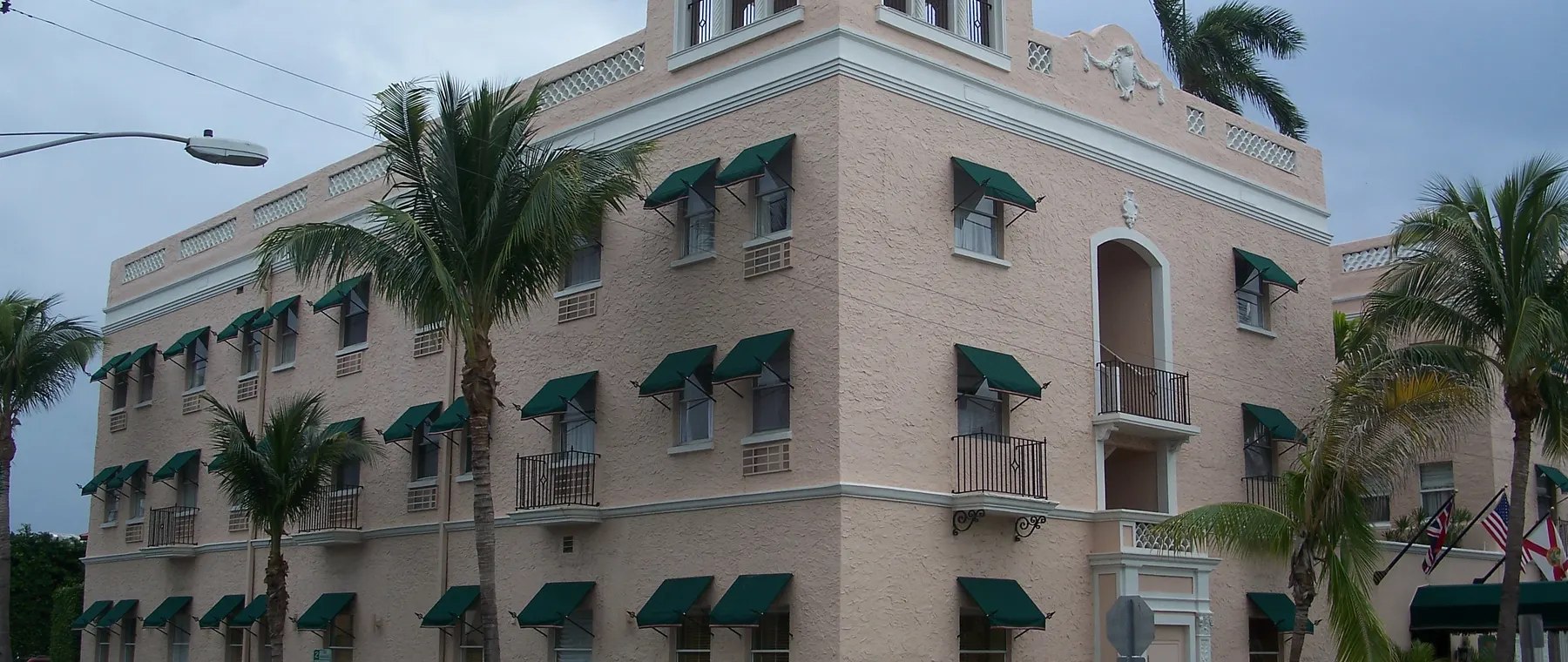
The Vineta is an example of the Mediterranean Revival idiom associated with Palm Beach: stucco surfaces, decorative openings and an exterior designed to suit the region's light and vegetation. Oetker describes the 2026 project as a full restoration, with interiors designed by Tino Zervudachi. The contrast between a preserved historic presence and a newly conceived interior is central to its identity.
A project of this sort faces an interesting challenge. The structure must retain the visual cues that make it locally recognisable while providing the accommodation, climate control, bathrooms and service standards expected by contemporary travellers. The historical building establishes the atmosphere, but guest experience depends on current-day operation. That is why the practical hotel details, from its room types to its dining choices, are as important to a prospective guest as the photograph of the façade.
A design mood shaped by coastal light
The operator presents the rooms and suites as bright spaces inspired by Palm Beach's climate and island lifestyle. A restrained palette and carefully considered furnishings suit a resort town where guests may move between a morning walk, a leisurely lunch and evening engagements without demanding an elaborate change of scene. The architectural setting keeps the experience rooted in Florida rather than simply reproducing a European hotel.
Travellers should note that Oetker's public material does not currently agree on the total number of rooms: its main hotel page refers to 41, while its frequently asked questions list 37. Rather than rely on an uncertain inventory figure, guests who require connecting rooms, a particular suite or several rooms for a cruising party should confirm availability directly. The hotel distinguishes rooms, one-bedroom corner suites and a presidential suite; some second-floor accommodations have Juliet balconies, but sweeping sea views should not be assumed.
Coco and the Mediterranean connection
Food is a significant part of the Vineta proposition. Its signature restaurant, Coco, is described by the hotel as Mediterranean-inspired and operates alongside The Bar and a more relaxed Pool House. These venues make the property useful for two very different occasions: an intimate dinner after arrival in town, or a low-key gathering for people who have spent several days aboard a yacht.
A hotel's restaurant can also become a destination in its own right. That is especially true in Palm Beach, where social life moves between private homes, clubs, restaurants and seasonal events. Coco's courtyard setting provides a transition from the hotel interior to an open-air environment. The emphasis is not on a theatrical maritime theme; it is on familiar hospitality elements—good food, an agreeable setting and enough discretion for conversation. Dinner reservations remain sensible, particularly during busier winter periods.
An outdoor space with a slower tempo
The restored property includes a landscaped courtyard and outdoor swimming pool. Pool House dining adds an informal alternative to the restaurant, while a small hotel footprint offers a less elaborate day than a sprawling beach resort. For guests who spend much of their time on the water, that contrast can be appealing: a morning ashore may be devoted to rest, a private meeting or simply walking through a familiar neighbourhood.
The Bar offers the more enclosed side of the experience. Its role is not identical to that of a destination cocktail lounge in a major city; here it is part of a compact sequence of spaces within the hotel. An attentive hotel concierge can help connect those spaces with restaurant plans elsewhere in town. As with any property, specific operating hours, menus and access for non-resident visitors may change, so they should be checked before arranging an evening.
Worth Avenue and Palm Beach at walking pace
One of the clearest advantages of the site is proximity to Worth Avenue, the shopping street closely associated with Palm Beach. Oetker places the hotel about two blocks from it. That creates a practical base for visitors who want to browse fashion, jewellery and design without building their entire day around taxis. Art galleries and restaurants add reasons to linger beyond the boutiques.
A stay can also be structured around the town's quieter cultural landmarks, including the Society of the Four Arts and the Henry Morrison Flagler Museum. These should not be confused with attractions inside the hotel: they are independent places to visit. The value of the address lies in the ability to combine activities. A visiting yacht owner might spend an afternoon meeting local contacts, make time for a museum or gallery, then return to the hotel for dinner without treating every movement as a lengthy excursion.
The beach is near, but the hotel is not on it
Palm Beach's Atlantic shoreline is part of the destination's attraction, yet the distinction between proximity and direct beach frontage is important. The Vineta's own guest information describes a short trip to the beach and says that the hotel can arrange a beach setup with chairs and an umbrella. It also makes clear that it does not operate a dedicated beach club. Guests should therefore expect a hotel-based day with an excursion to the coast, not a private resort frontage immediately outside their room.
This is relevant to yachting travellers accustomed to tender arrivals, direct waterfront views and seamless links between cabin and shore. A hotel can be excellent without offering those things, provided the choice is deliberate. The Vineta is positioned for the social and cultural life of Palm Beach rather than for watching a yacht from a terrace. Anyone prioritising dockside access will need a separately arranged berth or an alternative waterside property.
What yacht owners and charter guests should plan separately
The greater Palm Beach region has a substantial yachting identity, but there is no indication in the hotel's official facilities list that The Vineta is itself a marina or offers yacht mooring. Visiting by sea therefore means organising marina arrangements independently, considering transfer time and deciding whether to leave a yacht crewed and attended while guests stay ashore. Berth availability, vessel dimensions and docking costs should be checked with the relevant facility, not assumed from a hotel booking.
That practical boundary can improve an itinerary. A yacht party planning a Florida stop might choose a marina for operational convenience and The Vineta for a night of hotel hospitality, dining and town access. Families seeking a genuine waterfront resort should weigh the trade-off differently. The important distinction is between yacht logistics and the land-based experience: they may complement one another, but they are not the same reservation.
Wellness services without a traditional spa
Luxury properties often advertise wellness so broadly that guests cannot tell what is actually present. The Vineta provides a useful case for checking particulars. Its current frequently asked questions state that there is no on-site spa and no conventional fitness centre. Instead, the hotel offers the possibility of in-room wellness treatments and equipment for exercise in the accommodation. Guests can also enquire about nearby fitness arrangements.
This is not necessarily a disadvantage for someone who values privacy, but it changes how a stay should be planned. A traveller expecting a large thermal circuit, treatment suites and a gym with extensive machines would be disappointed. Someone who wants a massage in the room, a swim in the courtyard pool and an easy walk outdoors may find the more modest arrangement entirely sufficient. The lesson is simple: read facilities in operational terms, not merely as lifestyle labels.
Service details that matter on a short stay
Behind the photography, practical matters often determine whether a luxury hotel suits a trip. The Vineta lists concierge support, valet parking and in-room dining, and its official information gives a 3 p.m. check-in and noon check-out. It describes Palm Beach International Airport as approximately fifteen minutes away by car under ordinary conditions, but says it does not run a dedicated airport shuttle. Guests arranging travel between airport, marina and hotel should request the relevant transfer rather than infer that a shuttle is included.
The hotel says that dogs may be accommodated subject to policy and that children are welcome, though it does not advertise a dedicated kids' club. Room selection will matter for a family, while accessibility requirements should be confirmed before reservation. These details are easy to overlook when the main attraction is a landmark building. They are also the difference between a pleasant place to photograph and a hotel that genuinely works for the people using it.
The wider coastal-hospitality trend
The Vineta illustrates a broader direction in the higher end of leisure travel: restoring historically recognisable buildings and filling them with contemporary hospitality, rather than relying exclusively on new megaprojects. The partnership announced by Oetker with the building's owners, Reuben Brothers, set out precisely this ambition several years before the 2026 opening. The fact that the project took time is unsurprising in a protected, nearly century-old property.
Palm Beach is an apt place to attempt the formula. Many travellers there value distinctive architecture and long-established local identity. An intimate hotel can present an alternative to a large resort while supporting nearby independent businesses. For yacht owners, it also creates more choice when a Florida itinerary includes nights ashore. There is no need to turn that observation into a claim about berth demand or hotel revenue, neither of which has been published in the sources reviewed.
A considered stop in a Florida itinerary
The strongest case for The Vineta is a deliberate one: stay in a restored Palm Beach landmark, dine at Coco, walk towards Worth Avenue and use the hotel as an elegant base for the town. It is less suitable for someone whose overriding priorities are on-site yacht berthing, a private beach club or a large spa complex. Those are different hospitality products, not failures of this one.
Before booking, travellers should check room configuration, current restaurant service, beach arrangements and any transport needs directly with the hotel. The operator's website provides the most useful live description of its facilities, while its original project announcement explains how the Vineta name and architecture were brought back into focus. For a luxury-yachting audience interested in life beyond the boat, the result is a timely illustration of how a century-old Palm Beach address can serve a contemporary coastal journey.
Archive photograph: Ebyabe, 2010, CC BY-SA 3.0, via Wikimedia Commons. This is a historic exterior view, not a photograph of the hotel following its 2026 restoration.
Sources: The Vineta Hotel, Oetker Hotels; Oetker Hotels guest information; Oetker Collection and Reuben Brothers announcement.