Luxury service begins out of sight
A new interview with Papillon Milano 1990 founder Luca Legnani has brought a useful question into focus for yacht owners: how much of a memorable meal is determined before anyone sits down to eat? Published by the Italian marine outlet PressMare on 6 November 2026, the discussion connects the company's event-catering experience with the logistics of providing refined hospitality at sea. For 12-to-23.99-metre yachts, the topic is particularly practical. A vessel in this class may offer an excellent galley and dining space but does not necessarily carry a large dedicated hospitality team or extensive cold-storage capacity. That makes advance planning, careful sourcing and communication especially important. The interview's main relevance is not a promise that Papillon has launched a new yacht-catering route, but an account of how event professionals think about quality, resources and service.
From major events to the constraints of a yacht
Legnani describes an industry where the visible meal depends on a lengthy sequence of purchasing, transport, storage and preparation. Those activities are familiar to any chef, but a yacht brings extra constraints. The galley moves, the guest list may change, and the next reliable supplier may be a day's passage away. One consequence is that ambitious menus cannot be planned in isolation from the itinerary. The captain, cook or chef and person arranging supplies must understand departure times, berth or anchorage plans and the availability of refrigeration and dry storage. On a larger yacht those duties may be divided among departments; on a smaller luxury yacht the same person may handle several roles. The goal is not to reproduce the scale of a hotel banquet, but to apply the discipline of professional event planning to a much smaller and more dynamic environment.
Why the guest should lead the menu
The PressMare interview places personal attention above an abstract notion of extravagance. Legnani argues that clients seeking luxury hospitality value food and service that feel distinctive and appropriate to them. On board a yacht, that principle can be translated into an accurate preference sheet and open communication before departure. Dietary restrictions, allergies, children's meals, preferred dining times and dislikes are more useful to a cook than a vague request for something impressive. Owners should also think about whether the group wants relaxed lunches, formal evenings or several smaller dishes served over a long afternoon. It is often easier to deliver an elegant, well-timed meal with ingredients that travel reliably than a complicated menu that exceeds the available equipment. The choice should be shaped by the people aboard rather than by a land-based banquet format.
A plant-led approach with room for choice
Legnani outlines an 80/20 philosophy in which plant-based ingredients carry most of the culinary weight, with animal products playing a smaller, deliberately chosen role. In the interview this is presented as an approach to creativity and resource use, not a medical prescription or an obligatory menu for every client. The examples include vegetables and grains treated with the same care as fish and meat. For yacht hospitality, that can open valuable possibilities. Seasonal produce purchased near a cruising stop can provide freshness, colour and variety without requiring every meal to centre on heavy cuts or elaborate imported ingredients. The ratio should not be imposed on guests with different tastes or nutritional needs. Its usefulness is as a design principle: challenge the kitchen to make local produce feel like a central pleasure rather than a secondary garnish.
Provisioning for more than one port
One of the most practical observations in the interview concerns alternative destinations. Yacht itineraries change in response to weather, guest preferences and operational issues; a reliable provisioning plan should therefore include options beyond the single port listed first on the schedule. Legnani describes the value of identifying suppliers at several possible stops in advance. For a family yacht, that might mean knowing which harbours can provide fresh fish, vegetables, bakery products or specialty ingredients, and how much warning each supplier requires. The point is not to buy everything at once. It is to avoid discovering too late that a preferred ingredient cannot be delivered to the marina or that the vessel will not reach the expected port. A small, verified supplier list for alternative destinations can preserve both quality and flexibility.
Space and preservation shape the result
A shore-based kitchen can call on walk-in refrigeration, large storage rooms and frequent deliveries. Many yachts in the 12-to-24-metre bracket cannot. The way ingredients are chosen, packaged and prepared must reflect the actual galley and electrical capacity of the boat. The PressMare discussion acknowledges that some produce may be processed before loading so it takes less space and simplifies service. That idea can be useful, but it does not remove food-safety obligations. Chilled deliveries need appropriate temperatures, packaging should withstand the passage and raw and cooked foods must be handled properly. For longer cruises, menu sequencing helps use perishable produce first while retaining alternatives for later days. Good hospitality planning is partly about selecting what not to carry, especially when every compartment has another role aboard.
Sustainability starts with realistic quantities
Legnani describes avoiding excess production as a first priority in preventing food waste. It is a sensible point for yachts, where leftover food can be difficult to manage and replacement supplies may be unpredictable. Crew should know how many people are eating, when they will arrive and whether a particular event replaces an ordinary dinner. Those details allow more accurate quantities without compromising the feeling of abundance at the table. The environmental benefit depends on the complete process, including packaging, storage, energy use and local disposal rules, not on one menu choice alone. Papillon also describes food redistribution through Italian partner organizations where local logistics permit. It would be misleading to suggest that the same redistribution programme automatically operates from any foreign marina or during a yacht passage. Local arrangements must be confirmed.
Hospitality at a boat show
The interview also addresses business entertaining during yacht exhibitions. Legnani suggests that smaller groups and staggered appointments may allow hosts to give people more individual attention. His company previously worked on the hospitality element of YachtWorld House at the 2026 Monaco Yacht Show, a setting that joined yacht-industry meetings with food and informal conversation. There is a practical lesson for brands and brokers: a smaller, well-planned welcome can achieve more than an overcrowded reception if the purpose is to build meaningful relationships. The standard of service is shaped by timing, staffing and the availability of quiet space as much as the dishes served. For an owner hosting aboard, the same logic may improve a private gathering: agree guest numbers and boarding times before arranging a menu that the galley and service team cannot comfortably deliver.
The unseen work of the team
Luxury is often described in terms of finishes and ingredients, but the people making a meal happen must coordinate long before service begins. A yacht cook may need to receive deliveries, store them safely, prepare the cabin or cockpit, serve guests and restore the space afterwards. On a busy cruising day, those tasks compete with other duties. A realistic schedule protects quality and allows the team to work without constant last-minute disruption. Legnani's interview connects such coordination with staff training and working conditions. The principle can be applied without importing a large banquet structure aboard a small yacht. Brief meetings, clear roles and an accurate service plan are often more valuable than extra complexity. Guests notice relaxed, attentive hospitality; they rarely need to know how much organization made it possible.
Certification claims and their limits
Papillon's founder refers to ISO 9001, ISO 14001 and ISO 20121 in describing the company's approach to quality, environmental and sustainable event management. These are claims made in the published interview, and Luxury Yacht Guide has not independently audited the company's current certificates or the scope of each registration. Equally, a certification held by a shore-based caterer does not automatically certify a yacht's galley, crew or food-supply chain. Owners evaluating a catering provider can request the relevant documentation and confirm which services and locations it covers. Procedures are most useful when visible in everyday operations: accurate receiving records, appropriate storage, clear hygiene controls and responsible waste handling. The presence of a logo should be the start of due diligence rather than the end of it.
How an owner can apply the ideas
A practical approach to a special yacht dinner begins with the itinerary and the guest list. The host can agree the occasion, number of diners, service style and any dietary restrictions. The cook can then design a short menu around ingredients that are available and suitable for the boat's facilities. A provisioning plan should identify a primary supplier and at least one workable alternative if travel plans change. The captain can confirm when deliveries may come aboard and what access arrangements are necessary. Finally, a realistic serving timetable should leave sufficient time for preparation, guest attention and safe clearing of the galley. These steps do not guarantee a flawless evening, but they reduce the likelihood that small logistical problems will reach the dining table. The most successful meal is often the one that feels effortless because everyone involved understood the plan.
What the interview adds to yachting
The new PressMare feature does not announce a fleet of Papillon catering yachts or a contracted service network operating in every cruising area. Its value is more considered: it shows how a company known for event hospitality translates familiar problems of supply, waste and guest preference into the maritime setting. Luxury Yacht Guide regards that as relevant lifestyle coverage for owners who invite friends aboard, charter a mid-sized luxury yacht or organize an intimate waterside event. The standards should remain clear. Any promise of supplier availability, yacht-specific capability or international food redistribution needs independent confirmation from the people providing it. The lasting idea is simple but demanding: excellent hospitality is engineered through choices made before a vessel sails, and its quality is experienced in the ease with which guests are cared for once they are aboard.
Sources: PressMare original interview by Filippo Ceragioli with Luca Legnani, 6 November 2026; YachtWorld's official September 2026 announcement of YachtWorld House hospitality. The interview is first-hand reporting; supplier availability and certification claims are attributed, not independently audited.
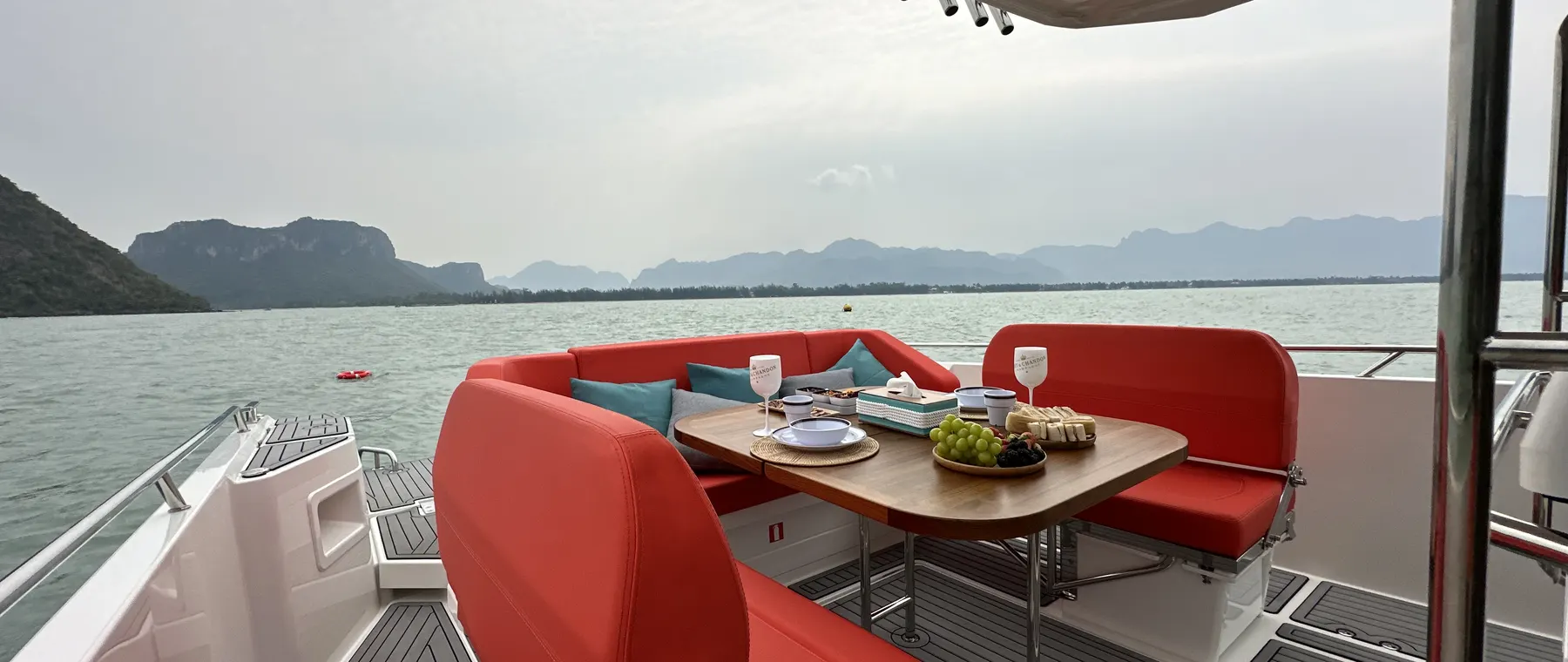
Photograph and licence: A separate example of yacht dining photographed by Myachthuahin on Wikimedia Commons, licensed CC BY-SA 4.0. This contextual photo was made in Hua Hin, Thailand, and does not depict Papillon Milano's food, staff or a 2026 event.