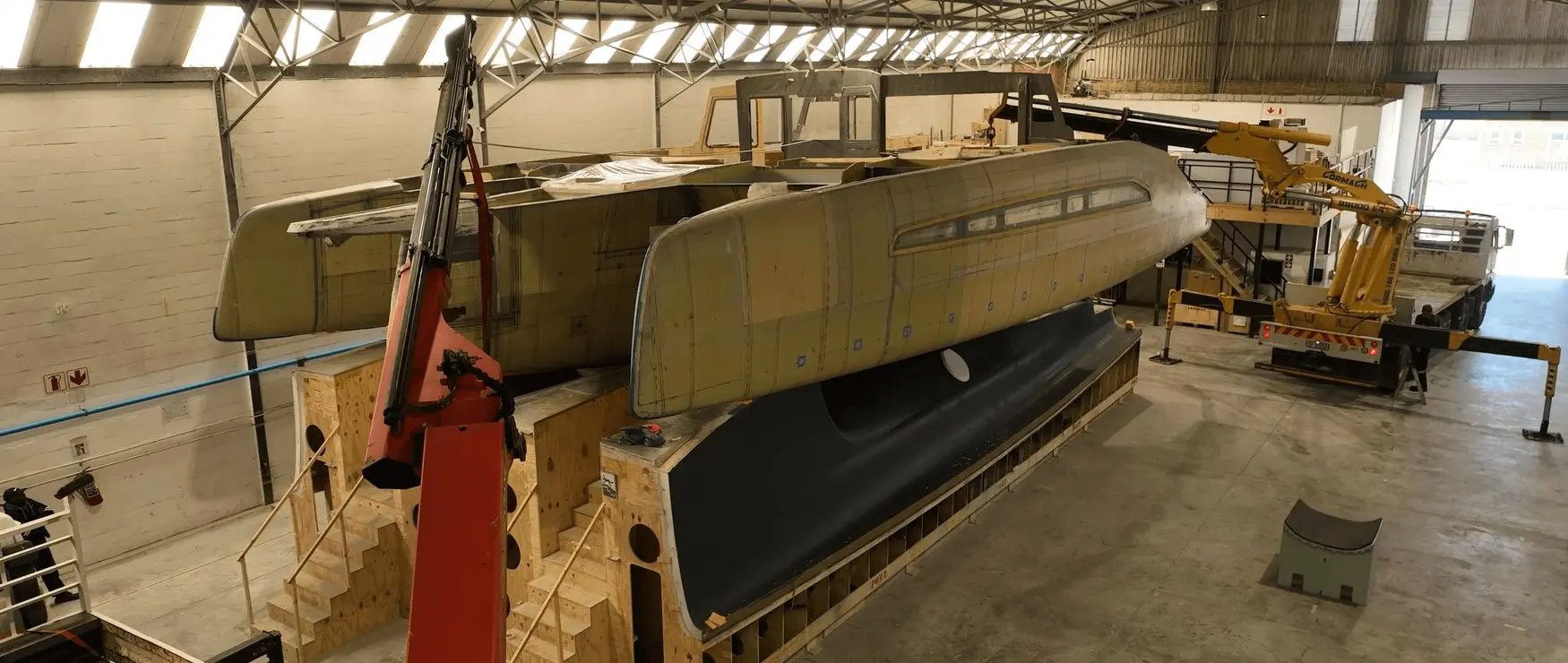
The first 53-foot project advances in Cape Town
VMG Trimarans has reported substantial progress on the first VMG 53, a roughly 16-metre performance cruising trimaran taking shape at Evolution Marine in Cape Town. A manufacturer-authored update circulated on 24 November 2026 describes an active build and a target for completion and handover in 2027. The immediate news is work on a physical first hull rather than the release of another conceptual rendering. The builder's website separately shows a photograph of hull number one under construction, offering a practical reference for what has reached the workshop.
It is important to distinguish a projected delivery window from a completed launch. The public report cannot establish that sea trials have taken place or that the first boat is already cruising. A future handover remains dependent on construction, commissioning and acceptance processes. The hull photograph supports the manufacturing milestone without proving any finished-yacht performance figures.
A trimaran within the Luxury Yacht Guide range
The 53-foot designation puts the project at approximately 16.15 metres, comfortably inside the 12-to-23.99-metre editorial range. The difference between a sailing trimaran and a monohull of similar length is not cosmetic: the central hull and outriggers create different relationships between beam, stability, deck use and interior volume. Those attributes require examination of the actual design rather than assumptions based on nominal length alone.
An owner looking at a trimaran should ask for the precise length and maximum beam used in marina and harbour planning. Overall dimensions, draft with appendages raised or lowered, and transport requirements can materially influence where the boat can be based. The manufacturer's early project presentation does not remove those practical constraints.
VMG and Evolution Marine have different roles
VMG identifies the boat as its own project, with Evolution Marine associated with the Cape Town build. This matters when discussing responsibility for design, construction, commissioning and support. A report that names a production partner does not necessarily establish that every company has identical warranty or contractual obligations toward an owner.
Prospective buyers should seek a written explanation of which organisation supplies the boat, which party handles subsequent service and how any design updates will be documented. The wider team behind a yacht can add valuable expertise, but accountability must remain transparent rather than inferred from publicity.
Design expertise from a multihull team
The project draws on specialist performance-multihull knowledge, including naval architecture associated with VPLP Design. That design pedigree provides background to the proposed sailing characteristics and the attention to weight, hull form and rig configuration. It is not an independent speed certificate or a guarantee of particular offshore results.
The real test of a performance cruiser is how its design balances passage making, safe operation and accommodation. Drawings can establish proportions and intended arrangements, while a completed boat and subsequent trials are needed to assess the lived experience. Until those are documented, design claims should be presented as goals.
An important distinction between renders and the hull
VMG's first-party website contains attractive exterior design images as well as the photograph of hull number one under construction. They document different stages of the programme. A rendering illustrates the planned appearance; an in-build photograph shows tangible manufacturing progress. Neither should be passed off as a sea-trial photograph.
For this article the lead image is the company's authentic construction photograph from its official website. It avoids implying that the prototype has already been delivered or filmed at sea. The original image remains subject to the builder and photographer's rights, and its caption should retain that context.
Construction progress is a technical milestone
Moving a complex composite yacht from design to physical construction involves structural components, bonding, systems routing and detailed assembly. The reported progress is therefore relevant, even though readers cannot independently assess the entire build quality from one picture. Production is a sequence of verification stages rather than a single announcement.
A yacht may appear externally complete while still requiring significant electrical, mechanical and sailing-system work. Owners should ask which components are installed, what tests remain and whether the build schedule includes commissioning and remediation time. A photo of a hull is not a substitute for a technical progress report.
Carbon and weight management
Performance-oriented multihulls often place special emphasis on structural weight and stiffness. The VMG 53 project reflects that design direction, seeking efficient sailing without abandoning the comfort expected from a substantial cruising yacht. The actual benefit depends on engineering and workmanship as much as the selected composite materials.
Carbon construction should not be described as automatically maintenance-free, indestructible or safer than every alternative. Inspection, impact history, repair methods and suitable structural documentation remain important. A qualified surveyor must evaluate the individual vessel rather than rely on a material label.
Sail handling and smaller crews
The manufacturer's design philosophy emphasises a performance experience that can remain manageable for experienced owners and relatively small crews. This is commercially meaningful because some prospective buyers want a substantial bluewater sailboat without a large professional crew complement. Ergonomics around winches, sheets, visibility and deck movement can influence that ambition.
The ability to sail short-handed cannot be established solely from marketing language. Owners should assess actual deck hardware, redundancy, emergency arrangements and the techniques needed to reef or change course in adverse weather. The early construction report provides no completed handling trial to replace that evaluation.
Living space on a three-hull platform
A cruising trimaran offers an unusual distribution of external and internal spaces compared with conventional sailing catamarans or monohulls. The design must address transitions between the central accommodation and the surrounding deck areas, while preserving usable spaces when the yacht is moving offshore.
Prospective owners should examine cabin privacy, galley operation, ventilation and storage rather than simply compare quoted dimensions. A performance cruiser may feel very different during a sea passage than it does on a showroom plan. That difference deserves a physical inspection once the first hull is ready.
Layout flexibility requires a current specification
The VMG 53 programme has been presented with an adaptable accommodation concept. Such flexibility can be attractive to owners combining private cruising with guests, but it must be tied to the actual ordered configuration. A concept drawing may depict choices that are optional or not available together.
Buyers should request dated arrangement plans, an equipment list and confirmation of how choices affect weight and service access. A shipyard can evolve its early layouts as construction progresses. This article does not attribute a final cabin configuration to hull one without supporting documents.
Performance is still a future question
A multihull of this size may promise rewarding passage making, but speed claims need a defined context. Wind strength, sea state, sail selection, loading and crew decisions can have large effects. The November 2026 update is about build progress, not an independently timed ocean passage.
For a meaningful comparison, owners should ask for measured trials after commissioning and understand whether figures represent forecasts, prototype results or production averages. Publishing an invented maximum speed or passage time would add false certainty rather than useful information.
Marina access and maintenance
Beam can be especially consequential for a trimaran, potentially limiting conventional berth options. The question is not whether the design is appealing, but whether a marina in the owner's intended cruising region can accommodate its dimensions and service requirements. Lift capacity and specialist repair facilities also deserve attention.
A buyer intending extended cruising should discuss suitable home ports and possible maintenance locations before signing a construction agreement. Practical ownership involves more than a good sailing design. Access to qualified technicians, documented structural repair procedures and replacement parts can shape the experience over several seasons.
The difference between a project and a delivery
A first-hull milestone is newsworthy because it moves an announced design closer to a working yacht. Yet a projected 2027 handover should not be converted into a guaranteed date, a sale announcement or a statement that all certification processes are complete. The builder has not provided those outcomes in the cited progress report.
The next reliable milestones would be a dated launch notice, commissioning results and confirmed delivery or first sailing report. Reporting them separately gives readers a clearer view of the project's actual development.
Owner questions about a new design
Prospective clients may wish to ask how the first boat's lessons will be incorporated into subsequent construction, what design changes are possible and how technical documentation will be delivered. Those are sensible questions for any newly introduced yacht rather than evidence of a fault in the VMG project.
Warranty, survey access and payment stages also merit professional review. A first-of-series yacht can offer meaningful design advantages but requires an informed approach to technical and contractual risk. The current update gives a construction reference, not a universal ownership recommendation.
Why the Cape Town build attracts attention
Cape Town has a recognised marine construction industry, including companies experienced in composite sailing craft. The association with an active local yard makes the VMG project part of that wider manufacturing ecosystem. It should not be extended into claims about regional employment or investment that the release does not quantify.
For Luxury Yacht Guide readers, the story has global relevance because the finished vessel may appeal to experienced owners who cruise internationally. Local construction expertise and international design collaboration can coexist, but their success is ultimately assessed in the delivered boat.
The November milestone in perspective
The dated development is an advance in the physical construction of the VMG 53, supported by an authentic first-party photograph of hull number one. The January 2027 target discussed in the manufacturer-authored press account is a future intention and not evidence of delivery. The boat's approximately 16-metre length makes this a relevant new-build story for the sub-24-metre segment.
Readers should expect subsequent news to distinguish launch, commissioning, trials and handover. That discipline preserves the difference between a promising design, a working hull and an independently proven cruising yacht.
Primary sources and image provenance
News based on the current verified manufacturer or event news announcement and original builder, event or authorised distributor specifications and imagery. © VMG Trimarans and original Cape Town build photographer. Authentic first-party photograph of VMG 53 hull #1 under construction, not a rendered finished yacht nor evidence of delivery. Images are genuine original subject-specific manufacturer, authorised distributor or original event photographs or official product design visual; they are not AI newsroom artwork. Prior events, future shows and construction are identified distinctly.