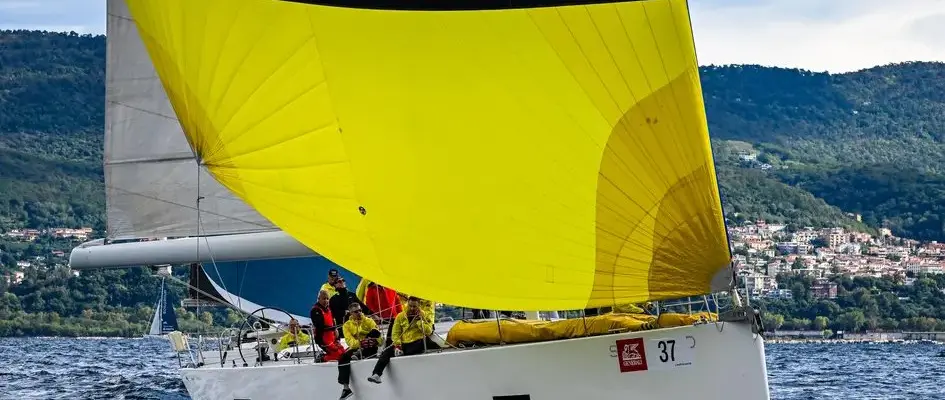
A Solaris 55 takes the Adriatic Cup
Paolo Bastiani's Giovi, a 2019 Solaris 55, has won the 2026 Barcolana Solaris Adriatic Cup at Trieste. The event brought owners of yachts built by Solaris Yachts together during the Barcolana58 sailing festival, culminating in racing on the course used by the main Autumn Cup. Giovi finished ahead of Alvise Zanetti's Sunny, a 2015 Solaris 58, and Luigi Panozzo's Solaris 44 Isla Bonita III in the published overall standings.
The result, confirmed by organiser Barcolana on 9 October, is particularly relevant to the 12-to-24-metre sector. All three podium boats sit within the dimensions of substantial owner-operated cruising yachts, rather than the much larger professional maxi fleet. Their participation demonstrates that a yacht intended for comfortable passages can also become the centre of a competitive and social owner's programme.
Portopiccolo hosts an owner-focused series
The Solaris Adriatic Cup has developed as an end-of-season gathering for owners of the Aquileia-based builder's yachts. Its 2026 edition was organised with Yacht Club Portopiccolo and planned as two days of sailing and social events. The programme started around Portopiccolo before moving towards Trieste and the familiar Barcolana course, linking yacht ownership with one of the Adriatic's best-known sporting occasions.
That setting brings benefits beyond a race result. Owners can compare equipment, discuss maintenance approaches and meet crews who sail related models in different conditions. An informal conversation between people operating similar yachts may be more useful than a product brochure when the subject is sail handling, storage or the realities of keeping a vessel in commission through an extended Mediterranean season.
Giovi tops the larger-yacht division
Group B covered Solaris yachts measuring from 48 to 57.99 feet, and Giovi won the division ahead of Sunny and Renzo Franco's Bambù 4. The class brings together cruising yachts with substantial sail plans and accommodation, so the demands of a short coastal race are not quite the same as those faced by a lightweight grand-prix boat. Well-prepared crews still need to make efficient starts and manoeuvres despite relatively high displacement and complex deck hardware.
Performance comparisons between such yachts should be interpreted in the context of their individual specifications and the race's scoring method. Sail wardrobe, keel and propeller choices, crew experience and weather conditions all influence the outcome. A larger yacht does not automatically win a mixed fleet, particularly when the organisers apply an appropriate rating system to compare results among boats of different size.
Isla Bonita III wins the smaller group
Luigi Panozzo's Isla Bonita III, a Solaris 44, won Group A for yachts between 36 and 47.99 feet. The category's next places went to Farewell IV, entered by Solaris Yachts, and Roberto Mattiuzzo's Andreborah. This gives the overall result more depth: Giovi won the larger division and overall honours, while a considerably shorter yacht achieved its own class victory.
For prospective owners choosing between a forty-four-foot cruiser and a fifty-five-footer, the distinction is more than a matter of speed. Larger hulls create additional accommodation, storage and systems complexity, while smaller boats may be easier for a reduced crew to manage. An owner's racing ambitions should sit alongside the intended cruising programme, usual crew numbers, berthing costs and willingness to maintain performance equipment.
Student sailors add a training element
Farewell IV sailed with young participants drawn from nautical institutes in Trieste and Imperia, together with two female students from Carducci Dante. The educational participation was organised in cooperation with the Friuli Venezia Giulia Region, PromoTurismoFVG and Solaris Yachts. It offered students practical time aboard a substantial sailing yacht while placing them alongside owners and experienced competitors in a real event.
Such experiences can help young people connect classroom subjects with seamanship, teamwork and professional possibilities in the marine industry. A complex cruiser relies on mechanical systems, rigging, navigation and safe deck operations, making it a useful platform for observing several disciplines at once. A regatta is not a replacement for a formal training qualification, but supervised participation can make future career paths feel more tangible.
Why mixed cruising fleets race on corrected time
The Adriatic Cup uses a format designed to compare yachts that are not identical in length or configuration. Corrected-time racing attempts to compensate for differences in expected performance, allowing crews of smaller yachts to challenge larger competitors based on how well they sail relative to their rating. That differs from a simple first-across-the-line race in which absolute speed alone determines the order.
Ratings inevitably depend on accurate data about a vessel's measurements and equipment. Owners considering competition should check the event's notice of race, certificate requirements and what changes may affect the handicap. Boat preparation can include carefully maintaining the hull finish, inspecting the rig, practising manoeuvres and ensuring safety equipment is suitable for the intended race area.
The Solaris design philosophy has a racing dimension
Solaris Yachts has long combined contemporary cruising accommodation with an emphasis on sailing performance and high-quality construction. The presence of several generations of its yachts at the same event shows how owners can continue competing and enjoying their boats years after delivery. Giovi dates from 2019 and Sunny from 2015, while the Solaris 44 represents another size within the builder's wider programme.
Those production dates matter because they put the result in the context of real ownership and ongoing maintenance, not merely a new-product demonstration. A racing yacht may benefit from a refreshed sail wardrobe, careful servicing of running rigging and attention to weight distribution. But the outcome does not prove that any particular equipment upgrade is essential or that one production model is universally superior to another.
The result sits within Barcolana58's larger programme
Barcolana58 includes multiple regattas in the days leading up to the celebrated Autumn Cup on Sunday 11 October. The Solaris fleet's own championship was decided on Friday 9 October; it should not be confused with the outcome of the main race, which belongs to a separate competition. That distinction is important when different events share the same waterfront, organisers and media attention.
Giovi's win provides a timely snapshot of what makes owner-led sailing attractive in the mid-size yacht market: close racing, social connections and the chance to test a cruising boat within a structured sporting environment. The confirmed results identify Giovi as the overall winner, Sunny second and Isla Bonita III third, alongside individual division honours. Future competition will depend on the owners' plans and the events they choose to enter.