A deck specialist confronts changing timber supply
Dutch yacht deck company Royal Deck is drawing renewed attention to the search for alternatives to Myanmar teak. Speaking at METSTRADE 2026, project and aftersales manager Jurrian Kerstholt described a market in which sourcing restrictions and changing customer expectations are influencing decisions about natural wood, laminated deck systems and synthetic materials. The discussion appeared in a 26 November marine industry interview.
This is not a claim that traditional teak has disappeared from every yacht or that all alternatives are automatically environmentally preferable. It is a report of the practical questions facing a specialist supplier as yacht builders and owners weigh appearance, sourcing and long-term deck maintenance. Those questions matter across motor and sailing yachts, even when specific reference projects are larger vessels.
Myanmar timber creates a particular challenge
Teak from Myanmar has long been associated with high-quality yacht decks, but trade restrictions, concerns about the timber's provenance and related environmental and governance questions have complicated its supply. Royal Deck's representative says identifying a suitable replacement is one of the major challenges for the business and its clients.
The existence of restrictions should not be used to claim that every teak board currently fitted to a yacht is illegal. Material acquired in different periods and jurisdictions may have distinct documentation and legal circumstances. Owners considering a refit need to ask for current sourcing and compliance evidence, not rely on general statements.
Laminated teak is one proposed response
Royal Deck says its focus is on engineered or laminated teak rather than exclusively on solid planks. Its representative describes plantation-grown teak sourced from Thailand and manufactured into laminated deck slats, creating another way to obtain usable pieces where long, high-grade solid timber may be difficult to source.
A laminated component is not simply equivalent to any solid plank. Bonding systems, dimensions, wear layers and the intended installation method determine how it should be used. A buyer should understand the actual specification, the manufacturer's quality controls and the service methods applicable to that system.
The company's historical link to timber supply
Royal Deck was founded in 2004 with involvement from Royal Boogaerdt Timber and experienced deck fitters, according to its company history. Royal Boogaerdt remains an established timber supplier with published information on laminated teak for yachts. That relationship provides useful background to the wider material discussion.
It would nevertheless be misleading to label every deck installed by Royal Deck as a Royal Boogaerdt product or to assume that all suppliers share the same origin. Project specifications can vary. Buyers should request a clearly identified material schedule and any relevant documentation for their own vessel.
A natural finish still demands practical choices
Teak's appearance and feel are important to many yacht owners, particularly in areas where guests move barefoot or sit close to the deck surface. A well-laid natural deck can also be a defining element of a boat's exterior design. Visual preference, however, is only one consideration.
Thickness, substrate preparation, bedding compounds, drainage and maintenance methods influence how a deck performs over time. A highly attractive material can disappoint if the installation is poor. Owners should evaluate workmanship and planned maintenance alongside the origin of the timber.
How engineered slats differ from solid wood
An engineered or laminated deck component can use shorter lengths or selected material arranged into a larger stable product. The approach may expand the usable yield of timber, depending on production methods. That possibility is part of the rationale for investigating engineered alternatives.
No public evidence in the November interview quantifies the overall carbon footprint or lifetime performance of the specific Royal Deck products. Bonding processes, transport, replacement frequency and end-of-life treatment would all enter a full environmental comparison. The article therefore avoids unsupported percentage claims.
Synthetic products are part of the discussion
Royal Deck also offers synthetic and alternative deck surfaces alongside natural wood systems. Such materials can appeal to owners seeking a different maintenance profile, predictable appearance or reduced reliance on scarce timber. The suitability of any specific product depends on its technical characteristics and the intended vessel.
A synthetic deck should not automatically be described as cooler, cleaner or more sustainable than teak. Surface temperature, traction, abrasion and repairability vary by formulation. Owners should inspect actual samples and seek documented test results for the chosen material.
Slip resistance depends on conditions
A yacht's deck must be practical when wet, especially near steps, cleats and boarding areas. Both natural timber and synthetic coverings can behave differently as they become worn, polished or contaminated. The colour or grain shown in a brochure is not a substitute for a suitable slip-resistance assessment.
The installer should consider the boat's layout and operating conditions, including where crew may work while the vessel is underway. Cleaning recommendations and safe use are part of that assessment. No single interview can certify the traction of every available deck system.
Refit is different from new construction
On a new hull, deck materials and substrate details may be planned together before the boat is fitted out. On an existing yacht, removal of old coverings can reveal hidden defects, moisture or unexpected bonding conditions. A refit may therefore require additional preparation before any new planks are laid.
Owners should seek an inspection and realistic work specification, including what happens if underlying problems are found. Refitting a deck is rarely only a question of selecting a visually appealing colour. The condition of the structure and the installer’s method have long-term consequences.
Material origin should be documented
A supplier may describe wood as plantation-grown, responsibly sourced or certified. Those terms need evidence appropriate to the material and chain of custody involved. Certification of one company or a timber supplier is not automatically proof that every individual yacht deck contains an identical certified product.
For a major refit, an owner can request origin declarations, product details and any applicable chain-of-custody paperwork. These documents are more useful than a broad claim that a material is environmentally friendly. Requirements also differ between countries and should be confirmed with relevant professionals.
Why family attitudes enter the conversation
Royal Deck's representative observed that younger family members of yacht owners may ask more questions about the provenance and environmental impact of materials. This is a qualitative industry impression from a supplier working with customers, not a representative survey of all yacht owners.
It may nevertheless reflect a useful change in purchasing conversations: deck appearance is increasingly discussed alongside documentation and responsible sourcing. The answer should be based on verified materials and realistic maintenance needs, rather than treating age or family background as a reliable predictor of any individual's values.
The sub-24-metre ownership perspective
While Royal Deck is well known for large superyacht installations, the fundamental questions about decking also arise on smaller private motor and sailing yachts. A twelve-to-twenty-four-metre owner may be more directly involved in maintenance budgeting, yard selection and the practicalities of replacing part of a worn deck.
The company interview does not claim that every listed Royal Deck system is offered or economical for all smaller boats. The relevance here is the wider material choice facing yacht owners, not an unsupported statement about the supplier's entire customer base.
Deck weight and service life deserve attention
A replacement covering contributes weight high in a boat and interacts with its underlying structure. Material choice and thickness may therefore have consequences for the vessel's characteristics, particularly on sensitive sailing designs. An experienced installer should review the details rather than assume that any new surface is a direct substitute.
A heavier or thicker alternative might require changes to thresholds, drains or fittings. Service life, ease of repair and future refinishing are also part of the total ownership picture. A comparison should consider these practical issues rather than choosing solely on purchase price.
The official image has a defined provenance
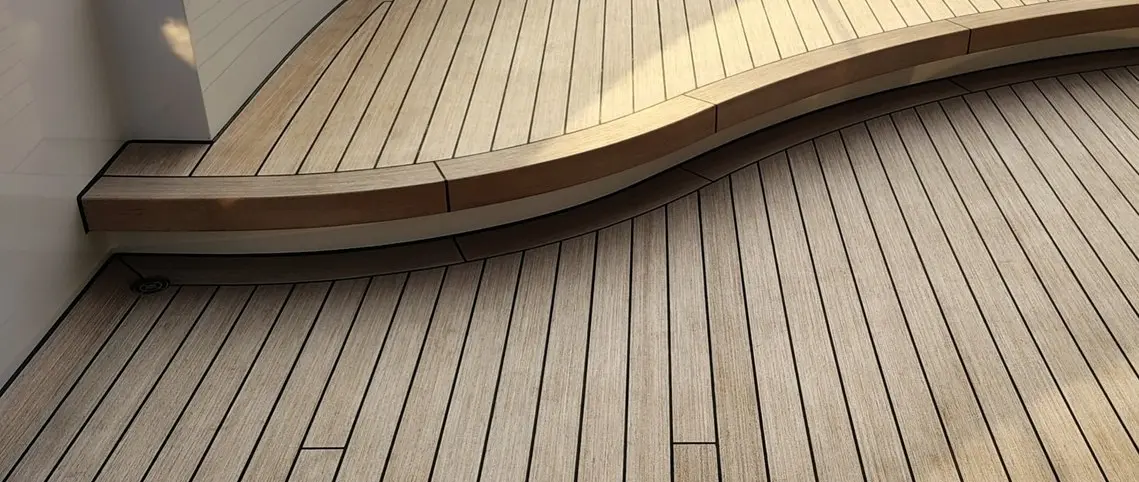
The accompanying photograph comes from Royal Boogaerdt Timber's first-party website, showing a finished yacht deck with integrated curved seating. Royal Boogaerdt helped establish Royal Deck and supplies relevant timber products, but the photograph is used only as illustrative material for the laminated-teak discussion.
The image is not represented as an independently identified Royal Deck project or a test proving environmental performance. The original timber company and photographer retain their rights. This distinction allows readers to understand what the material can look like without inventing a specific installation.
Limits of the METSTRADE interview
The November account offers a supplier's perspective on the search for materials, but it does not publish audited lifecycle assessments of every candidate, independently compare deck systems in a common test or announce a universal ban on teak for yachts. That distinction limits the weight an owner can place on claims of superior sustainability or longer service life without additional technical evidence.
Those limitations are important. Engineering decisions must be made for an actual vessel, and material-sourcing claims need current evidence. A professional evaluation should combine sample inspection, technical specifications, documented origin and a clear maintenance plan.
An evolving deck-material decision
The fresh development is Royal Deck's explanation of why laminated plantation teak and alternative surfaces are increasingly relevant as access to Myanmar teak changes. The interview connects supply-chain concerns with the day-to-day engineering and appearance decisions faced by yacht builders.
For Luxury Yacht Guide readers, the practical takeaway is to ask better questions before planning new decking: where does the material come from, how is it constructed, what supports its claims, and how will it be installed and maintained? The supplier's interview is useful context, not a substitute for those answers.
Primary sources and image provenance
News based on the current verified manufacturer or event news announcement and original builder, event or authorised distributor specifications and imagery. © Royal Boogaerdt Timber and original photographer. Illustrative first-party yacht deck photograph supplied by the timber company that originally helped establish Royal Deck; it does not identify a specific Royal Deck installation or verify a November 2026 material test. Images are genuine original subject-specific manufacturer, authorised distributor or original event photographs or official product design visual; they are not AI newsroom artwork. Prior events, future shows and construction are identified distinctly.