North America arrives in Amsterdam with a focused programme
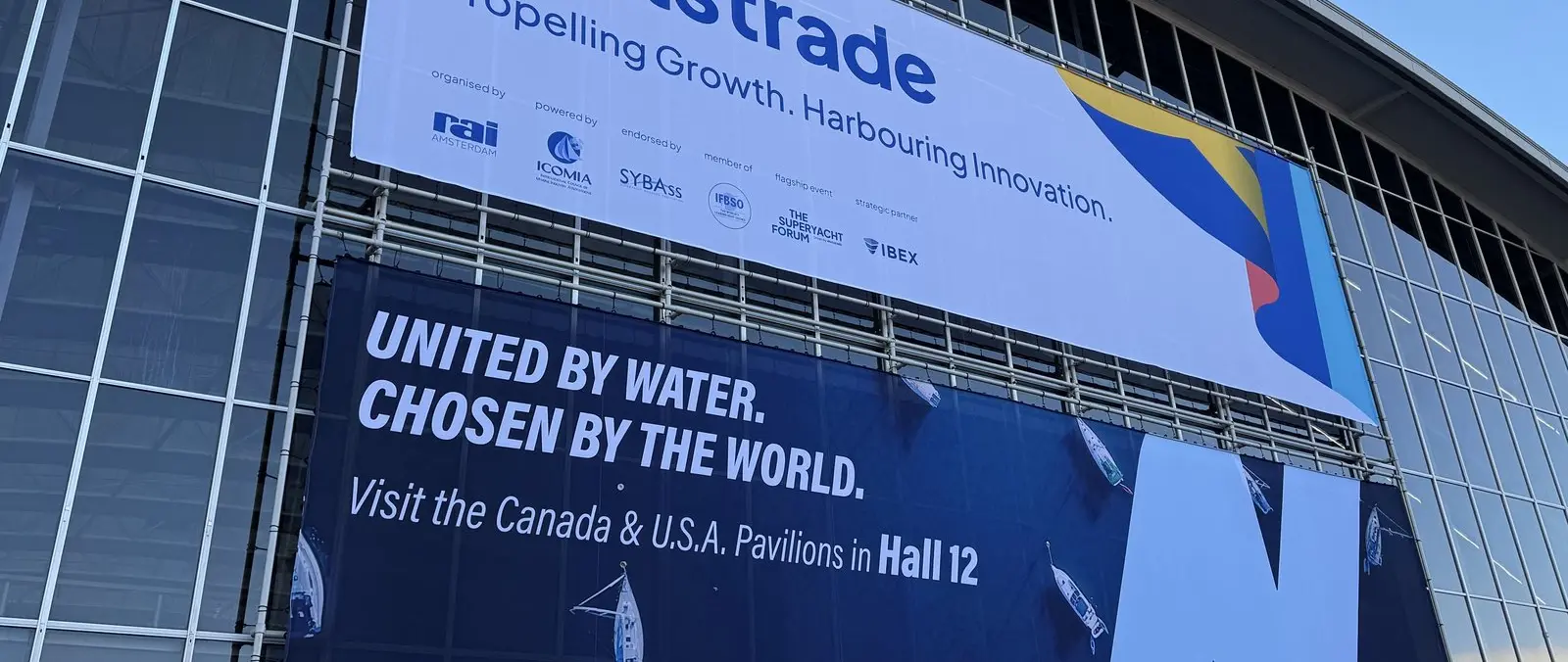
The National Marine Manufacturers Association organised dedicated United States and Canada pavilions at METSTRADE in Amsterdam from 17 to 19 November 2026. Its 9 November announcement identified Hall 12 at RAI Amsterdam as the centre for North American exhibitors, distributors and market discussions. Alongside the stands, NMMA joined the International BoatBuilders’ Exhibition and Conference and Soundings Trade Only to arrange the North American Stage. The programme combined nine discussion sessions with an industry reception. For yacht builders, dealers and equipment suppliers, the event offered a practical way to discuss certification, production methods, market trends and cross-border relationships in one place.
A trade show is more than a display of products
Unlike a conventional consumer boat show, METSTRADE concentrates on marine equipment, materials and professional relationships. Visitors may encounter propulsion components, onboard systems, materials, software and specialist services that eventually influence the cost and capability of finished yachts. The North American pavilions were designed to help companies meet buyers and international distribution partners. A pavilion creates visibility, but an introduction at a trade stand is not a commercial agreement or evidence of future sales. The value of the event is best understood through the conversations it enables, especially those concerning market access and technical standards that affect manufacturers working across regions.
Import compliance opens the agenda
The first announced stage session on 17 November addressed import compliance, certification and market entry. NMMA's Scott Berry, ABYC's Craig Scholten and US Coast Guard representative Jeff Ludwig were named among the speakers. This reflects a fundamental issue in international recreational marine trade: a component accepted in one market may still have documentation, testing or installation requirements elsewhere. Builders and suppliers should distinguish marketing claims from the actual technical standards applicable to a vessel or product. Approval processes can affect design, lead times and after-sales responsibilities. A discussion panel can help identify the relevant questions, but it does not replace formal assessment for any specific product.
Why certification matters to yacht buyers
Owners often encounter compliance indirectly, through the equipment that a yard includes in its standard specification. However, differences in electrical systems, safety equipment, fuel arrangements and installation documentation can become significant when a boat is moved between markets or refitted. A product that performs well in a demonstration may still be unsuitable for a particular installation without further work. The METSTRADE discussion programme highlights why manufacturers invest in regulatory expertise before placing goods into unfamiliar markets. Buyers may benefit from asking whether an imported feature carries the certificates required for their flag, intended use and service location. Clear documentation is a practical form of ownership protection.
Additive manufacturing moves beyond prototypes
The scheduled session on 3D-printed boatbuilding included Hilmar Backer, James Anderson, Twan Jonkman and Emil Johansson, with Aaron Porter moderating. Additive manufacturing has attracted attention for tooling, prototypes and the possibility of producing complex shapes with less conventional mould work. Yet the technique is not automatically superior to traditional fabrication for every component. Structural properties, surface finishing, quality assurance and repairability need examination. The discussion topic signals a maturing interest in how digital production can operate inside real boatyards. Commercial builders will ultimately judge success by repeatability, certification, total cost and the ability to deliver parts that remain reliable in service.
Marine marketing enters the AI conversation
NMMA scheduled a Tuesday discussion about artificial intelligence in marine marketing with David Gee, Laurie Louvier and Matt McKenna, moderated by Michele Goldsmith. For suppliers and builders, AI may affect the way customer enquiries are handled, technical information is organised or products are promoted internationally. Those uses also raise questions about accuracy, privacy and the danger of inventing specifications. Marketing automation should never turn uncertain performance claims into established facts. The presence of this discussion in an equipment-focused trade event illustrates how digital workflows are now considered part of marine business operations. Whether a particular tool provides measurable value remains a matter for practical testing.
Retail trends on the second morning
The 18 November programme included a session on United States retail trends led by West Marine chief executive Paulee Day. The topic matters to European manufacturers because demand in North America can influence the allocation of inventory, dealer support and product development. Consumer purchases do not move uniformly across every boat size and equipment category. A downturn in one segment can coexist with strength in another, and retail sales information needs to be interpreted with attention to market definition and reporting periods. The official stage schedule confirms the speaker and subject, but it does not justify attributing a particular forecast or sales number to the discussion without a separate published record.
Wood-composite yachts deserve a closer look
A panel on wood-composite yacht construction brought together Sam Temple, Eric Blake, Thomas Degrémont and Ben Van Dam. The subject challenges assumptions that modern yacht building must choose exclusively between traditional timber work and advanced composites. Combining materials can offer design opportunities while making engineering, workmanship and maintenance critical. Buyers interested in specialised construction should ask how the structure was designed, tested and protected against moisture. A material name is not enough to establish durability or environmental performance. The value of the panel was in placing a range of technical viewpoints before builders who may be weighing alternative production methods.
America's Cup methods and commercial application
Another Wednesday session examined commercial applications of America's Cup technology with Ferdinand van West and Tyson Lamond, moderated by Luca Rizzotti. Racing programmes can accelerate experimentation, but a technique that improves performance over a short competitive campaign may not translate directly to a family cruising yacht. Cost, reliability, operator skill and repairability can be more important in everyday use. Suppliers need to consider whether an innovation solves a real ownership problem rather than merely drawing attention to a racing connection. The panel subject is valuable because it asks which advanced techniques can survive that transition. Without individual test data, it would be premature to make claims about particular commercial products.
A joint North American market perspective
NMMA president and chief executive Frank Hugelmeyer and NMMA Canada executive director Marie-France MacKinnon were scheduled to discuss North American market conditions with moderator Robert Newsome. Their participation reflects the interconnected nature of US and Canadian supply chains, even though the two countries have different commercial and regulatory settings. A European component maker considering expansion may need to understand dealer geography, certification, warranty expectations and after-sales service before choosing a distributor. High-level market commentary can provide context, but it cannot replace a carefully developed business case for a particular product or segment. The practical value lies in identifying relationships and information sources for further work.
Networking has an operational purpose
The Wednesday North American Reception was intended to bring exhibitors and business partners together in Hall 12. Such events may sound primarily social, but supplier relationships often depend on trust established outside the formal buying process. A distributor may need to know how a manufacturer handles damaged parts, warranty claims and seasonal inventory before committing to a new range. A shipyard may need evidence that a specialist system can be supported in several cruising regions. Meeting representatives in person can accelerate those conversations. The reception itself should not be presented as a commercial result, but as one element in a broader programme of relationship development.
Consumer research connects with boat design
The Thursday schedule included a Discover Boating session led by NMMA's Kevin Williams on consumer insights and the marketing funnel. This topic creates a useful bridge between upstream equipment manufacturing and the experiences that motivate people to buy boats. A technically impressive feature may have limited appeal if it does not solve a problem that owners recognise. Conversely, seemingly modest improvements in access, ease of use or maintenance can change how often a vessel is enjoyed. Designers and suppliers can benefit from systematic customer research while remembering that preferences differ among first-time buyers, experienced cruisers and luxury-yacht owners. A single consumer profile cannot represent the entire sector.
Lithium-ion shutdowns become a design concern
The final scheduled technical discussion, led by ABYC's Maciej Rynkiewicz, focused on designing electrical systems for battery management system shutdowns. The subject is directly relevant to modern yachts using lithium-ion energy storage for house loads or propulsion support. Battery protection systems can disconnect power under certain conditions, making it important to understand what other systems depend on that supply. Engineers must address safe installation, suitable protection, emergency operation and the behaviour of connected loads. A panel discussion is not a replacement for installation instructions, class or flag requirements, or competent electrical design. It nevertheless highlights a risk that deserves attention before a system is specified.
The supplier's view of environmental performance
Marine companies increasingly discuss efficiency and environmental impact, but meaningful comparisons require defined methods. One component may reduce operating energy while introducing different manufacturing or disposal requirements. Discussions about production methods and battery systems at METSTRADE provide context for these trade-offs. A supplier should not describe an innovation as sustainable merely because it is electric, digitally manufactured or lightweight. Relevant evidence may include energy use, material sources, lifespan and serviceability. For yacht owners, a clearly documented installation can be more valuable than a broad environmental slogan. The trade programme illustrates the need to connect emerging technologies with engineering evidence.
How the event affects 12–24 metre yachts
Luxury motor and sailing yachts in the 12–24 metre range often combine systems from many specialist manufacturers. Even when owners buy a completed vessel from a recognised yard, the experience aboard depends on navigation electronics, electrical components, mechanical equipment and dealer support. A supplier pavilion can influence what options become available in future build specifications. However, an exhibition appearance does not imply that a particular product is compatible with every boat. Owners contemplating a refit should work through a systems inventory and verify the constraints of their vessel. A well-integrated result matters more than collecting fashionable equipment without a coordinated installation plan.
What exhibitors should take away
The stage programme addressed regulation, manufacturing, marketing, retail demand, yacht construction, racing technology, industry trends, consumer behaviour and electrical design. That range is a reminder that marine suppliers operate inside an ecosystem rather than in isolation. A company may have an excellent product and still struggle without market knowledge, certification or service partners. Trade-show conversations become useful when followed by technical documents, test procedures and commercial commitments. The North American pavilions created a location for such discussions, but the lasting value will depend on work undertaken after the event. Both manufacturers and buyers benefit when announcements are converted into clear, verifiable commitments.
An international perspective on marine manufacturing
NMMA's Hall 12 initiative at METSTRADE 2026 is significant because it combines physical exhibits with substantive professional discussion. It offered North American companies a setting to explore European and international relationships while raising practical questions about compliance, new production techniques and onboard technology. The programme is not proof of a market boom or a prediction of individual sales. Its importance lies in the effort to connect people who design, certify, distribute and maintain the equipment that eventually reaches yacht owners. For the luxury boating sector, such cooperation can be just as consequential as the launch of a highly visible new model.