A new debate about how long a yacht should last
Oyster Yachts has placed the service life of existing sailing yachts at the centre of a broader industry discussion on maintenance, modernisation and circular construction. Reporting published by the official Metstrade trade-show platform on 26 November 2026 described how original equipment manufacturers are taking a more active role in the refit of boats that have already enjoyed many years at sea. The account included comments attributed to Oyster leadership alongside a separate discussion of Groupe Beneteau's NEO programme. The significant development is not a newly launched Oyster model but the changing role of its builder after the initial sale.
For owners of cruising yachts between 12 and 24 metres, this question reaches beyond environmental terminology. An existing hull can remain useful while navigation equipment, charging systems, domestic appliances, interiors and operating requirements evolve. A manufacturer-backed service organisation can help establish which upgrades are practical without sacrificing structural integrity or the vessel's original operating characteristics. The Metstrade report provides a timely opportunity to examine what Oyster's Barcelona operation already offers, what its executives are advocating, and which claims remain subject to independent verification.
What the November Metstrade report actually established
The Metstrade article, titled "Sail it again: Industry goes circular by refurbishing," was published on 26 November after the Amsterdam trade event held earlier in the month. It reported remarks by Oyster Yachts chief executive Stefan Zimmermann Zschocke on keeping older yachts sailing, bringing new owners into the brand through previously owned vessels and supporting refit work even when it is carried out away from the manufacturer's own facilities. The article positioned these remarks alongside comparable developments at other builders, rather than announcing a single new Oyster investment.
An important distinction must be maintained between a statement about the size of a service community and a confirmed number of completed refits. Oyster's own public account of its Barcelona operation says that more than 45 Oyster yachts were wintering in the city when the service centre opened in 2025. That number does not establish that 45 individual refit projects have been completed, nor does it specify a current 2026 completion rate. Any assertion of an exact refit total would need fresh confirmation from the yard. The material points to a substantial owner base and an established service network, not a verified new contract volume.
Barcelona as a practical Mediterranean service base
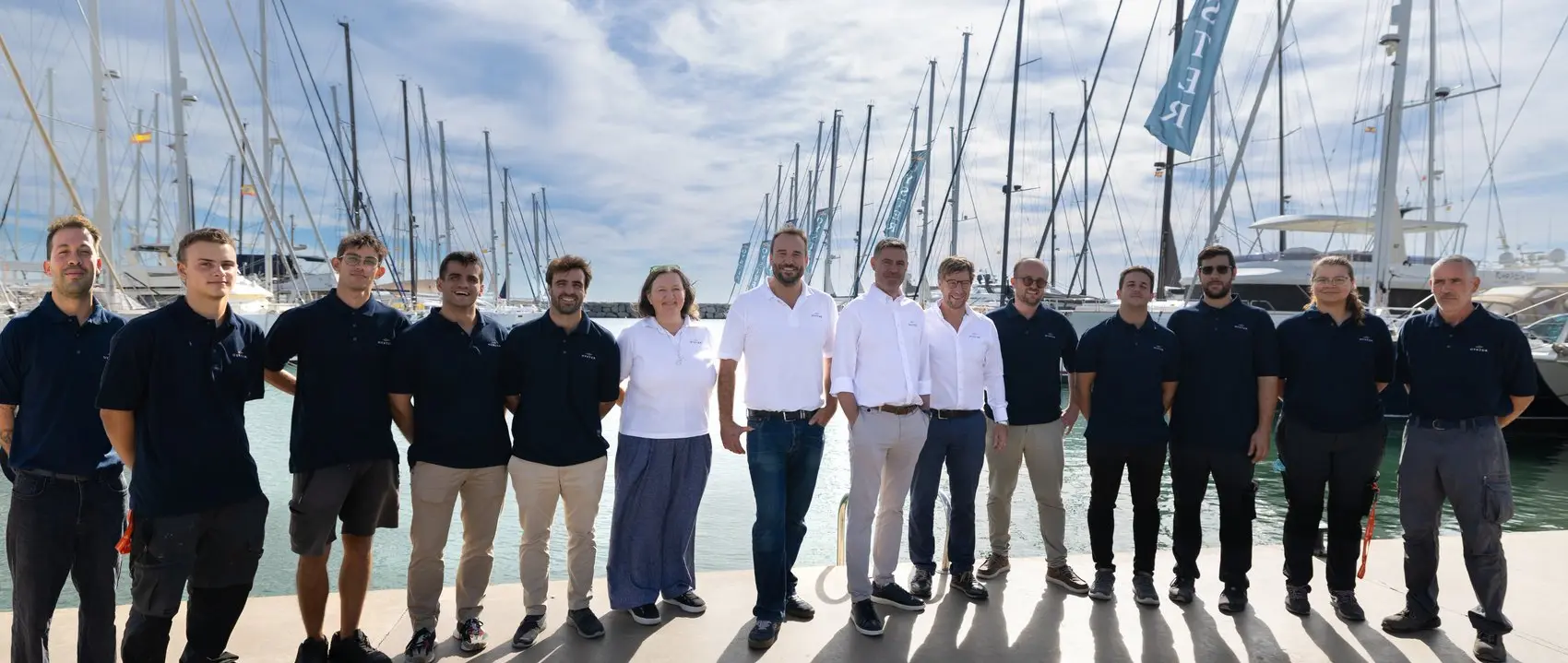
Oyster officially opened its Barcelona Service Centre at Premià de Mar on 31 October 2025 and announced the milestone on 5 November that year. The location gives Mediterranean owners an alternative place to plan maintenance, upgrades and winter preparation. Oyster described the centre as part of its expanding international support network, with the intention of helping boats prepare for another cruising season or for longer bluewater passages. The site has an engineering and refit function rather than being merely a sales office or a showroom.
That distinction matters to an owner calculating the cost of keeping a familiar yacht. Some work can be scheduled around a seasonal lay-up, while more substantial changes may call for longer planning, engineering advice and coordination with specialist suppliers. Being near the owner's intended cruising grounds can reduce avoidable movements and make inspection easier. However, neither Oyster nor Metstrade publishes a universal refit price list in the cited announcements, and a reader should not treat industry-level cost comparisons as quotations for a particular boat. Each proposal depends on condition, complexity, labour and scope.
Why the original builder can have an advantage
An original shipyard may know construction details that are difficult for an unrelated contractor to reconstruct. This can include the layout of inaccessible systems, original drawings, equipment specifications and information about changes made during production. Oyster's own maintenance guidance says the company retains original plans and build records to support owners and refit teams. That knowledge becomes particularly useful when a job involves hidden cable runs, structural interfaces or the interaction of several onboard systems.
It does not follow that every repair must be done by the builder. An experienced independent yard can carry out high-quality work, and a geographically remote owner may need a local engineering solution. The distinction is access to authoritative design information and the ability to coordinate manufacturer support, parts and service history where available. The November Metstrade discussion suggests that Oyster is willing to assist work beyond its own workshops. Owners should still establish the precise division of responsibility for design advice, installation, testing and any warranty before the project starts.
Upgrading electronics without creating a fragile boat
Navigation and communications systems can become functionally outdated long before a yacht's hull has reached the end of its useful service. Replacing a display is not always a standalone job: a modern installation may require new cabling, compatible sensors, software configuration, power protection and an assessment of existing data networks. Owners should ask whether the proposed package remains maintainable when individual components eventually fail, and whether the new equipment can be supported in the regions where the boat is likely to cruise.
The objective is reliable operation rather than maximising the number of screens. In a long-range sailing yacht, redundancy and simple failure procedures may matter more than the newest interface. A thoughtful refit can preserve independent navigation and communications paths while adding digital conveniences. Those considerations help explain why work led by experienced marine engineers can deliver value beyond the visible equipment purchase. They are general technical principles, not claims that Oyster has introduced a specific new electronics package or that any particular existing Oyster model needs replacement.
Energy systems pose a different set of questions
The official Metstrade account also examined electrification and integrated onboard energy management as future opportunities for existing sailing yachts. Battery chemistry, charging arrangements, shore-power equipment and domestic loads have changed considerably in recent years. A yacht that once depended on separate systems for lighting, cooking and propulsion may be a candidate for better integration, but suitability cannot be inferred from age alone. Weight, hull balance, ventilation, electrical protection and operational range all have to be considered together.
For yacht owners, the first step is a documented energy audit based on actual cruising habits. It should distinguish overnight hotel loads from occasional peaks, long-distance passage requirements and shore-side charging opportunities. A reduction in generator running may be desirable, but the technical and financial case will be different for a coastal cruiser and a vessel preparing for an ocean crossing. Metstrade reported broader industry ambitions for electric propulsion; it did not provide a verified propulsion-conversion specification for Oyster's Barcelona fleet, and no such claim is made here.
Refits as a route into yacht ownership
One theme of the 26 November discussion was the possibility that a professionally updated used yacht could attract a buyer who would not otherwise purchase a new vessel from the same yard. The appeal is straightforward: a known design with refreshed equipment and a coherent maintenance history offers an alternative to commissioning an entirely new boat. Yet affordability should not be judged solely against the purchase price of a new model. Insurance, surveys, sails, rigging, berthing, taxes and subsequent service commitments can alter the ownership calculation.
A manufacturer-backed refit may add confidence because the yard can explain the work and its relationship to the original design. Even so, the condition of a particular yacht must be demonstrated through independent inspection and documentation. Buyers should ask for dated work orders, component records, rigging reports, sea-trial results and evidence of any warranties. They should also distinguish between items professionally refurbished and those simply cleaned or cosmetically improved. A used yacht is not made equivalent to a new one merely by an extensive interior update.
What warranty support should mean in practice
The Metstrade coverage linked manufacturer-managed refurbishment with the possibility of providing a yard-backed warranty. A warranty can be commercially significant, but its wording is more important than the headline. It may cover the new parts or labour carried out during a specified project without extending to the whole hull, earlier equipment or unrelated faults. Geographic coverage and the procedure for making a claim deserve scrutiny, particularly for yachts intended to cross oceans and remain away from the original service centre.
Before commissioning work, an owner should obtain a written scope defining inspections, approved parts, labour, acceptance tests, exclusions and the handover file. It is also useful to understand how subsequent maintenance performed by another yard affects any promised coverage. Oyster's publicly described network provides a framework for discussing these matters, but it should not be read as a blanket guarantee that every second-hand Oyster is automatically covered. Any warranty rights arise from the applicable contract, not from a general industry statement about circularity.
Longevity has an environmental dimension, not a free pass
Keeping a structurally sound yacht in service can avoid some of the materials and industrial processes needed to replace the vessel. Fibreglass hulls in particular create difficult end-of-life questions, making careful retention and upgrading worth considering. However, it would be misleading to describe any refit as automatically carbon-neutral or environmentally superior. New batteries, electronics, upholstery, coatings and machinery also carry manufacturing impacts, while some ageing equipment may become less efficient or harder to repair.
A defensible sustainability assessment asks what is replaced, why, how long the refurbished yacht is expected to remain in use, and what happens to removed equipment. Re-use, recycling and disposal should all be considered. The November Metstrade discussion demonstrates growing interest in circularity within the leisure marine sector, but it does not supply a full life-cycle assessment for Oyster refit projects. Owners and yards should avoid turning an encouraging technical approach into an unsupported emissions claim.
How this relates to Oyster's wider support network
Barcelona is only one part of Oyster's after-sales structure. The manufacturer has also publicised services in Palma and other cruising centres, describing support that extends from routine maintenance to larger work packages. Its June 2026 company update referred to continued investment in the global service network, including dock infrastructure at Barcelona. In the manufacturer's own framing, refit, technical advice and after-sales support sit alongside brokerage and owner programmes in a longer relationship with each boat.
There is a practical commercial logic to that model. Maintaining contact with later owners can preserve technical knowledge, strengthen parts support and make the original brand relevant throughout a yacht's service life. For smaller luxury-yacht operators, it may also provide more predictable access to specialised skills than assembling an entirely new team for each project. The success of the approach should ultimately be judged by measured customer outcomes, quality of work and repeat use, not simply by the number of facilities listed on a corporate website.
Questions an owner should put to a refit yard
A serious first meeting should begin with the vessel's survey findings and intended voyages, not with a catalogue of fashionable equipment. Owners should identify the most consequential existing problems and the systems that present the highest operational risk. Questions about hull condition, rigging age, electrical protection, tank access, spare-parts availability and safety equipment will often determine the eventual work programme. A credible yard should be willing to separate essential maintenance from optional enhancements and explain which tests will demonstrate that the completed project meets the agreed specification.
Scheduling matters just as much as specification. A project that runs into the next sailing season can cause costs beyond the refit invoice, especially if accommodation, berths and crew have already been arranged. The owner should request milestones, inspection opportunities, a change-order process and a realistic commissioning period. Manufacturer participation may simplify access to records, but it does not remove the need for independent judgment and disciplined project management. The ultimate purpose of the investment is a dependable yacht ready to sail, not a list of newly installed components.
The significance for 12m to 24m luxury sailing yachts
For Luxury Yacht Guide's 12-to-23.99-metre audience, the Metstrade report is notable because it treats the older yacht as an ongoing product rather than the end of a one-time sale. This is particularly relevant to bluewater cruising designs whose structural and sailing qualities may remain attractive even when the equipment and accommodation require modernisation. The significance lies in the builder's continuing role, the development of specialist service infrastructure and the possibility of better documented second-life ownership.
The reporting available as of 27 November 2026 supports a measured conclusion: Oyster has an established Barcelona service presence, its leadership has publicly advocated long service lives and manufacturer support for refits, and a wider conversation about circular refurbishment is taking shape. It does not establish a new number of completed Barcelona projects, guaranteed cost savings or a quantified environmental outcome. The primary reporting is the Metstrade article published 26 November 2026; additional confirmation comes from Oyster's official Barcelona service announcement and its June 2026 company update.