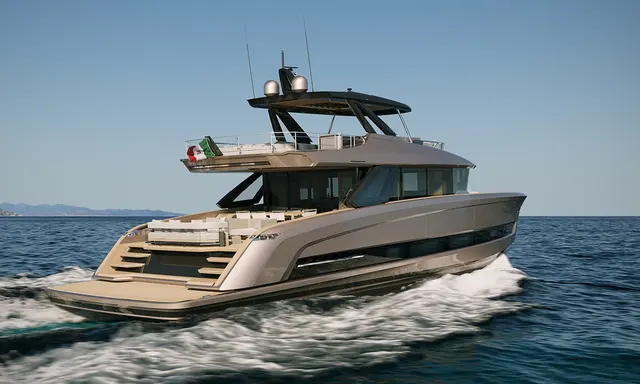
MARCOPOLO Adventure Yachts is making its Cannes debut with the MP12, the flagship of a two-model range created by the Aschenez Group and built by 3AF Shipyard in Sicily. The project follows its first international presentation at boot Düsseldorf and brings the brand’s transformable open-to-cruiser idea to an in-water Mediterranean show.
The Cannes release describes the MP12 as a 12-metre adventure yacht, while earlier official technical material has used a 12.70-metre overall figure depending on measurement. Both place the model firmly below 24 metres, and the design emphasis is less on the exact number than on extracting multiple uses from a compact plan.
Open boat and cruiser in one layout
The MP12’s central feature is a modular arrangement that can change between a largely open day-boat format and a more protected cruiser configuration. Fold-down side balconies further expand the usable deck when the boat is at anchor, increasing the area devoted to swimming and social use.
That transformability is meant to extend the boat’s relevance beyond one type of owner. A buyer can prioritise day use in warm Mediterranean conditions without giving up the ability to create more shelter or accommodation for longer trips.
Triple outboards and a three-step hull
MARCOPOLO says the MP12 can be equipped with as many as three 450 hp outboards. The running surface uses three steps and has been developed with CFD analysis, combining the high-output propulsion package with a hull intended to manage lift and resistance efficiently at speed.
The project is not being marketed only around top speed. The builder repeatedly links performance to comfort and usable range, suggesting that the stepped hull is intended to make the boat practical for repeated coastal passages rather than simply spectacular during brief demonstrations.
Composite construction includes recycled PET
The structure incorporates modern composite materials including recycled PET core and carbon fibre. The brand also draws on finishing ideas and technical materials associated with automotive, aerospace and motorsport applications, using those references to support its premium positioning.
Lightweight construction has obvious performance benefits, but it can also influence how much equipment, fuel and interior finish can be carried without undermining the hull’s intended running attitude. That makes the material strategy part of the overall design rather than a standalone sustainability claim.
Roberto Delfanti shapes the identity
Exterior styling is by Roberto Delfanti Design Lab, with project development led by Rosario Alcaro, who previously founded Invictus Yacht and Capoforte. The design avoids a traditional utilitarian explorer look, instead combining muscular proportions with large sea-facing leisure areas.
That visual direction helps explain the ‘Adventure Yacht’ label. MARCOPOLO is not proposing an offshore expedition vessel in miniature; it is presenting a versatile luxury boat intended to carry equipment, adapt its deck and support active use while retaining Italian styling and finish.
A second major show for a young brand
After Düsseldorf, Cannes gives the company its first major opportunity to demonstrate the MP12 afloat to a broad international audience. The show also places it directly against established premium day-boat and weekender brands in one of the most competitive segments of the market.
The MP12’s success will depend on whether buyers find genuine value in the open-to-cruiser transformation rather than viewing it as added complexity. If the system proves intuitive in daily use, the platform gives MARCOPOLO a clear technical story around which to build the rest of its range.
The MP12 has to make modularity feel effortless
Transformable boats are attractive on paper because one platform can support very different days on the water, but the mechanisms only add value if owners actually use them. MARCOPOLO therefore has to make the MP12's opening balconies, changing furniture and open-to-cruiser configuration quick enough that converting the boat becomes part of normal operation rather than a show feature used only occasionally.
The 12-metre size gives the concept a useful test bed. There is enough deck area for the transformations to create a visible difference, but the boat remains compact enough for private operation and conventional marina use. If the mechanisms prove robust through repeated saltwater exposure, the MP12 could establish the practical credibility the young brand needs before expanding further. The first owner boats will show whether that flexibility remains intuitive after the novelty of the show demonstration has passed.