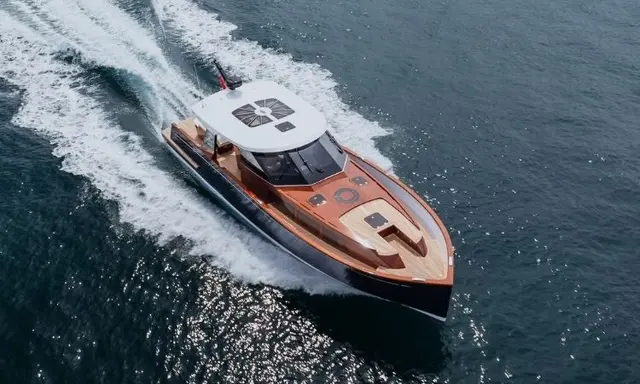
Manari Yachts is using the 2026 Cannes Yachting Festival for the European debut of a particularly specialised Manari 52: a 16-metre boat commissioned to operate as the chase yacht for a new megayacht. The yacht has been painted and finished to match its future mothership and is intended to read as part of the same owner programme rather than as an unrelated support craft.
The project marks Manari’s entry into the dedicated chase-boat market only a short time after the young brand’s own launch. After Cannes, the 52 is scheduled to continue to the Monaco Yacht Show, where it will be displayed alongside the megayacht it was designed to support.
A chase boat designed as part of the mothership
The owner’s brief extends beyond matching hull colour. Manari says detailing and finishes have been coordinated with the larger yacht so that the 52 feels visually connected to the mothership when both vessels are operating together.
That approach reflects the changing role of premium chase boats. Instead of being treated only as fast transport for guests and crew, they are increasingly specified with the same attention to materials, entertaining and brand identity as the yacht they support.
Custom deck plan and opening balconies
The 52 uses a custom layout built around a beach-club atmosphere, with folding side balconies expanding the aft platform toward the water. A large wet bar supports outdoor entertaining, while the furniture and circulation have been configured around the owner’s intended use rather than a standard showroom package.
The boat can therefore work independently at anchor as well as shadow the mothership underway. For owners of very large yachts, that flexibility is valuable because a chase boat may be asked to carry guests, scouts, water-sports equipment or provisions at different times during the same programme.
Volvo Penta IPS underpins the handling brief
Manari has selected Volvo Penta IPS propulsion for the custom yacht, giving the crew joystick control and pod-drive manoeuvrability in marinas. The builder says sea trials confirmed the stability and control required to sustain useful speed in unsettled conditions, although it has not framed the project around one headline maximum-speed figure.
For a chase boat, predictable handling can matter more than a short burst of top speed. The vessel has to arrive where the mothership needs it, often carrying guests or equipment, and must remain manageable in tight harbours after a fast transfer offshore.
Cannes before the reunion in Monaco
Cannes gives the 52 its first European public exposure before the more symbolic appearance in Monaco. There, the relationship between chase boat and mothership will be visible directly, showing how closely the smaller yacht has been integrated into the owner’s wider build programme.
That sequence also gives Manari access to two different audiences. Cannes is strong for production and semi-custom yachts below 24 metres, while Monaco brings the captains, owners and project teams responsible for the much larger yachts that are the natural buyers of high-end chase boats.
Manari builds a specialist division
The company now presents Manari Privé as its superyacht tender and chase-boat division, offering technical support in locations including Saint-Tropez, Ibiza and Miami. The custom 52 provides a real project around which that service can be demonstrated rather than leaving the division as a marketing concept.
At 16 metres, the yacht also remains capable of operating as a luxury motor yacht in its own right. That dual identity—serious support vessel when required, independent entertaining platform when desired—is becoming a defining feature of the most ambitious chase-boat projects.
The chase-boat role is becoming more sophisticated
Manari's project illustrates how the chase-boat brief has moved beyond simple guest transfer. Matching the mothership's finish, carrying serious entertaining space and remaining comfortable enough to work independently at anchor all increase the value of the smaller yacht within the wider owner programme, especially when the mothership cannot enter shallow harbours or crowded destinations.
That sophistication also raises expectations for reliability. A chase yacht may be asked to run hard, dock repeatedly and move people or equipment on short notice, so service access and predictable handling matter as much as visual continuity with the mothership. The Manari 52 has to prove it can deliver both roles without becoming too delicate or complex for the practical work expected of a support vessel.