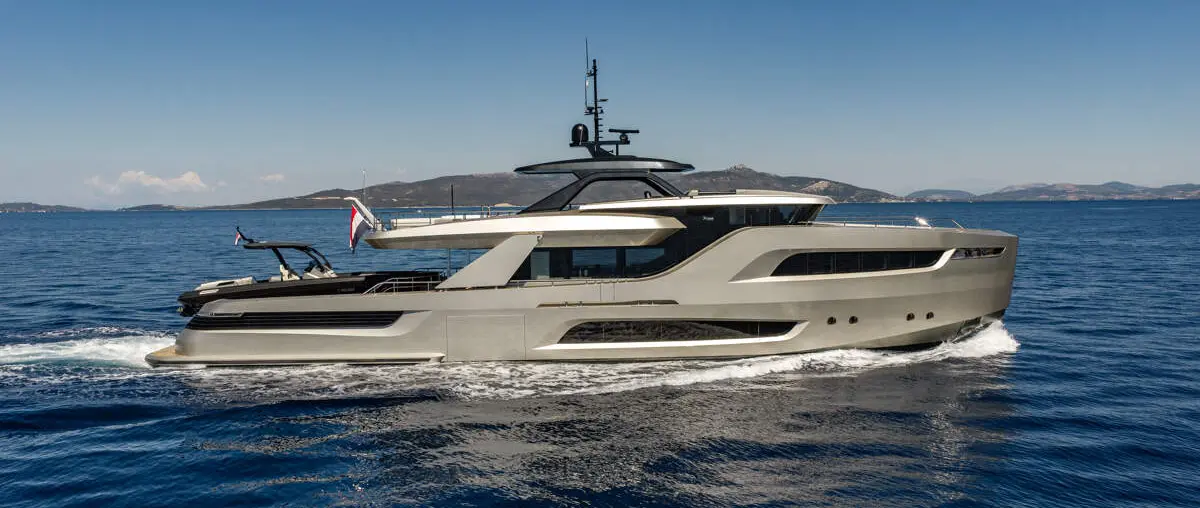
A different proposition in the 33-metre market
Fraser has announced that LADY FLEUR, a thirty-three-metre motor yacht built by Holterman Shipyard in the Netherlands, has joined its sales fleet. The announcement highlights Dutch steel construction, space for ten guests and an unusual hydraulic feature on the main aft deck. For a buyer scanning brokerage listings by length alone, those details make the yacht worth a closer look because they point towards operational choices not found on every yacht in this size band.
The shipyard’s steel-hull approach is associated with structural strength and the ability to shape substantial onboard spaces. Yet the material alone does not establish condition or maintenance costs. A second-hand buyer should evaluate coatings, corrosion protection, machinery and systems independently of the builder’s reputation. A full technical survey is required to understand whether a particular vessel suits the intended cruising schedule.
Fraser positions LADY FLEUR for extended family voyages rather than purely for harbour-to-harbour social calls. That is a useful editorial distinction: the ideal yacht for entertaining at anchor may not be the same as the one that carries stores, toys and people comfortably across a long season. The listing should be assessed through its actual circulation, crew arrangements and tender facilities, not merely by deck photographs.
An aft platform changes how the boat is used
The broker calls attention to a hydraulic platform integrated into the main aft deck. Such equipment can create a flexible connection between the vessel and its tenders or the water, depending on the exact operating arrangement. It potentially makes embarking, swimming and moving equipment more convenient, but every hydraulic system introduces lifting limits and maintenance obligations. The permitted loading, motion and operating procedure must be confirmed from the yacht’s technical manual.
Tender handling is especially important when the primary yacht anchors away from a marina. A heavy tender, diving equipment and watersports gear need safe storage and launch systems that do not obstruct guest movement or emergency access. If the hydraulic arrangement is intended to support any of these uses, the buyer should ask for an operational demonstration under the appropriate conditions. An impressive photograph is no substitute for a safe lifting test.
For families, ease of movement between interior space, aft deck and water can define the quality of daily life aboard. Guests of different ages may want very different levels of activity, so the platform and surrounding deck must be reviewed for safe access, supervision and rail arrangements. The appeal lies in practical flexibility rather than in assuming that the feature is suitable for every recreational use without restriction.
A claimed range for more ambitious cruising
Fraser advertises a range of approximately 2,400 nautical miles for LADY FLEUR. That number suggests the boat was conceived with extended movement in mind, but it is not a guaranteed distance available under every passage condition. Speed, sea state, loading, reserves and hull cleanliness all influence fuel consumption. A buyer should request the builder’s performance documentation and verify actual consumption under realistic operating loads.
Ten guest berths allow a relatively substantial party to travel together, although the detailed arrangement of cabins matters more than the headline capacity. A family may need separate accommodation for children, additional privacy for adults or enough storage for longer voyages. The specification should also establish how many crew can be carried comfortably, how guest areas are serviced and whether the practical hotel systems support the full complement offshore.
A steel yacht with long-range ambitions also needs robust technical preparation. Fuel handling, freshwater generation, refrigeration, spares and maintenance access can determine how independent a voyage becomes. Claims of exceptional tender capacity or flexible deck arrangements should be tested against the yacht’s real payload and safe loading plan. Engineering review is therefore inseparable from understanding the advertised lifestyle.
What prospective owners should ask
The current listing is an invitation to inspect a specific yacht, not an announcement of a completed transaction. Buyers should obtain an up-to-date inventory, ownership and flag documentation, class or survey status and a schedule of recent works. Commissioning an independent hull and systems survey is especially important if the intended itinerary includes remote waters or significant annual mileage. Survey findings will also influence future insurance and refit budgets.
A viewing should include a demonstration of the aft platform and a careful inspection of its hydraulics, structural supports and controls. The crew’s description of daily tender operations can reveal practical details that marketing copy overlooks. Ask how much deck space remains available when equipment is stowed or deployed, and review whether the arrangement introduces any limitations at sea or in restricted harbours.
LADY FLEUR is an interesting addition to Fraser’s October selection because it combines a manageable overall length with an emphasis on flexible water access and longer cruising. Its suitability will ultimately depend on confirmed technical specification, condition and the owner’s preferred cruising pattern. The hydraulic feature and advertised range are good reasons to investigate, but informed ownership begins with verifying exactly what those capabilities mean on the individual vessel.
Primary source: Fraser Yachts. For specifications and availability, consult the original official announcement and current publisher information.