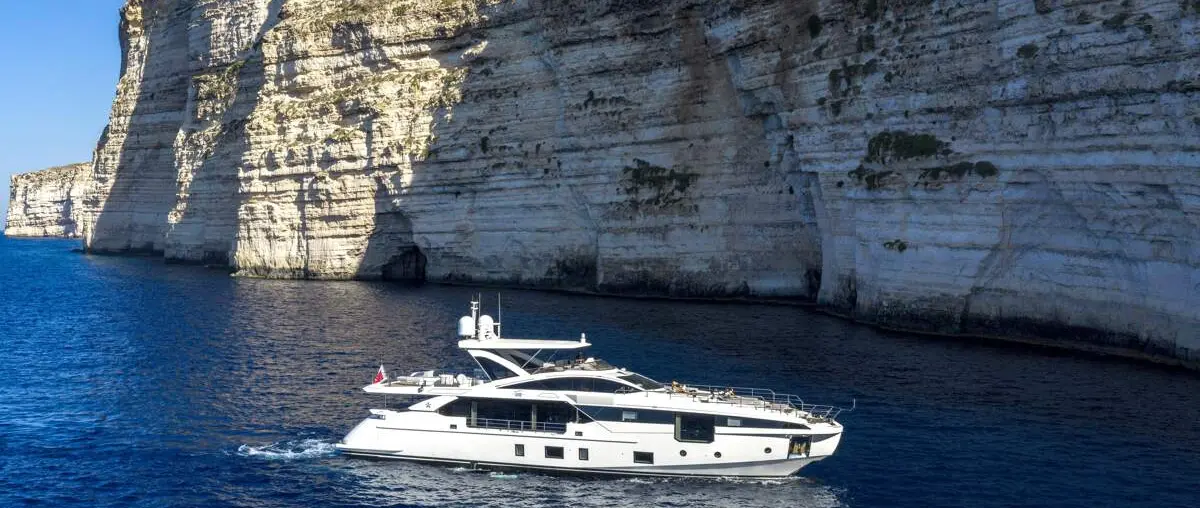
A high-performance Azimut with a new sales mandate
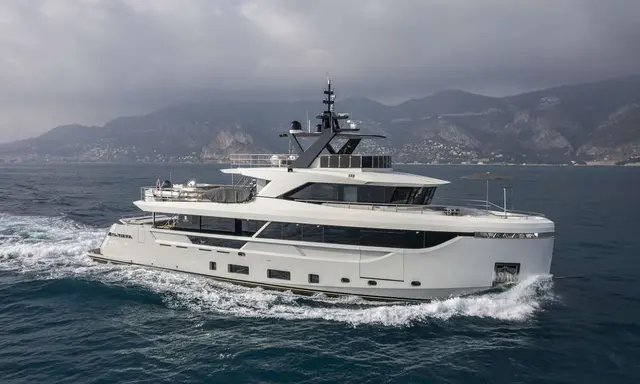
Fraser has added STARKISS, a thirty-two-metre Azimut Grande built in 2021, to its international sales fleet. The broker’s current public particulars show an asking price of €8.25 million, eleven guest berths and five staterooms. The yacht occupies a different part of the market from slower, full-displacement vessels of comparable length, with a declared maximum speed of twenty-six knots and a design intended to combine energetic cruising with comfortable guest areas.
Stefano Righini is credited with the exterior design and Achille Salvagni with the interiors. Their work is evident in the angular bow, large areas of glazing and a more contemporary domestic setting than many older motor yachts. The design is not merely a style exercise: windows, deck proportions and the position of guest spaces influence how the vessel feels when underway and at anchor. The actual comfort at speed should still be judged during a sea trial.
Fraser’s announcement is dated 23 October 2026 and follows a five-year survey and Malta commercial coding. Those are important selling points, particularly for a buyer considering commercial operation, but they are not guarantees that every intended charter itinerary is automatically authorised. The buyer’s adviser should review the survey record, certificates and any remaining conditions or renewal dates.
Five cabins and a strongly outward-facing layout
The main-deck owner’s cabin extends across the yacht’s beam and uses large windows to bring the water into the room visually. Four other guest cabins include double and twin arrangements, with a Pullman berth allowing the total advertised capacity to reach eleven. This can suit a mixed family party, although the actual distribution of adults and children needs attention to berth dimensions, privacy and local passenger limits.
STARKISS also offers a generous flybridge and an outdoor lifestyle that makes sense for warm-water cruising. The broker describes lounge and dining areas, foredeck sunpads, an outdoor cinema and cooking facilities. These elements provide different places for guests to gather, but the owner should check the real storage, shade and service requirements behind them. A cookery feature on an open deck may have operating constraints when wind or a rolling anchorage intervenes.
At the stern, the nearly eighteen-square-metre beach club and side-opening garage are key attractions. The yacht is described as carrying a five-metre tender along with personal watersports equipment. Tender deployment should be inspected carefully, including hydraulic arrangements, stowage and crew access. A high-performance hull can be inviting for short coastal passages, but life at anchor is often determined by how smoothly the tender and swim facilities operate.
Performance claims and the operational reality
Azimut’s D2P hull concept and use of carbon-fibre superstructure materials form part of the yacht’s technical proposition. The stated twenty-six-knot maximum is a useful indication of capability, but it does not specify range or consumption at normal cruise. A purchaser should request machinery records, current engine hours and sea-trial results under realistic loading. Comfort, noise and fuel use at the speeds the family actually intends to travel are more relevant than the maximum alone.
The public listing describes substantial enclosed volume for her length, around 224 gross tons. Gross tonnage is a measure related to internal volume rather than the vessel’s weight, so it should be compared carefully with competing designs. A larger internal arrangement can support more guest accommodation but also increases demands on generators, cooling and crew servicing. Equipment age and maintenance access deserve a detailed inspection alongside the attractive layout.
Commercial coding is relevant to a prospective charter programme but is only one part of the operation. Suitable insurance, local cabotage and tax rules, crew qualifications and specific cruising-area permissions remain separate questions. Buyers should also confirm whether existing charter bookings, if any, are included in or excluded from a transaction. A responsible purchase process distinguishes the current sale listing from an assumed future stream of charter income.
What a serious buyer should establish
The asking price is a published seller-side figure, not a completed-sale benchmark or an independent valuation. An inspection should include hull condition, the integrity of carbon-fibre and composite elements where relevant, stabilisation and all operating systems. A technical review can also assess the long-term support available for electronic and hydraulic equipment. Newer yachts still require careful scrutiny because high-use leisure systems can be expensive to repair.
A family comparison would be most valuable if it placed STARKISS beside other thirty-metre yachts with similar guest numbers but different hull forms. A fast planing design may suit an owner moving often between nearby destinations, while a slower displacement vessel may offer advantages on an extended passage. The right decision depends on cruising habits, crew requirements and the importance of time spent outdoors.
STARKISS enters the market with a distinct combination of contemporary Azimut design, speed and large water-level leisure spaces. Her recent survey and Malta coding broaden the questions a buyer can ask about future use, but they do not replace independent diligence. A good viewing will test how the yacht works for the intended owner rather than simply confirming that the photographs are attractive.
Primary announcement: https://www.fraseryachts.com/en/news-detail/starkiss-is-now-available-for-sale/. Details and availability are subject to current brokerage confirmation.